
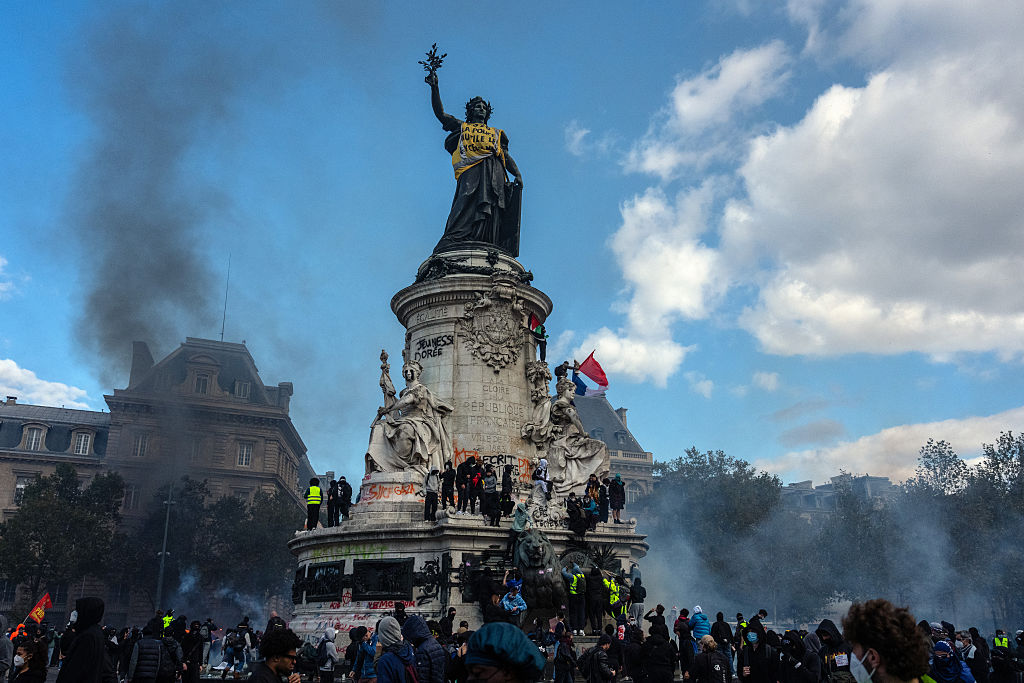
Whatever happens from here on out, this regime has lost. In ten years, Macronism has quite literally destroyed the country, before sinking into shame and disgust. We have long awaited the moment to present it with the bill. And here it is. Macronism is not only morally delegitimised but also symbolically defeated. No movement in France since May ’68 has produced such a wealth of imagery. TikTok has become the channel of vitality, invention and creativity: when we aren’t trembling with rage at videos of police violence, we’re crying with laughter — or simply crying because it’s so beautiful. Who would have thought: TikTok, the return of Simone Weil’s ‘pure joy’.
A tyrannical regime cannot beat it. Here, high school students sing Aznavour’s ‘Emmenez-moi’ beneath the sunlight; there, eruptions of energy right under the bullies’ noses. We don’t know where to look. A radio broadcast arrives from the blockade at none other than the École Alsacienne, the famously elite private school, where a ‘woman in fur’ is asked for her view of the students. The woman in fur says ‘I support them.’ In the background, we hear the protesters sing the final verses of The Internationale at the top of their lungs. Only times of extreme crisis produce scenes so absurd, so joyful. The symbolic disaster is total. There is no recovering from this convergence of images.
La Totale marks the culmination of a bourgeois state that has been looming on the horizon for quite some time: a state reduced to two ministries — the Ministry of the Budget and the Ministry of the Interior. Or, to put it another way: the Ministry of Friends (the markets) and the Ministry of Enemies (the people). As the first runs up against the economic impasse of neoliberalism, the second comes to hold all the power. It is nothing more than a gathering of sadistic thugs at every level; this is indeed the novelty of Macronism.
Even Pasqua, even Pandraud, even Sarkozy, even Hortefeux knew when to stop. The new rulers do not. They take pleasure in beating people, gouging out eyes, maiming, strangling young women or groping them. The levels of sexual violence in police custody are staggering. The police are nothing more than a degenerate force, made up of degenerates. We are living in an era where the police now inspect protest signs. What little bell is jingling inside an officer’s head when he decides which are allowed and which are not? Who gives such instructions? It’s true, as we are often told, that there are lawless zones in the country: they are called ‘the Ministry of the Interior’ and ‘the police stations’.
Such is the hideous spasm of powers on the wane. Macron, a sham ruler and a puppet of historical forces that overwhelm him on all sides, came to power to carry out neoliberalism — that is, to bring it to an end. He has now been overthrown, and by whom? By kids. An abject disgrace on top of a historic failure. A young girl protesting sums up the situation: ‘I don’t understand why they tell us not to revolt’, she says, ‘when our curriculum is literally full of people who revolt — Arthur Rimbaud, La Boétie, Olympe de Gouges’. Suddenly, the morocrats of the 24-hour news channels — old, white, bourgeois — find themselves ridiculed. The unfathomable hypocrisy of bourgeois culture, which cares nothing for what it reads, what it sees, what it claims to revere — which celebrates merely to embalm and neutralise — is exposed. Only young people, from the depths of their integrity, can rediscover it.
Among the avalanche of photos destined to go down in history, one will undoubtedly stand out. It shows a child, sitting on the ground against a police van, handcuffed, beneath the two thugs who arrested him. Everything in the frame is dark: the street, the police vehicle, especially the helmeted officers. But a patch of light radiates, leaping out of the image: the face of this child looking directly at the camera. It’s as beautiful as a Rembrandt.
The entire period has become melodramatic, full of stark polarities — from Rembrandt to Hugo, so to speak. But one subsumes all others. There is the struggle, which is life, and the bourgeoisie, which is death.