
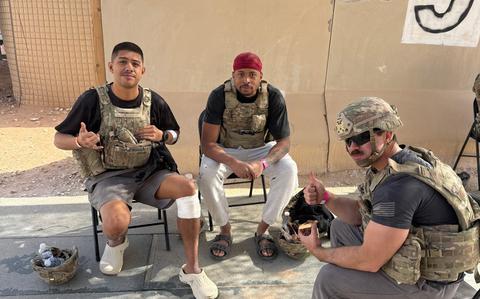
The “Alarm Red” siren shrieked across Prince Sultan Air Base in Saudi Arabia on March 27, a warning that an Iranian attack might be on its way across the Persian Gulf.
For a trio of soldiers in the 6th Battalion, 56th Air Defense Artillery Regiment, it was a sound they had heard often since Operation Epic Fury against Iran launched nearly a month earlier. But they still made their way to Bunker 100 at the base to take cover.
Staff Sgt. Kalob Mitchell, Sgt. Xavier Jones and Spc. Nicholas Cabo, part of the 6th Battalion, 56th Air Defense Artillery Regiment, 1st Cavalry Division Artillery, hunkered down and waited for the all clear.
“We’re sitting there talking, and then all of a sudden, we didn’t hear anything, no sound at all,” Mitchell said.
A 550-pound Iranian ballistic missile had slammed into the base near their bunker, sending out intense shock and sonic waves. The three were slammed into an interior wall, and they lost consciousness.
“Everything went black,” Mitchell said. “We’d been hit.”
The soldiers recalled the attack on Oct. 1 during a ceremony at Fort Hood, Texas, where they received the Purple Heart medal, awarded to service members wounded or killed in the line of duty.
As part of the ceremony, Fort Hood released a narrative of that day underscoring that, despite their own injuries, the soldiers went to the aid of others perhaps hurt far worse.
Capt. Tyler Ritter, the unit commander, read notes of thanks sent to the three after the attack.
“Sir, your soldiers saved my life,” Ritter read. “I thank God every day that these gentlemen survived.”
The Army did not say how many soldiers were killed or wounded in the March 27 attack. Overall, the Defense Casualty Analysis System has recorded 21 Americans killed and more than 865 wounded since the conflict with Iran began with U.S. and Israeli attacks on Feb. 28.
The three soldiers recalled the attack, their struggle to help injured soldiers and their own later efforts to heal and put the day in perspective.
After the blast, Mitchell was awakened by a fellow soldier.
“Woke up, checked on them. They were good. At that time, we heard screams from the opposite side of the bunker. Two soldiers, I’m not too sure who they were, had significant injuries; ran over there, applied tourniquets, T Triple C (Tactical Combat Casualty Care), everything,” Mitchell recounted.
Alongside Cabo and Jones, Mitchell gave aid to a severely wounded soldier, treated another with a neck injury and helped calm and keep safe a soldier disoriented by the blast until it was safe to evacuate the bunker.
“I think it was just the adrenaline because, after we woke up, I checked myself,” Cabo said. “I just saw that my leg was a little bit bleeding, so I didn’t really mind it. It wasn’t anything like crazy bleeding, so we just heard screams and went to go help those guys.”
“Sgt. Jones and I even carried them out to the ambulance on the stretcher,” Cabo said. “[One] guy probably would have died because he was bleeding a lot from his right leg, and good thing Sgt. Mitchell just came up really quick, then called for us and we helped him out.”
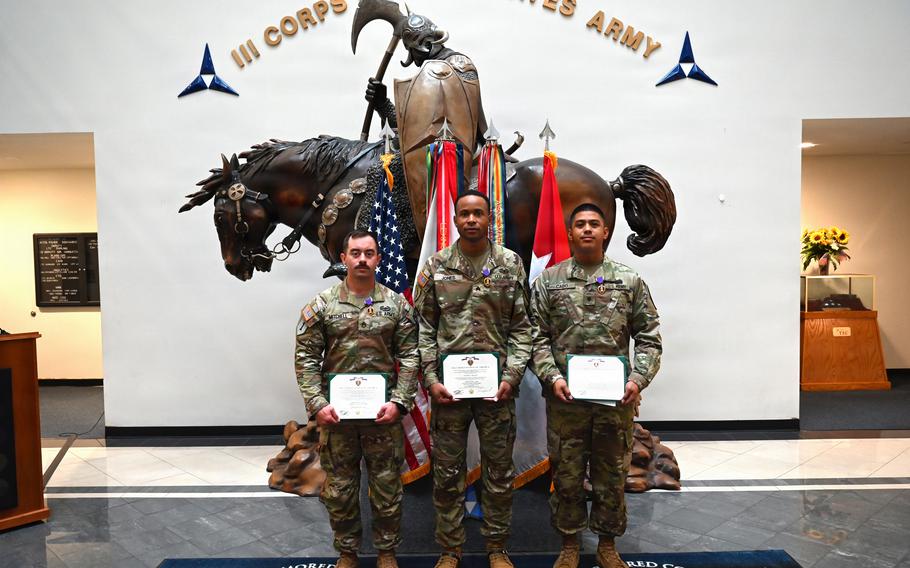
From left to right, Staff Sgt. Kalob Mitchell, Sgt. Xavier Jones and Spc. Nicholas Cabo, all part of 6th Battalion, 56th Air Defense Artillery Regiment, 1st Cavalry Division Artillery, pose for a photo after receiving the Purple Heart during a recognition ceremony on Oct. 1 at the III Armored Corps headquarters building at Fort Hood, Texas. (Derika Upshaw/U.S. Army)
Jones recalled the “relentless” long hours of training, learning basic field aid that seemed annoying in its repetition at the time.
“So when you’re out in the field, and it kind of seems pointless … you’re just like ‘Why are we doing this?’ ” Jones said. “And then once you actually do it, like it was definitely beneficial.”
Mitchell said he, too, sometimes wondered if the training was too much.
“I know it sucks going to the field and all that, but it gets you ready,” Mitchell said. “So, when I was putting the tourniquet and everything on … the shell shock was real. I was on autopilot. I had no idea where I was, what I was doing, but I’d done it so many times, putting on a tourniquet. It was like second nature for me.”
Mitchell said he had done such a good job with the tourniquet that the surgeon at the triage center thought one of the paramedics had put it on.
Though the trio felt great about saving lives, the journey from the combat zone back home and dealing with their own wounds was not easy.
Cabo explained he went between three hospitals, from Germany to Virginia, then Fort Hood, and that each visit left more medical notes in the system.
Jones said being back at Fort Hood took some getting used to.
“I’m trying to get back to reality, trying to get anxiety back down, trying to just not be as alert, trying to reintegrate,” Jones said. “I was at work a couple of weeks before I took leave, and it just was … it felt different. Like it felt non-serious, and it just was throwing me off because seeing everybody have fun, we had fun too, but … it was just different.”
The soldiers struggled to sleep, and the pace and size of crowds at the base were difficult.
“So I guess it has this … like a slight impact because I just don’t want to be around people,” Jones said. “I mean, I’m a gamer initially, but I usually try to go out. But now I don’t even try to go. I really just chill.”
Cabo has had his moments, like when a sound instantly brought him back to the conflict
One day Cabo headed to a Sam’s Club near the airfield runway. “I was like, ‘oh, drone’, and so I stopped and looked,” Cabo said. “I’m like, ‘it’s coming.’ Then I saw the plane, or the type of aircraft it was, I was like, ‘oh crap, it’s just in my head.’ ”
While reintegration has brought challenges, the soldiers said support from family, friends and good behavioral health care has eased their return.
“I find it super helpful because the only person I would talk to about the situation, if anyone, besides like behavioral health, will just either be the team or my wife,” Cabo said. “So talking to somebody who has an outside perspective from it is good.”
Cabo urges other soldiers to do the same.
“Just go to appointments and try to really give them (medical professionals) honest feedback so they can help you as much as they can and give you what you really need,” Cabo said.
Mitchell agreed.
“I feel like it’s, kind of, instilled in the military, like don’t go to sick call,” Mitchell said. “Like, you’ll be seen as a problem child. Like they’re running from something. But these are real issues, and they need to be addressed. So be honest with the medical staff and get the help you need.”
Although their return from Saudi Arabia has been a test, physically and emotionally, the three soldiers said the attack also created a lasting bond. They still find reasons to laugh together, balancing lighthearted moments with honest conversations about how close a call they had.
“The one that hit us was on the smaller side, so it was about 250 kilograms of explosive versus what some of the bigger ones they had hit us with, which were about 750,” Mitchell said. And, if it was one of those, “we wouldn’t have been here.”
Lt. Gen. Kevin D. Admiral, the commander of III Armored Corps and Fort Hood, described the three soldiers’ actions as the “ultimate description of what we mean when we talk about warfighting, readiness, grit and taking care of our soldiers.”
Though none sought the Purple Heart, Jones said the recognition was appreciated.
“I mean, we raised our right hand for a reason,” Jones said. “We all knew what we were going into. So honestly, it’s kind of cool.”
For Mitchell, a high-five from his fellow soldiers would have sufficed.
“I guess I’d say that it kind of puts it in perspective that we went, we did our job to the best of our ability and we almost paid the ultimate price,” Mitchell said.