
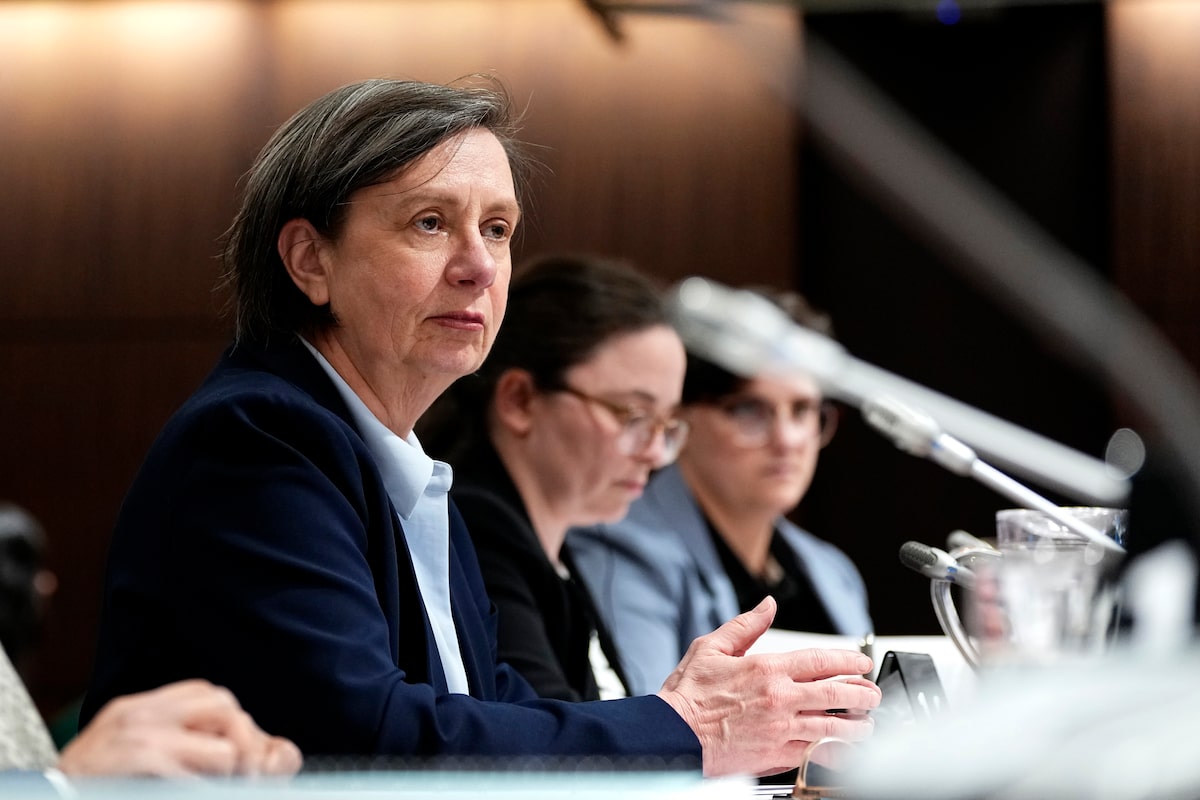
Parliamentary Budget Officer Annette Ryan, shown in Ottawa in June, pointed out in her report that the federal debt is growing twice as fast as the growth in deficits.Justin Tang/The Canadian Press
Parliamentary Budget Officer Annette Ryan warned that government borrowing is on track to grow more quickly than the country’s deficit and that Ottawa’s accounting “obscures” the true scale of debt.
The PBO on Tuesday released its Economic and Fiscal Outlook, which provides an independent assessment of the state of federal finances ahead of the 2026 budget, scheduled for Nov. 5.
Ms. Ryan’s report says that while higher oil prices and other factors have provided a short-term boost to Ottawa’s bottom line, new spending announcements have already used all of that fiscal room and more.
Federal deficits are projected to be $3-billion higher per year over the next four years in comparison with the PBO’s most recent forecast in June.
But Ms. Ryan points out that the federal debt is accelerating twice as fast as the growth in deficits because of the government’s increased use of Crown corporations to deliver on its agenda, as well as increased defence commitments.
The report notes that loans to Crown corporations are financed through borrowing, but under accrual accounting, are recorded as assets rather than expenses and therefore do not add to the deficit.
Major projects bill under fire from critics as hearings begin under tight timeline
Further, capital purchases, such as military equipment, are paid for at the time of purchase through borrowing but are expensed gradually as they are amortized.
“Federal borrowing will significantly exceed cumulative budgetary deficits over the projection period, because under accrual accounting, capital expenses and loans to Crown corporations are recorded as assets rather than liabilities,” Ms. Ryan said in a statement. “This obscures the realities of cash debt and raises questions about whether the current fiscal framework provides a complete and transparent picture of Canada’s fiscal sustainability.”
Conservative MPs seized on Ms. Ryan’s comments, raising them in a news conference and then later in the House of Commons during Question Period.
“With such stark warnings from an expert this government hired itself, will the Liberals finally admit that it’s time to reverse course and rein in that spending?” asked Conservative deputy leader Melissa Lantsman, who called the PBO’s report “scathing.”
Finance Minister François-Philippe Champagne responded by defending the government’s fiscal record, pointing to Canada’s triple-A credit rating.
“We have fiscal discipline,” he said, later adding he wished the Conservatives would “stop talking down the Canadian economy and work with us to build Canada strong.”
Under Prime Minister Mark Carney, the government has increasingly turned to Crown corporations as a way of delivering on key priorities. Examples include the creation of Build Canada Homes, the Canada Strong Fund and the recently proposed Canadian Corporation for Defence Investment.
Tuesday’s PBO report shows the size of the federal debt will rise to $1.67-trillion in 2030-31, up from $1.3-trillion in 2025-26.
The debt as a percentage of GDP will reach 42.6 per cent, up from 41.1 per cent over the same time frame. The deficit-to-GDP ratio is projected to increase slightly from 1.8 per cent in the current fiscal year to 2 per cent in 2027-28, before declining to 1.7 per cent in 2030-31.
Ottawa says it’s open to mediation with Canadian diplomats allegedly suffering from Havana Syndrome
The PBO points out that an increase in the deficit-to-GDP ratio would be at odds with one of the government’s two fiscal anchors. Last year’s budget committed the government to maintaining a declining deficit-to-GDP ratio and to balance operating spending with revenues by 2028-29.
The PBO says the government will balance its operating budget as scheduled.
“On balance, the two fiscal anchors have imposed limited fiscal discipline on government spending and borrowing,” the report notes.
The PBO repeated its view that focusing on the debt-to-GDP ratio would provide a stronger fiscal anchor. The Liberal government under former prime minister Justin Trudeau had previously promised to reduce the debt-to-GDP ratio over time, but that is not a current commitment.
Mr. Carney ran in 2025 on a Liberal Party platform that said the government would ensure that the “debt-to-GDP declines over the budget horizon.”
Tuesday’s report points out that the International Monetary Fund has called on Ottawa to reinstate the debt-to-GDP ratio as its primary fiscal anchor, which it said would “strengthen discipline, transparency, and credibility while preserving fiscal space for high-return investment.”
To further illustrate the impact of recent borrowing, the PBO said the debt service ratio – which measures public debt charges relative to total revenues – is projected to reach 13.6 per cent in 2030-31, up from 10.5 per cent in 2025-26.
Public debt charges are the fastest-growing federal expense, according to the report.
The cost of servicing the federal debt is projected to reach $83-billion by 2030-31, up from $24.5-billion in 2021-22.
On a per-capita basis, public debt charges are projected to reach $1,952 in 2030-31, up from $640 in 2021-22, which the PBO says reflects low population growth and a rising debt stock.