

Democrats in competitive U.S. Senate races are capitalizing on public anger about the Iran war. Republicans, they say, keep voting against resolutions that could stop it.
Polls show that voters disapprove of President Donald Trump’s handling of the war and overwhelmingly believe he lacks an exit strategy. Trump initially predicted it would last four to six weeks. It has now stretched on for more than seven months.
For voters, the economy and cost of living are still the dominant issues by a wide margin, said Rina Shah, a strategist and former senior GOP congressional aide. “But a large majority of voters” correctly link the war to energy prices and inflation.
The U.S. and Israel launched the war Feb. 28, causing gas prices to rise as Iran countered military attacks by squeezing oil shipments through the Strait of Hormuz. Gas prices are averaging above $4 a gallon nationally under a president who campaigned on a promise of reducing the cost to below $2.
The Democratic attacks in ads and debates zero in on Congressional War Powers Resolution votes. A tally by The New York Times found that, since March, the House held six such votes and the Senate held 14.
Since May, some of the resolutions passed. But to take effect, the chambers would have to pass identical resolutions, and then Trump would have to sign the measure. If the president vetoed it, which is likely, Congress could override only with two-thirds votes in each chamber. No war powers resolution has ever overcome a veto.
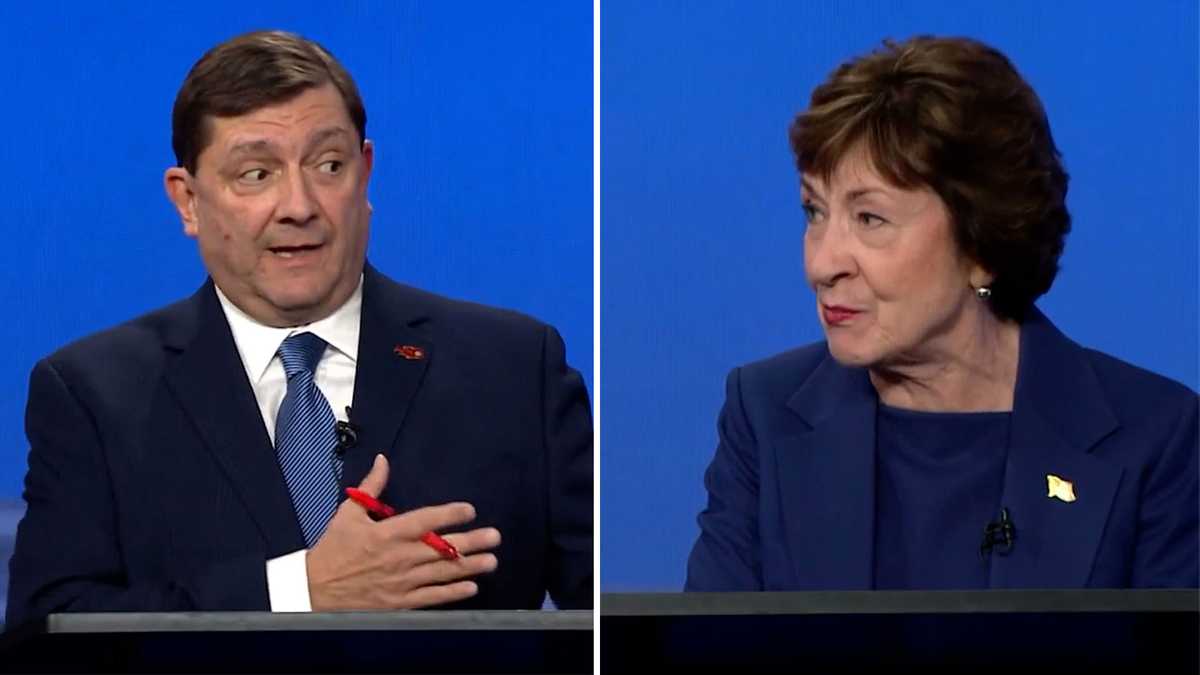
Democrat Troy Jackson: Sen. Susan Collins, R-Maine, “voted against it nine times before she voted for it five times.” (said in Oct. 8 debate)
Jackson reversed the votes.
He was responding to Collins’s statement that she had “voted nine times to bring the war in Iran to an end.”
Collins has said the War Powers Act gives permission for the president to wage war for 60 days, and she opposes the president’s decision to extend the war beyond that threshold without getting congressional approval.
Since the 60-day deadline on April 30, Collins has voted with Democrats nine times in support of ending the war. Before that deadline hit, Collins voted five times against such resolutions: March 4, March 18, March 24, April 15 and April 22.
During an earlier debate, Jackson said Collins voted for the Iran war “five times.”
Iowa Democrat Josh Turek: Republican Sen. Ashley Hinson “has voted in favor of (the Iran war) seven times.” (said in Oct. 7 debate)
This is mostly accurate.
Hinson has voted against six resolutions calling for the Iran war’s end. In a Sept. 15 vote, seven Republicans joined Democrats to pass the resolution through the House. It failed in the Senate.
One of the votes Turek pointed to was not a direct call to end the Iran war. In June, Hinson voted against Michigan Democratic Rep. Rashida Tlaib’s resolution to withdraw U.S. forces from hostilities in Lebanon. There were no U.S. forces engaged in conflict in Lebanon. However, the fighting between Israel and Hezbollah in Lebanon is connected to the Iran war and has threatened a potential U.S.-Iran peace deal.
Hinson said during the Oct. 7 debate she wanted an “immediate and successful end” to the war but doesn’t want Congress to limit Trump’s authority.
Ohio Democrat Sherrod Brown: Republican Sen. Jon Husted “voted 14 times for the war in Iran pushing gas, diesel prices to record highs.” (Ad)
This needs context.
Only one of Husted’s votes was on a resolution to end the war itself; the other 13 times he cast votes on procedural motions, keeping resolutions from coming to the floor. One was in 2025 after the U.S. struck nuclear sites in Iran and the other 12 were in 2026.
Days before the most recent vote in September, Husted told Politico, “The war needs to come to an end as quickly as possible so that we can lower gas prices.”
During an Oct. 15 debate with Brown, Husted said he wanted the war’s end to “happen on America’s terms and not Iran’s terms.”
In an email to PolitiFact, Husted’s spokesperson Amy Natoce said, “As you well know, a vote against a War Powers Resolution is not a vote ‘to continue the Iran War.’”
An expert said the resolution votes allow lawmakers to take a stance on continuing the war.
“Voting against such a resolution, in effect, allows the president to continue his chosen policies,” said Mark F. Cancian, a retired Marine Corps colonel and senior adviser with the Center for Strategic and International Studies. “The Republicans argue that the president is trying to negotiate a favorable end to the conflict. On the other hand, those efforts have been unsuccessful, so the conflict has continued at various levels of intensity.”
Aaron Pickrell, who has worked on past campaigns for Democrats in Ohio, including Barack Obama, said the economy, inflation and affordability are dominating this cycle.
“It’s not hard for people to tie high prices with the war in Iran and having the option to vote to end the war can be seen by some as a vote to lower gas prices,” Pickrell said.
RELATED: Fact-checking Donald Trump, Jon Husted at Ohio rally on economy, Sherrod Brown’s record
Georgia Sen. Jon Ossoff: Republican Rep. Mike Collins “voted seven times for the war in Iran.” (said in Oct. 8 debate)
That’s mostly accurate.
Ossoff’s campaign pointed to six war powers resolution votes and a vote in favor of a national security appropriations resolution. The funding vote was not entirely about Iran but said money could be used for preventing a nuclear Iran.
Collins replied by echoing Trump’s justification for the war.
“The President had every right to go in there and make sure that Iran does not get a nuclear weapon,” Collins said, adding “they were this close to getting a nuclear weapon and they would have used it.”
When Trump launched the war he exaggerated Iran’s nuclear capabilities and has since inflated the impact of U.S. military strikes. The 2025 U.S. military strikes likely set back Iran’s nuclear program but did not eliminate it, and the attacks in this year’s war have not further weakened Iran’s nuclear capabilities, military and nuclear experts said.
Brian Darling, a Republican strategist and former staffer for Kentucky Sen. Rand Paul, said when GOP candidates point to any votes or statements that the war needs to end soon, it shows they understand the widespread opposition to the war.
“An issue that is on the top of minds for voters may prove to be a tie breaker in these Senate elections,” Darling said.
PolitiFact Researcher Caryn Baird and Staff Writer Caleb McCullough contributed to this article.
RELATED: Trump said the war in Iran would last 4-6 weeks. Then he changed his story and blamed the media.