
Olivia Chow, flanked by environmentalist David Suzuki, launched a fresh attack Wednesday on her rival Brad Bradford’s plan to turn Toronto Water into a public utility.
The incumbent wasn’t alone. The union representing Toronto Water workers and 15 current councillors also issued a letter criticizing the mayoral candidate’s plan.
“Using debt to pay for water infrastructure is a bad idea,” Jon Burnside, who is seeking re-election in Don Valley East, wrote in a statement. “It will cost Torontonians more in the long run.”
Speaking with reporters, Chow said: “My opponent cannot promise what the water bill will be, he cannot promise that Toronto will remain in control.”
Suzuki was more blunt in his appraisal of the plan, calling it “crazy.”
Currently, Toronto Water is operated by the City of Toronto and its councillors. A separate utility company would be governed by an independent board, away from council, and created through recent provincial legislation.
Critics of the plan argue it potentially leaves the city without input on an asset currently entirely controlled by elected councillors.
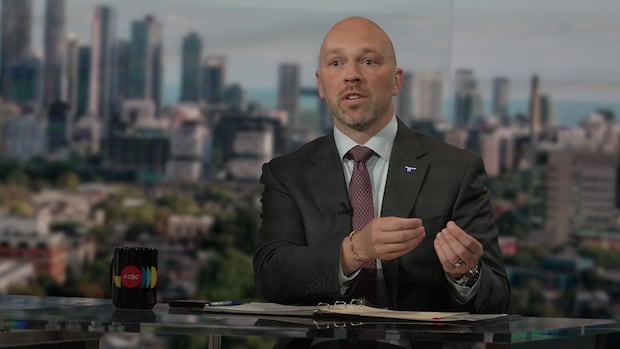
Bradford has defended his idea, saying he can reduce water rates and raise revenue for the city at the same time by taking water away from council and creating a new entity with capacity to carry its own debt.
He has repeatedly promised the corporation will remain under public control, and won’t raise costs for households. Bradford said his proposed change will slash the average water bill (about $1,100 per year, according to city documents) by some 25 per cent.
WATCH | As the Toronto mayoral race enters its final week, polls are tightening: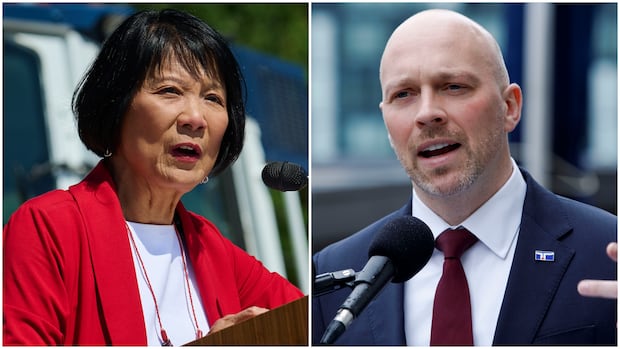
Toronto mayoral race tightens in final week, polls suggest
With one week until election day, the race for Toronto mayor is down to the wire. CBC’s Shawn Jeffords looks at where Olivia Chow and Brad Bradford stand in the polls during these final crucial days.
The public water company, Bradford said, will “have rates that reflect the cost of delivering the water just like we do today.
“The difference,” he told CBC Radio’s Metro Morning on Wednesday, “is going to be we’re not going to overcharge people two-thirds of the water bill.”
Opposition to plan raises strong mayor questions
CUPE Local 416, which represents workers at council-run Toronto Water and has endorsed Chow for re-election, highlighted its fears about the proposal on Wednesday.
It collected opposition from 16 incumbent council members — including Chow and some who are retiring — saying the plan relies on debt and raises concerns about control.
Thirteen councillors who signed the letter are seeking re-election.
If enough councillors opposed to Bradford’s plan win, he could face a council that doesn’t support the policy. That raises “the spectre of strong mayor powers,” said Myer Siemiatycki, political professor emeritus at the Toronto Metropolitan University.
“Any mayor can get one-third of their city council on board,” he added, referencing the support needed for strong mayor powers. “They’ve got enough inducements, enough sweeteners to hand out to councillors.”
Asked about the prospect of having to use strong mayor powers to get his water plan through on Wednesday, Bradford stepped around the question.
“I am going to deliver on the mandate that I am elected to with the tools that I have available to do that,” he said. “And I’m going to work with my council colleagues.”
Union, Chow push concerns
The union president, Domenic Maugeri, said he was concerned about the proposal.
“This is about as important an issue as it could be,” he told CBC News.
“I don’t want a problem for my children or yours to be working through a corporation that we can’t reach, when we have it (in) our control today.”
WATCH | Catch up on Bradford and Chow’s promises during CBC’s mayoral debate: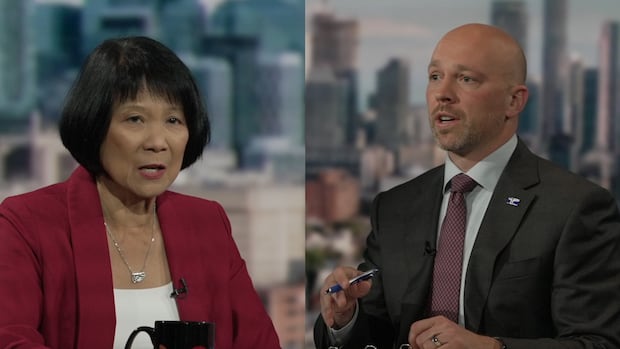
Chow vs. Bradford: CBC Toronto’s mayoral debate in 3 minutes
Bike lanes, property taxes and public safety: it was all on the table as Olivia Chow and Brad Bradford went head to head at CBC Toronto’s mayoral debate. Here’s everything you missed in less than three minutes.
The Chow campaign emphasized their concerns about the water company as its central message on Wednesday, enlisting the help of environmentalist Suzuki to amplify the issue.
“It’s not just the quality, the price of water will go up – guaranteed – if you privatize and let profit be the driving force of the people controlling that water,” he said.
“I think it’s crazy for a person saying they want to be mayor of a city and one of their things is potential privatization.”
Bradford accuses Chow campaign of misinformation
Bradford’s campaign has repeatedly said Chow’s characterization that creating a new public utility company would lead to privatization is false.
“It will be public forever because the law states that,” Bradford said Wednesday.
“Mayor Chow never acknowledges that, in fact she misleads people. Provincial legislation – the Water and Wastewater Act – states that this must be owned by the government.”
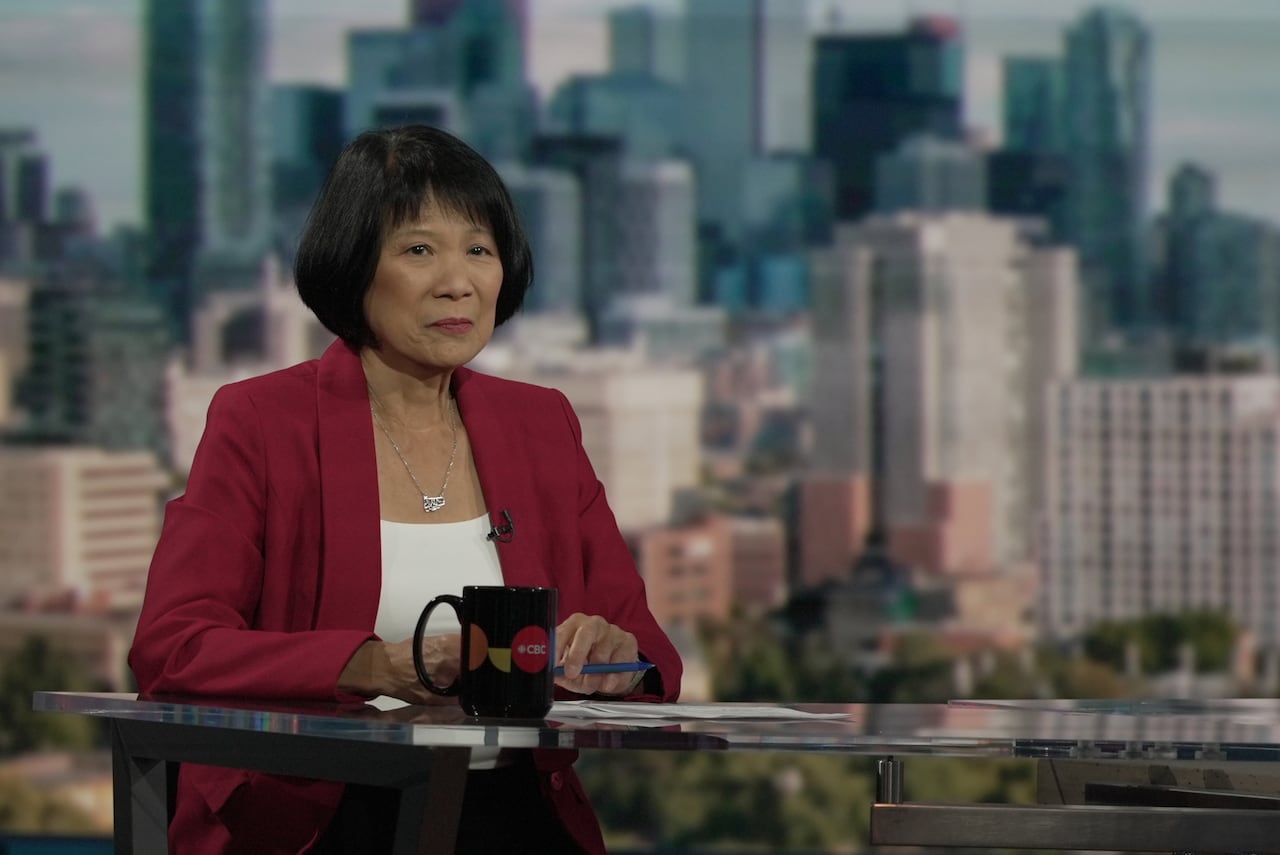
Toronto mayoral incumbent Olivia Chow and her supporters have raised concerns about Brad Bradford’s water plan, suggesting it could open the door to privatization. He’s rejected that idea. (Mehrdad Nazarahari/CBC)
Bradford has also pledged to pass a bylaw to keep any water or wastewater company public.
As part of its push against Bradford’s proposal, CUPE 416 commissioned a legal opinion to look at whether it would lead to privatization.
A letter from Goldblatt Partners points out the provincial government would have control of regulating public water utilities and could open them up to private investors.
Bradford’s campaign said that suggestion was a stretch.
“[The legal letter’s] strongest argument is that a future government could one day change the law,” Laryssa Waler, of the Bradford campaign, wrote in a statement.
“That’s true of every law in Ontario. By that logic, nothing this city owns is safe, from Toronto Hydro to the TTC.”
Bradford and Chow are just two of the 50-plus candidates running to be Toronto’s next mayor.
You can see a full list of candidates on the city’s website, and consult our promise tracker for the leading candidates’ promises.
Election day is Oct. 26, with voting between 10 a.m. and 8 p.m.