
When I told family, friends, and colleagues I was going on a J Street trip to Israel/Palestine, I always got one of two questions: “Is it safe?” “What do you mean, Palestine?” I went with 18 other J Street leaders from around the United States for an intensive one-week study of the Israel/Palestine conflict and the politics of each society. We met with a vast array of professionals involved in politics, civil society, and government work: from settlers on the West Bank and an IDF spokesperson to the Deputy Foreign Minister of the Palestinian Authority, Palestinian peace, food, and environmental activists, and many people engaged in the courageous and difficult work of trying to build a shared society. Yet the two questions my New York people asked predominated everything we saw: Is Israel secure, and is there really a place called Palestine?
In my 66 years, I’ve been to Israel four times, and Tel Aviv is one of my favorite cities in the world. Each time, I’ve been blown away by the growth; the construction crane remains the national bird of Israel. Tel Aviv’s waterfront skyline now rivals Chicago’s lakefront, and its beach scene far surpasses anything we have at home. The restaurants are excellent and filled with hipsters late into the night. Its public design is a progressive urbanist’s fantasy: bike lanes everywhere, excellent basketball courts in every park, public workout facilities in parks, and beachfront that is in constant use. It is a prosperous, progressive, energetic, fascinating first-world city – one whose talented young people spoke to us constantly during the visit about their plans to move overseas if things don’t change.
Taking a quick drive to the east, we traveled on Highway 1 through a series of tunnels into Jerusalem that put America’s aging infrastructure to shame. I took a short walk from our hotel to find a gift for a friend and found myself in a fabulous shopping plaza built of Jerusalem stone that had pretty much every high-end global retailer you can imagine. The first shop outside the Jaffa Gate of the Old City is now Christian Dior. I was baffled: this was not the Jerusalem I had known on prior trips, and this is not the threatened, beleaguered nation that we hear about in the news.
Zionism was a 20th-century national liberation movement intended to create a Jewish nation-state and to normalize Jews within the global system. Israel’s founding Prime Minister, David Ben Gurion, once quipped: “We will know we have become a normal country when Jewish thieves and Jewish prostitutes conduct their business in Hebrew.” Add Jewish tech bros, well-to-do young Modern Orthodox couples out on dates and even Jewish fascists, some of whom are government ministers, and you have Israel today.
Zionism succeeded. Israel not only exists, but it’s a powerful nation with a strong economy, regional hegemonic military power, and a delightful cultural mix of music, sport, dance, and art from all over the Jewish diaspora. These are not the ghetto Jews of old Europe, except for their abiding fear of attack by the outside world and potential elimination.
From Jerusalem, we headed further east into the West Bank and over to Ramallah, the temporary capital until they can return to East Jerusalem of the provisional Palestinian government, the Palestinian Authority run by the PLO and its dominant political faction, Fatah. To my New York friends who asked, “Where is Palestine?” I saw the answer: The Palestinian flag flies over Ramallah. It seems at first glance to be a modernish, pleasant city with government ministries, first-class hotels, and even a Mercedes dealer. Yet it is ramshackle and impoverished compared to Israel. It is also surrounded by a Berlin Wall. The wall runs for miles and miles, as far as the eye can see, around every Palestinian neighborhood, around every highway that Israelis, but not Palestinians, use to travel on the West Bank. And there are constant security checkpoints that make daily life for all Palestinians miserable.
We met the Arab director of a well-known American NGO who works in Ramallah and lives in Jerusalem. Three times the week before he had to stay overnight and couldn’t get home because the Israeli military closed off the city. We met a lovely woman who works at the Palestine Peace Council in Ramallah but lives a short distance away in Nablus. Sometimes it takes her five hours to get home. We heard innumerable stories of family separations when spouses have different statuses within the intricate, bureaucratic system of control Israel has imposed, people who have to formally give up access to their children because one spouse is a resident, but not a citizen, of East Jerusalem and another is a resident, but not a citizen, of the Israeli-occupied West Bank. Going forward, I will think of them, and not politics, when people shout “Free Palestine.” These people, even the Palestinian elite, are not free.
One day of our trip highlights the potential and pain of today’s Israel/Palestine. Our tour went to Hebron and the Hebron Hills. The experience included seeing an Israeli settler activist kissing the grave of Baruch Goldstein, the American-born follower of Meir Kahane who murdered 29 Palestinians in Hebron in 1994. The tour bus was twice stopped by angry settlers who tried to stop it from proceeding. The guide was an IDF veteran who is a well-known leader with Breaking the Silence, shining a spotlight on the increasing Israeli military dominance of the Palestinian sections of the West Bank. That made us, a group of American Jews who support Israel, the enemy. The settlers were not juvenile delinquents or rambunctious youths. They were adults, one with his son in tow. Jews being assaulted by Jews in occupied territory that the world demands Israel turn over to Palestinians longing for national rights and political autonomy for being supporters of Israel who want to rescue Israel from the errors of its ways says it all about how fractured Israel’s politics and society is.
I actually was not with the group that day. I landed in the emergency room of Shaare Zedek Hospital in Jerusalem at 3:30am that morning and remained in the hospital for tests for the remainder of the day. I’m fine now.
While my fellow travelers were in the midst of the Israeli-Palestinian conflict facing angry, right-wing Israelis who seek to harm anyone who wants to connect with, protect or make peace with Palestinians whose lives are being immiserated by Israel’s oppression of the West Bank, I was in a very different Israel.
I hobbled into an emergency room in the middle of the night without an Israeli health card, was admitted and treated in a first-class facility, with all the latest technology and a professional staff that rivals or exceeds any American hospital. Both doctors who treated me were Arabs. The staff was entirely integrated between Jews and Arabs, and they took excellent care of me. They ruled out the emergency condition my New York doctor was concerned about and quickly diagnosed the source of my pain – a common but uncomfortable condition I’ve probably had for quite some time but had never known about. I was discharged quickly and charged only $1,300 for the treatment that included X-rays and a CT scan. No uninsured patient in an American hospital would ever have an experience like that.
How can we reconcile the two Israels we experienced that day: One a unified, humane society that provides world-class health care without regard to the national identity of the patients or the medical professionals, and another that walls in an entire Palestinian society, subjects it to constant military suppression, and targets anyone who dares explore or expose the facts of this oppressive duality?
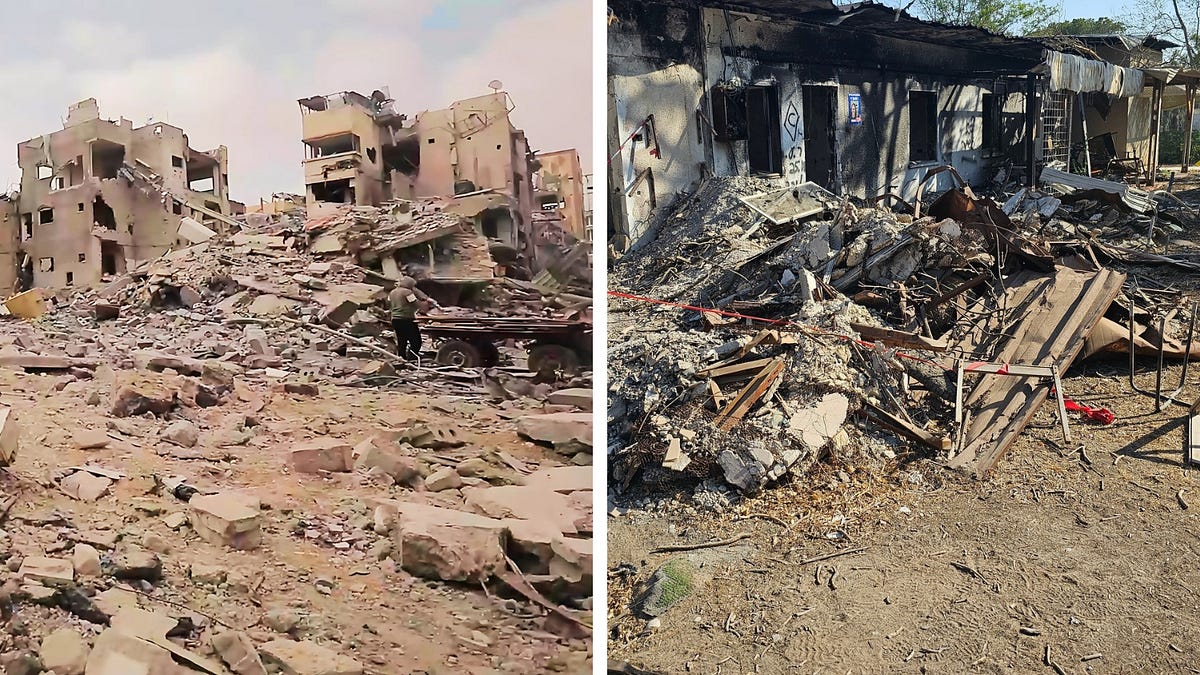
Which brings us to Gaza. Our trip spent a day in the Gaza Envelope, the narrow band of Isreali land surrounding the Gaza Strip, which magnifies the two questions I was always asked at home before leaving: Israel’s security and the whereabouts of the Palestinians.
We went first to the site of the Nova Festival, where young Israeli partygoers were savagely attacked by Hamas terrorists on the morning of October 7, 2023. I’ve done more than my share of witnessing tragedy. I’ve been to Auschwitz, Hiroshima, and the Lorraine Motel. I attended the funeral of an NYPD officer, a mother of two, who was assassinated in her squad car in the Bronx. Ground Zero is part of my everyday life in New York. Nothing can inure you from standing as a witness to man’s inhumanity to man. These were young Israelis out to have fun. Nothing more. Life. Then rampage and slaughter. Death. I walked slowly, tears running down my face, taking close-up portraits on my phone camera of the pictures of the beautiful kids who were murdered that day.
Then we went to the nearby settlement town of Sderot that was the site of day-long urban warfare on October 7 against Hamas terrorists who occupied the local police station. From a hill on the edge of town, I looked through a tourist telescope – the kind you put a quarter in to look at the Statue of Liberty or a mountain in a national park. What I saw a mere couple of kilometers away was the worst thing I’ve seen in my life. Gaza City, the largest urban center in all of Israel and Palestine, with a population greater than either Jerusalem or Tel Aviv, was complete rubble. I saw only one intact building that appeared to be a mosque. Everything else was destroyed – absolutely and completely reduced to a massive mound of debris. Picture the densest urban landscape you’ve ever seen, without any people, without any functioning buildings, without anything that could support human life. The apocalyptic last scene in a bad urban horror movie.
The world is recoiling at these images. But Israelis don’t see them. In our week in Israel, speaking with leaders and activists of all sorts, the only one who mentioned Gaza to us at all was a woman who founded The Gaza Children’s Village, which is creating Women’s Centers in Gaza – places for women who have been living in tents with their families for years without any privacy, without showers, without a room of their own, without training or economic opportunity, without hope. The leaders we spoke to by Zoom who are physically in Gaza running these centers spoke the way traumatized people do, in precise detail about when they “lost” their furniture, when their brother “died,” when their families “had to leave.”
After an intensive week of immersion in Israeli politics and society, I can only conclude that Israel is suffering from systematic, societal willful blindness toward what it has done in Gaza. The public statements of government ministers allowed South Africa to state a plausible claim for genocide in the International Criminal Court. I follow the major political candidates of the change bloc on X/Twitter. Not one has posted about Gaza. We asked a West Bank settler activist we met with, a psychologist with a sophisticated, comprehensive approach to children’s and family mental health, whether his professional understanding, empathy and compassion for the victims of trauma extends to families and children in Gaza. His answer was, in essence, “no.” A lifelong peace activist who protests against Netanyahu every Saturday night and is preparing with others to engage in civil disobedience if Bibi undermines the upcoming elections told me when it comes to having empathy for Gaza simply: “I can’t.”
The Hamas onslaught we witnessed at the Nova site and in Sderot was horrendous. The hostage situation over the next several years was profoundly inhumane. But as a military matter, the Hamas military action, despite all the intelligence, communications, and logistical failures of Israel’s security forces, was completely defeated in a day. Israel is not existentially threatened by effective military opposition, even from Hezbollah in the north of the Iranians or Yemeni Houthis who can rain missiles on Tel Aviv. Israel is the predominant military power in its region. The threat to Israel is terrorism, pure and simple. Terrorism is designed to instill fear. And it works.
Before going to the Gaza Envelope, I viewed Hamas’s use of kites to enter Israel on October 7th as ridiculous – and the celebration of it by some American protesters in the days after October 7th an absurdist fantasy. But standing a kilometer north of Gaza City and feeling the constant sea breeze from the Mediterranean, I realized that kites were in fact an incredibly efficient method of entering Israel by people who were on a one-way kamikaze mission to commit terror and sow fear, but who had no realistic hope of surviving for more than a short rampage.
Reportedly, Hamas leader Yahya Sinwar believed Arabs in Israel would rise up in revolt when his terrorists landed in Israel. Israelis told us of their fear that their Arab neighbors would rebel. Suburban neighborhoods installed security barriers. The sense of “enemies” in their midst was palpable. The government made a big show of arresting Arab students and others for alleged incitement. Yet nothing happened. Arab citizens of Israel did not participate in any way in the attack of October 7th. Because people integrated into a successful society, with individual rights, freedom of worship, and a stake in the country’s economic future don’t resort to terrorism. Terrorism is the result of alienation and desperation. To understand this phenomenon in American society, I recommend my friend Janet Reitman’s current book, The Inheritance, which documents how alienated, desperate people exposed to extremist indoctrination resort to violence.
Our trip ended with a visit to the beautiful home of a bereaved mother who lost her oldest son, a Sergeant in the IDF, on October 7th. She is as heartbroken as anyone who has lost a child. But she is an activist for peace and a shared society with Arab parents who have also lost their children in the conflict in a group called the Parents Circle Families Forum. Her home in the Jerusalem Hills is adjacent to the Green Line that separates the internationally-recognized border of Israel from the territories occupied since the 1967 Six-Day War. That occupation has lasted nearly 60 years now, longer than her entire lifetime. Unlike most of her neighbors, she has relationships with people in the adjacent Arab village across the Green Line due to her involvement in local development and environmental matters. After October 7th, while sitting shiva, she sent an open letter to her Arab neighbors explaining her grief, telling them that she did not blame them for Hamas’s terrorism, and expressing hope that their shared grief and trauma would continue to unite them in trying to build a shared society. In response, she received a huge box of dates, a traditional Muslim offering to a grieving family.
What is it that allows this grieving mother to maintain an open heart amidst the devastating loss of her beloved first son when most of Israeli society looks away from the suffering of Palestinians?
Politics divides people – especially when manipulated by leaders who traffic in exacerbating fears for their own power and self-preservation. I firmly believe that there are political solutions to this dispute. But that’s for ongoing work and not for this account of my recent trip. I’m glad to talk with anyone about the politics of what is to be done.
But all that talk, as important as it is, is not a substitute for action that recognizes and responds to the humanity of the people of two nations who live in this conflict over a shared land. What I saw in Israel and Palestine is that there is extensive and important shared society work going on: groups like Standing Together, both Israeli and Palestinian peace and environmental groups, Israelis and Arabs who send their children to a joint Jewish/Muslim pre-school in Jerusaelm, an Israeli religious settler who has founded the Anahnu Movement who gave us a tour of Mt. Herzel and has formed an organization with Palestinian colleagues to show that Israel’s Zionist tradition embraces and need not reject collective Palestinian aspirations for statehood. I certainly have renewed respect for the Israelis for Peace in New York, who hold a vigil for the Gaza victims every week in Union Square.
My week in Israel/Palestine convinces me that there is still a potential political path to peace because of the people, Palestinians and Israelis, who actively recognize the humanity of the other and deeply desire to live in a shared society with national and democratic rights for all. Where that path goes and what steps – hard steps that will require American actions previously deemed radical but now clearly necessary to break the status quo – is a discussion for another time and place. What my trip showed me is that there is no substitute for directly witnessing the conflict and engaging with the people living it. Things look different up close.
The competing narratives and opinions in the world media and the reductionist simplicities of partisans on both sides obscure the realities of the situation. What the world needs is not more performative partisanship from the “pro-Israel” and “pro-Palestinian” camps but genuine pro-peace actions creating an environment where two peoples living in one land can create a true shared society and reach a political solution to a conflict and occupation that has gone on for too many generations now.
 John Siegal is a trial lawyer, business advisor, Democrat, and advocate for peace and criminal justice reform.