
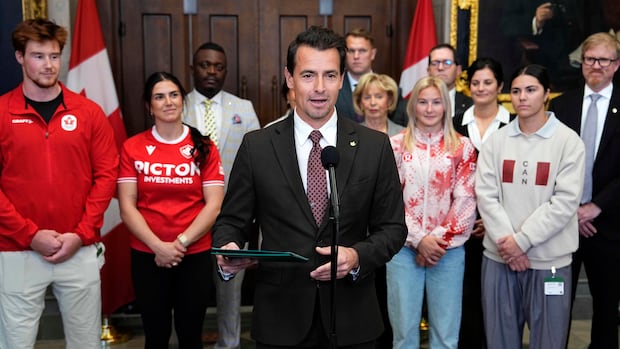
Canada’s national sport organizations (NSOs) are set to receive a long-awaited financial boost as the federal government unveiled nearly $60 million in supplemental funding for 62 sports governing bodies on Thursday.
“This investment will increase access and deliver more sport programming to all Canadians. It’ll enhance athlete development. It’ll help Team Canada compete at the highest level and advance safe sport and sport integrity, while strengthening a sport system that Canadians will trust and believe in every step of the way,” federal Secretary of State for Sport Adam van Koeverden said at the announcement in Ottawa.
The new funding will take effect this fiscal year.
“I think it is transformational and that word has been used. And I think it is. I think it is. It’s what the sports system really needed,” Suzanne Paulins, the CEO of Swimming Canada and a co-chair of the Summer Sport Caucus, said.
WATCH | Ottawa announces additional $60M in sports funding: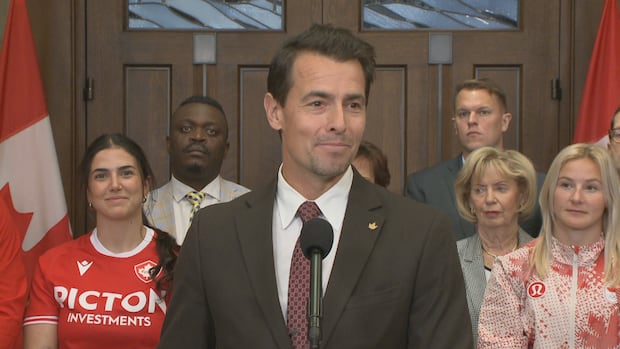
Feds announce additional $60M in sports funding
Liberal MP Adam van Koeverden announced on Thursday the federal government is investing an additional $60 million to ‘deliver more sport programming’ and build Canada strong ‘from playground to podium.’
Thursday’s announcement marks the latest step in the rollout of a funding boost that was first announced in April and comprises $660 million in sport support funding over five years directly to NSOs, multi-sport organizations (MSOs) as well as Canadian Olympic and Paralympic Sport Institute Network members (COPSINs).
In September, CBC Sports reported that over 101 applications were submitted with a sum ask of roughly $168 million.
The supplemental funding for three NSOs — Canada Basketball (originally announced as $1.8 million, bumped to $2.34 million), Alpine Canada ($2.77 million) and Wheelchair Canada Basketball ($813,500) — was previously announced in September. The funding for three others has yet to be finalized.
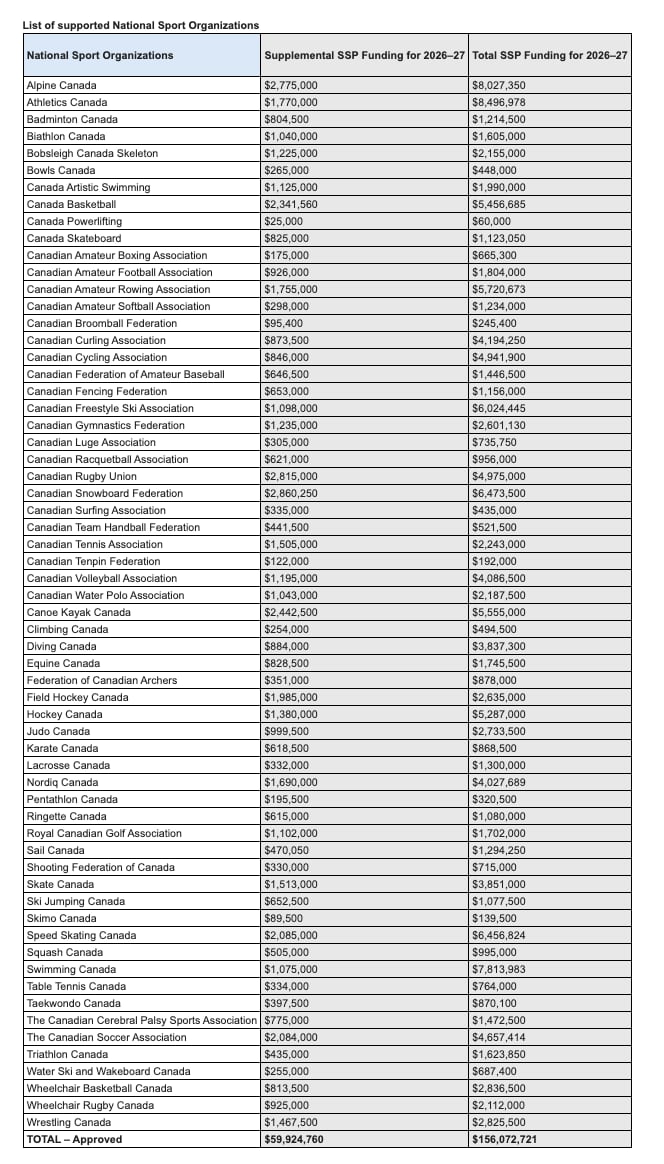
The middle column shows the supplemental funding announced Thursday. The right column shows total funding for the 2026-27 fiscal year. (CBC Sports)
COPSINs, which include seven institutes, received a total increase of $5.4 million this year, the feds announced last week. MSO applications are still being worked through.
The federal government has committed a total of $112 million in increased sport-support funding for this year. NSOs will receive just more than $156 million.
“[NSOs] understand that their mandate has now been significantly broadened from simply owning the podium and winning as many medals at the Olympics and Paralympics as possible, which continues to be a top priority, but also making sure that we broaden the base of the pyramid,” van Koeverden said.
The Canadian Snowboard Federation received the most supplement funding at $2.86 million, followed closely by the Canadian Rugby Union at $2.815 million and Canoe Kayak Canada at $2.44 million. Alpine Canada, Canada Basketball, Speed Skating Canada ($2.085 million) and the Canadian Soccer Association ($2.084 million) also came in above $2 million in supplemental funding.
Dustin Heise, the snowboard CEO, said he was “thrilled” with his organization’s coup, crediting an ambitious team that put together the application over the summer.
Like Paulins, he also termed the boost to the system as “transformational.”
“We made a submission that could demonstrate clear ability to support performance, clear ability to support participation, clear ability to make sure that we have a safe-sport environment that can support all those athletes and participants to do so in a great environment. And at this next step in this juncture, now we can start to make all of that real,” Heise said.
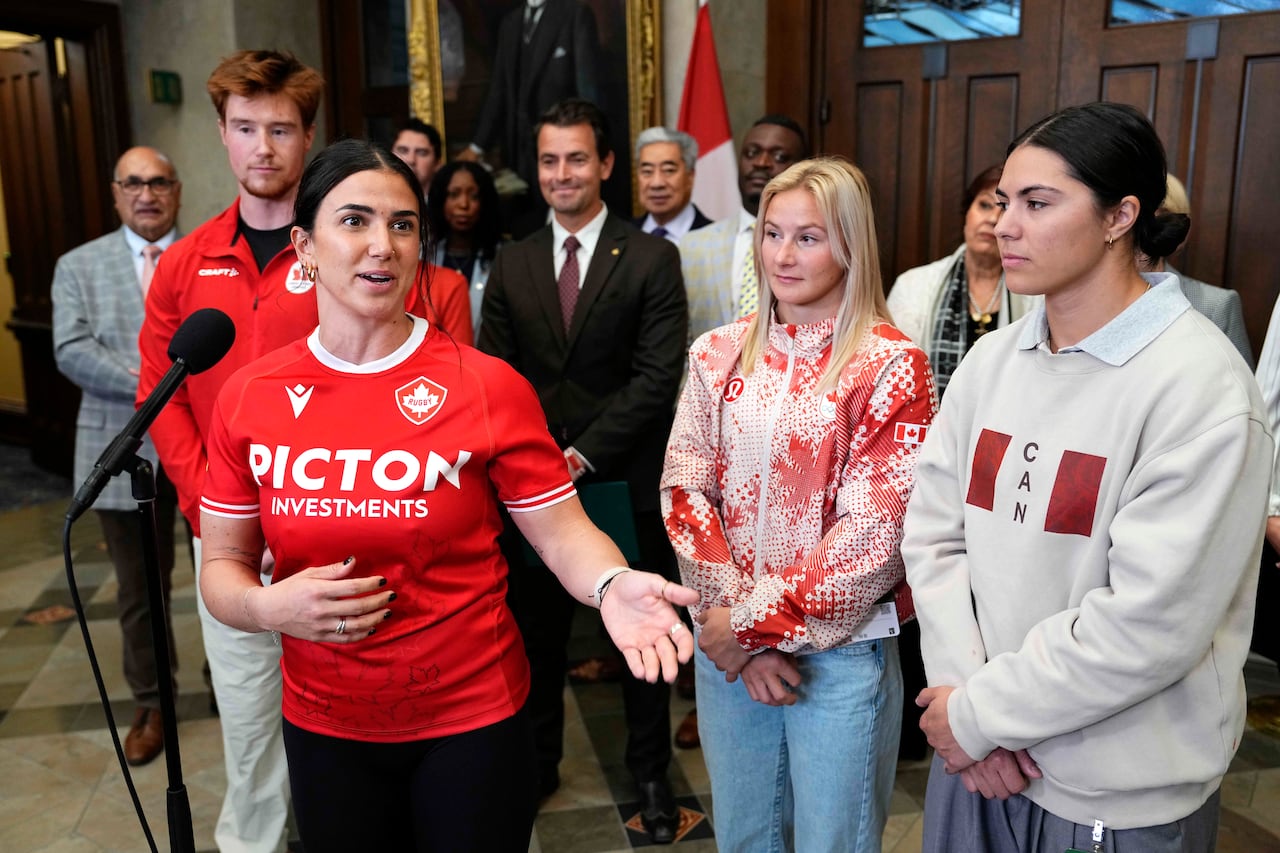
Rugby Canada’s Julia Schell speaks to media following Thursday’s funding announcement in Ottawa. (Justin Tang/Canadian Press)
NSOs learned of their exact supplemental funding earlier in October — around two weeks before Thursday’s announcement — and Paulins said the general response was “gratefulness” and “happiness.”
“I think everybody has been — as was noted in the Future of Sport Commission [report]— maybe underfunded, running really lean, not being able to do everything that they could do. And I think that this funding, especially in this fiscal, really just was the ability to bring people up to, OK, now I’ve got the funding. What can I actually now do of things that maybe we wanted to, but just didn’t have the capacity or the funds to be able to make them happen?” Paulins said.
Swimming Canada received $1.075 million, which Paulins said satisfied the organization’s request.
NSOs are still waiting for the funds to hit their bank accounts, though Paulins said she expected that process to be relatively seamless and done through November.
“To understand and know the amount is really helpful for all of the sports that I’ve spoken to, especially likely some of the smaller ones that really were in need of some support. And I think that this is significant,” Paulins said.
The funding bump for NSOs is part of what the government is calling a $1 billion investment in sports, also covering athletes directly ($43 million), hosting ($50 million) and infrastructure through the Build Communities Strong Fund.
New national training centres for Canada Basketball and Canada Soccer have been financially backed by the federal government to varying degrees, while money was also directed toward the rehab of Calgary’s Olympic oval, a Canada Snowboard national training centre and a national alpine centre.
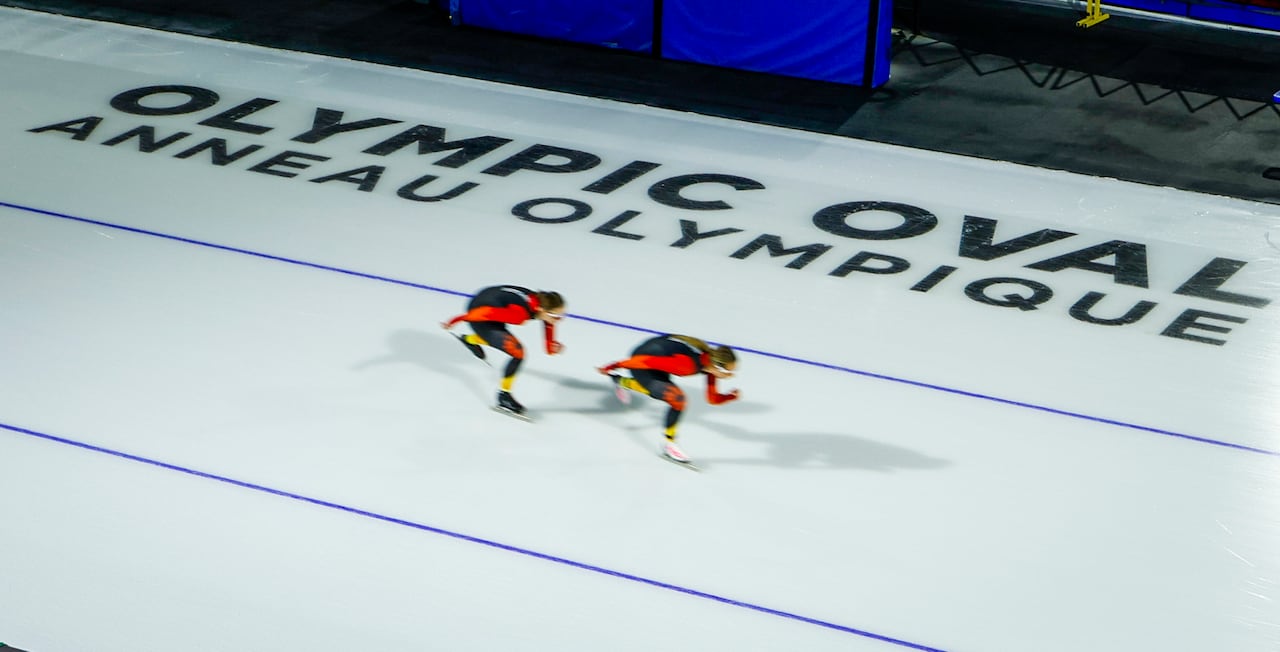
Calgary’s speed skating oval is one of a number of facilities receiving funding for upgrades. (Jeff McIntosh/Canadian Press)
Paulins said Swimming Canada’s application focused on small goals that could be accomplished in this fiscal year like updating training material for officials, marketing for a participation campaign called Stronger in the Water and a pilot grassroots project in Ontario that could be expanded to other provinces in coming years.
“I didn’t get everything we asked for, but I didn’t expect I’d get everything. But I think what we did ask for and have received from the base amount will allow us to do what I had hoped we’d be able to do for this fiscal,” Paulins said.
“Also understanding that when we get into the 2027-28 application process, my ask will go way up because I’ll have the runway and the ability to work with the provinces and look at areas in which we can partner, especially in that participation space. And I think there’s a lot of great potential there.”
Van Koeverden has organized a national sport summit in Ottawa from Nov. 9-10, where leaders in the space will come together to discuss how to continue to move the industry forward.