
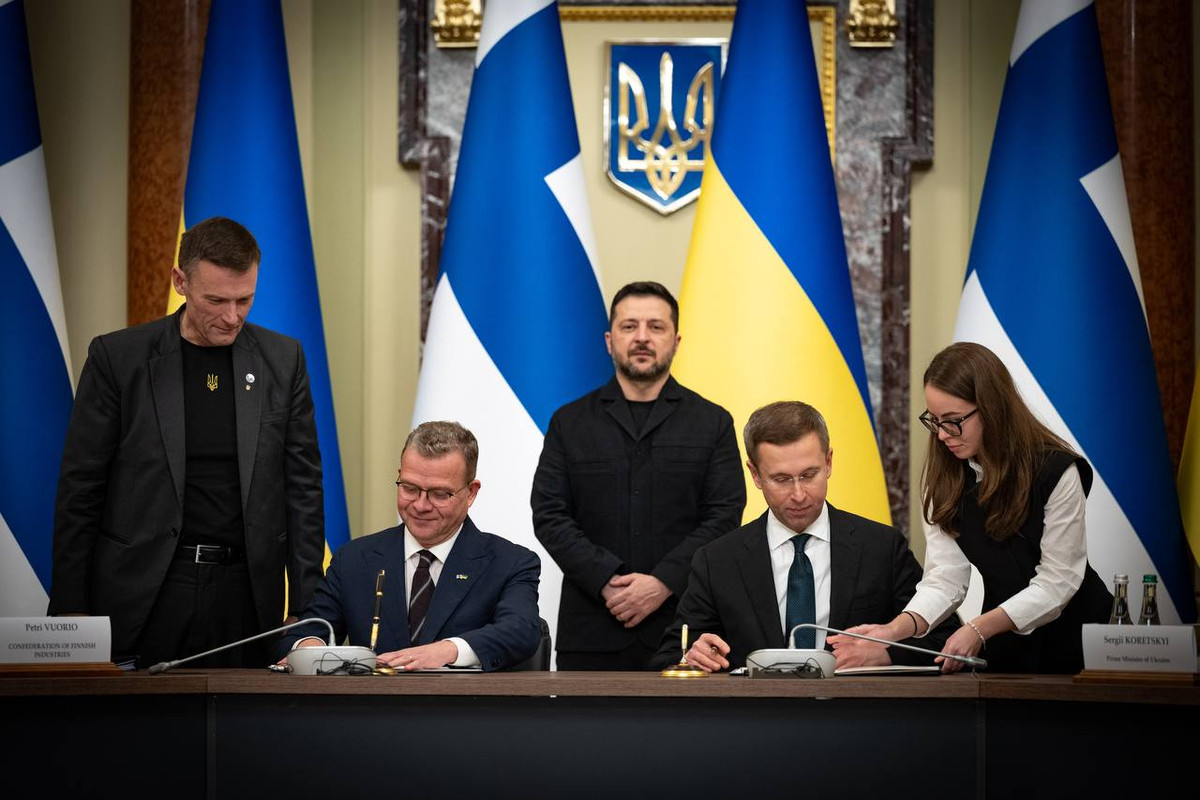
Ukraine signed seven agreements with Finland, including deals to expand Kyiv’s use of Finnish satellite capabilities through Nokia and ICEYE after recent Starlink disruptions exposed how much of the country’s defense hinges on a single private provider that can restrict service with no prior warning.
President Volodymyr Zelensky announced the agreements in a statement on Thursday, Oct. 22, after holding discussions with the government of Finnish Prime Minister Petteri Orpo. The documents, signed at the Ukrainian-Finnish Business Forum, outlines possible cooperation in defense production, rail transport, energy and housing construction, Prime Minister Serhii Koretskyi said.
JOIN US ON TELEGRAM
Follow our coverage of the war on the @Kyivpost_official.
“We agreed that we will make greater use of Finland’s satellite capabilities,” Zelensky said. “This is important for our defense and for Ukraine’s resilience.”
The total estimated value of today’s agreements is nearly €300 million (roughly $337 million).
Finland donates locomotives to Ukraine
Among the agreements, Finland committed to hand over 10 Dv12 diesel locomotives and spare parts to Ukraine’s state railway operator, Ukrzaliznytsia, free of charge.
Rail transport has become one of Ukraine’s most vital lifelines, with the country’s airspace closed to civilian flights from February 2022. Ukrainian citizens heavily rely on trains for travel, and the railway also carries critical cargo, including food shipments, across the country, making it a frequent target for Russian forces.
Other Topics of Interest
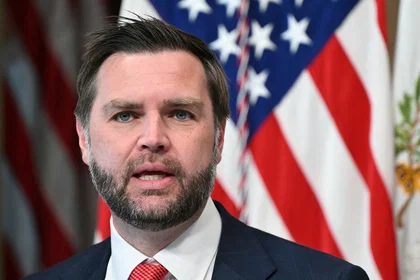
Vance: Starlink Use Depends on US Policy Toward Kyiv, Moscow – Not Musk
Vance accused European leaders of waging a “regulatory and licensing war” against SpaceX – only to turn to the company for help in Ukraine.
According to Koretskyi, Finland has become the first country to donate locomotives to Ukraine free of charge.
Earlier this week, Estonia has confirmed it will send a substantial number of locomotives to Ukraine. Although Foreign Minister Andrii Sybiha did not provide additional information on the shipment, he said on Tuesday, Oct. 20, that during talks with Estonia, he had “outlined our urgent needs to strengthen Ukraine’s defense and resilience ahead of winter, with a particular focus on Russian strikes against our railways”
The appeal for railway help initially came mid-September, when Sybiha urged allies to provide Ukraine with replacement locomotives after a Russian strike hit a railway infrastructure just kilometers from the Polish border in Volyn region, in what may have been a deliberate attack on a train carrying diplomats.
Western allies were asked in particular to assist in finding locomotives compatible with the 1,520-milimeter railway gauge Ukraine uses, as well as provide funding to accelerate the procurement of new ones.
Since the beginning of the full-scale invasion in 2022, Russia has damaged or destroyed more than 500 locomotives, with over half of those losses recorded this year alone, according to Sybiha’s estimates.
Mykola Kalashnyk, Ukraine’s Minister for Restoration, Infrastructure and Transport said on Aug. 23 that Russia has attacked Ukraine’s railway infrastructure at least 1,534 times so far in 2026.
Joint drone production and gas storage also explored
Ukrainian drone manufacturers are also exploring expanding joint production with Finnish companies on Finnish soil, Koretskyi said.
Separately, employers’ associations from the two countries plan to establish a Ukrainian-Finnish Industrial Council, while another project focuses on industrial housing construction.
The two governments also agreed to share experience in protecting critical infrastructure and discussed Ukraine’s need for mobile shelters.
Meanwhile, Kyiv invited Finland to join its War Risk Insurance Fund.
“We expect Finnish companies to become key investors and long-term partners of Ukraine,” Koretskyi said. “Together, we can create products, technologies and businesses that will be competitive in Ukraine and across Europe.”
Ukraine’s large unused gas storage capacity and developed gas transmission system were on the agenda as well, with the two sides discussing how they could help Europe build strategic non-commercial gas reserves.
The discussions come as the EU works to cut off Russian gas entirely.
According to the European Commission, the EU’s dependency on gas imported from Russia has fallen from 45% of total imports to 12% in 2025, while all imports of Russian coal have been banned under EU sanctions.
“The remaining 35 billion cubic meters of Russian gas still imported to the EU annually will be out of our markets in less than two years,” the EC said on its official website.
In January 2026, EU member states gave final approval to a law banning Russian gas imports by late 2027, despite opposition from Hungary and Slovakia, both of which remain heavily reliant on Russian energy.
Under the law, imports of Russian liquefied natural gas (LNG) will end by the end of 2026, and pipeline gas by Sept. 30, 2027. According to The Baltic Times, Brussels built the ban on trade and energy legislation rather than sanctions, which require unanimity, so that it could not be blocked by Budapest and Bratislava.
Europe looks beyond Starlink
The agreements with Finland come as Ukraine and its European partners search for alternatives to Starlink, the satellite service operated by Elon Musk’s SpaceX.
Overnight on Oct. 13-14, speed restrictions were imposed on Starlink terminals without prior warning, crippling Ukraine’s drone operations. The limits disrupted several types of drones Ukraine uses to defend itself against Russian attacks, including interceptor drones deployed against jet-powered Shaheds.
The connectivity was lost on terminals moving at roughly 160 kilometers per hour (100 miles per hour) or faster, while Ukraine needed the operating speeds to reach at least 450 kilometers per hour (280 miles per hour).
The restrictions coincided with a reported week-long suspension of US intelligence sharing, which left Kyiv without allied warnings of Russian ballistic missile attacks.
Zelensky has accused those responsible of deliberately restricting the service during Russian attacks, saying the disruption weakened Ukraine’s defenses and, by doing so, endangered civilians.
After meeting senior US envoy Steve Witkoff in Oslo on Tuesday, Oct. 20, Zelensky confirmed the intelligence sharing had resumed. He added that progress on Starlink restrictions and Patriot interceptors could come within 48 hours.
Separately on Thursday, US Vice President JD Vance said Musk should not be at the center of the dispute over restrictions on Ukraine’s satellite service, framing the issue instead as a matter of US policy toward Russia’s war.
“Well, I think that fundamentally Elon Musk runs a private corporation, and I think it’s completely understandable that he doesn’t want to get in the middle of what is a war between two state actors without the US government effectively directing him on what to do,” he said, leaving unanswered who ordered the restrictions.
Both Musk and the White House denied responsibility for the restrictions, while pinning the blame to the other.
Meanwhile, the European Union is negotiating Ukraine’s access to its secure satellite communications program that could expand the system with commercial services in early 2027.
Currently, Europe has no ready-made replacement that Ukrainian troops can immediately attach to their drones and political pressure to develop alternatives is growing.