
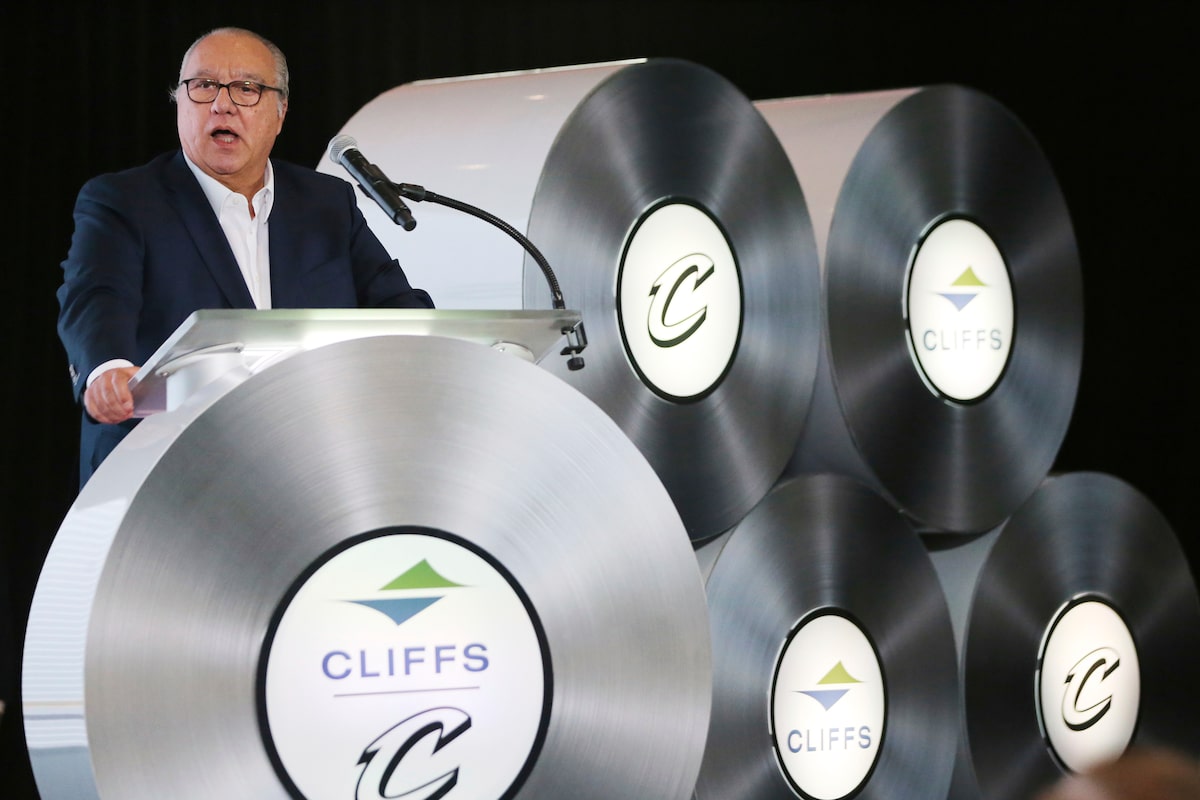
Cleveland-Cliffs CEO Lourenco Goncalves, who has publicly supported U.S. tariffs on Canadian steel, in 2022.John Kuntz/The Canadian Press
Marty Warren, the Canadian national director of the United Steelworkers union
As I write, more workers at Hamilton’s Stelco steel mill are being laid off. In all, the plant’s U.S. owner, Cleveland-Cliffs Inc., will cut up to 500 jobs. This, not two years after making legally binding assurances under the Canada Investment Act that it would maintain the number of unionized jobs for five years.
When seeking approval to purchase Stelco, Cleveland-Cliffs CEO Lourenco Goncalves couldn’t say enough about what a “net benefit” a takeover would be to Canada. Not to mention to Cleveland-Cliffs itself, acquiring one of the newest and most efficient mills going. Among the “lowest-cost steelmaking facilities in North America,” the company called it.
And how would U.S. ownership produce a “net benefit” to Canada? In part, through exports to the United States. After all, as Mr. Goncalves once said, “not all [American] imports were created equal … Canada follows the rules and does things the right way,” claiming “this is a large part of the rationale behind Cleveland-Cliffs acquiring Stelco.”
That’s Mr. Goncalves before Donald Trump was elected in 2024. How things have changed since – to the detriment of Stelco workers, the Canadian economy, and indeed to our national interest.
Not a year after investing US$2.5-billion in Stelco precisely because of its competitive advantage in the North American market and despite acknowledging that “Canada follows the rules,” Mr. Goncalves cheered on Mr. Trump’s tariffs.
“We at Cleveland-Cliffs appreciate the recently announced 25 per cent tariffs on steel imports from all countries,” he said. “We thank the Trump administration for having the courage to implement [them].” Without missing a beat, he explained American orders would henceforth be filled by American mills. And that if Canadian companies wanted to buy “more sophisticated grades” of steel, American mills would supply these higher-value orders, too.
In other words, Canadian operations would be pared back – and now stripped down – not to the net benefit of Canada as promised, but instead to benefit Cleveland-Cliffs as a whole. In effect, Mr. Goncalves paid $2.5-billion to prevent Stelco exporting into the American market. Why, after all, allow more efficient Canadian steel to compete with Cleveland-Cliffs’s pricier American steel when it can just pay to restrict supply?
Don’t just take the Steelworkers’ word for it.
As Mr. Goncalves told investors, “With Stelco’s favourable cost structure … [it] was a major disruptor here in the Midwest of the United States. The strategic repositioning of Stelco as a Canadian supplier of steel to the Canadian market has given our U.S. mills more business opportunities.” (My italics.)
He went on to say that his commitments to the federal government notwithstanding, “we acquired Stelco with the decision already made in our minds that we would take [it] out of the American domestic market as a disruptor … tariffs on steel were just a consolidation of what we were already doing.”
And when those tariffs were doubled, Mr. Goncalves doubled down: “We understand why the U.S. has a 50 per cent tariff on imported steel from Canada and that’s fine. We are keeping all Stelco steel in Canada, and we are doing that by design since we acquired Stelco in November [2024] and not now as a result of the tariffs being implemented in 2025.”
Yet in explaining Cleveland-Cliffs’s decision to gut operations in Hamilton and lay workers off at a separate plant in Nanticoke, Ont., Mr. Goncalves invoked changing market conditions and U.S. trade policy. But these were not simply imposed upon the company. They were, rather, created and advocated for by the company itself. Tariffs merely confirmed Cleveland Cliffs’s own, de facto export ban on Stelco.
Again, don’t take the Steelworkers’ word for it. Here’s Mr. Goncalves himself: “Prior to our acquisition, Stelco was a low-price exporter into the U.S. and a highly disruptive one, by the way. When you look at the big picture, what our acquisition has done to transform the U.S. marketplace more than justifies a return on our $2.5-billion purchase price of Stelco.”
These are the words that matter, not empty commitments made to Ottawa when seeking to purchase Stelco. An acquisition, it is increasingly clear, that has nothing to do with Canada’s benefit, but the monopolistic benefit of Cleveland-Cliffs for which Canadian workers are paying the price.