

Listen to this article
Estimated 5 minutes
The audio version of this article is generated by AI-based technology. Mispronunciations can occur. We are working with our partners to continually review and improve the results.
The Manitoba government is banning teachers from sending social media messages or texting students privately, weeks after two educators were stripped of their licences for inappropriately communicating with students.
Education Minister Tracy Schmidt issued a directive to all publicly funded school divisions on Friday mandating them to update their digital communication policies, prohibiting school employees from direct messaging students outside of internal school platforms.
“We believe this is one very important step we can take as a government to both protect students, [and] provide greater clarity and professional regulation for teachers in the profession,” she said at an announcement in her office at the legislature Friday afternoon.
The directive comes days after Manitoba’s independent teacher commissioner, Noni Classen, published rulings from earlier in the month in which she terminated the teaching certificates of one former educator in Winnipeg and one in Portage la Prairie for inappropriately communicating with students by text and over social media.
The province began publicly posting rulings from the commissioner on a teacher disciplinary outcomes dashboard earlier this year in response to calls for greater transparency around teacher misconduct.
Schmidt said she and Classen met about a month ago to discuss the possibility of banning unmonitored online communications between teachers
The cabinet minister said she made the move after reviewing some of the commissioner’s cases and seeing “a consistent pattern” in most.
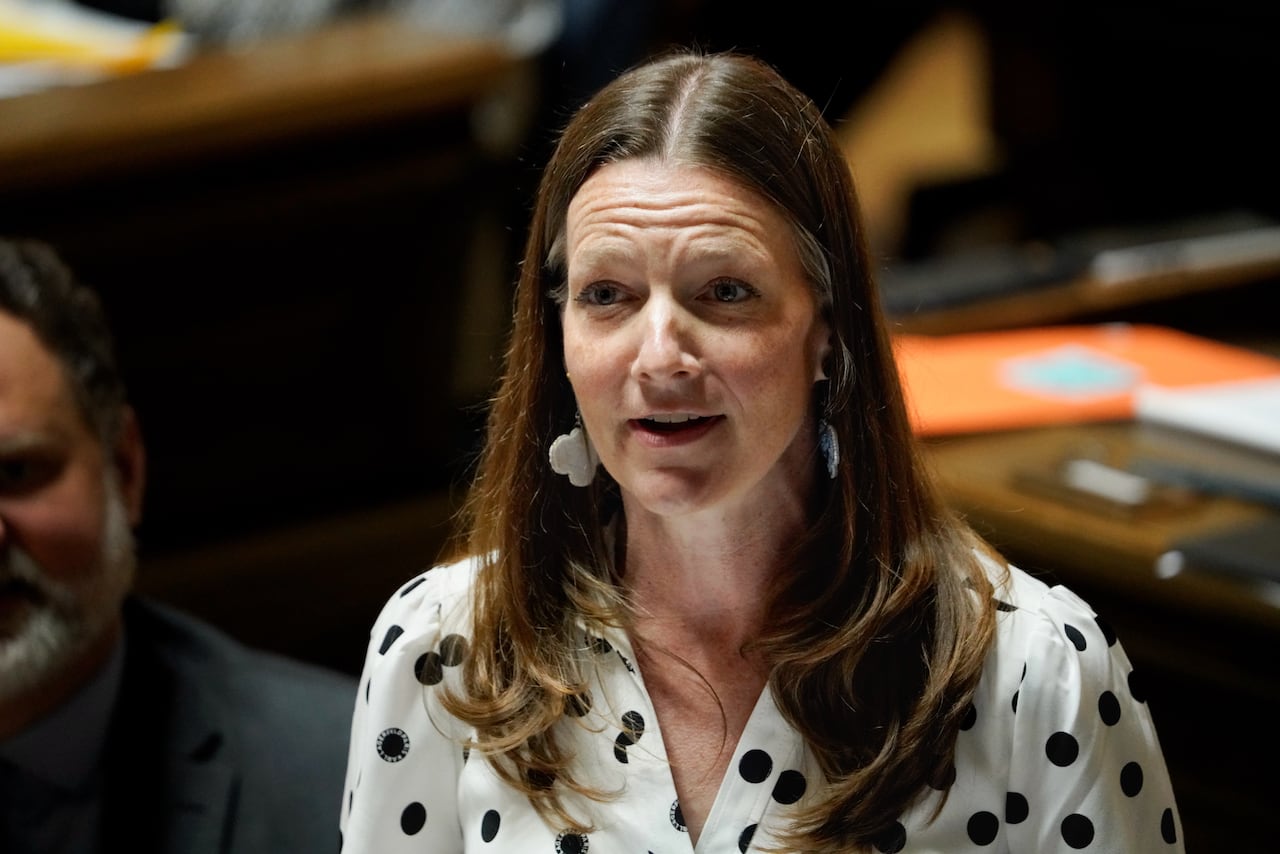
Manitoba Education Minister Tracy Schmidt, seen here during question period in June, says she made the decision after seeing ‘a consistent pattern’ in many teacher misconduct cases. (Bryce Hoye/CBC)
“And that was the inappropriate communication between teachers or school staff and students, and what that contributed to the grooming process, and ultimately what are some really tragic and terrifying cases,” Schmidt said.
Classen said the decision “enhances and enforces” the importance of professional boundaries.
“This will give a chance for kids not to have to manage this space as it relates to communication with their teachers,” Classen said.
“Teachers should be taking the lead on this and managing where those boundaries are, and setting and modelling those expectations to enhance the safety of kids.”
The only acceptable forms of digital communication between teachers and students moving forward will be through internal platforms sanctioned by schools and the division.
Alternative arrangements to the new communication rules will be considered on a case-by-case basis and must be pre-approved by school administrators, the minister said.
All schools are expected to relay guideline revisions to staff members, as well as students and their families, Schmidt said.
Manitoba Teachers’ Society president Lillian Klausen welcomed the change.
She said educators have been asking for clear guidance for years in terms of “on- and off-duty communication with students.”
In response to those calls for clarity, the teachers’ union developed a professional conduct workshop with a section that explores what constitutes appropriate communication and how to maintain boundaries with students.
“We are pleased to see the government taking steps in this direction,” Klausen said in a statement to CBC News.
“A consistent policy framework, supported by meaningful professional learning, will help reinforce expectations, support educators in their professional responsibilities, and strengthen the shared commitment to student safety and well-being.”
The Manitoba School Boards Association was consulted on the directive earlier this week, interim president Leah Klassen said.
Most teachers won’t be surprised by it, she said, because there’s already been a “significant shift” at the school-division level.
“Our teachers are doing a fantastic job, and we certainly don’t want the actions of a few to impact the majority of our teachers,” Klassen said. “That should really be highlighted, that they are doing a great job in those classrooms.”
She acknowledged the likelihood that there are teachers and school staff presently communicating with students via unsanctioned platforms who aren’t necessarily ill-intentioned. They might be reflexively participating in a culture where texting and social media messaging have become normalized modes of communication over the past couple decades.
Klassen cites school sports teams with WhatsApp groups used to relay when a practice time has changed, as an example.
Nonetheless, some of those teachers will have to adjust under a paradigm that no longer tolerates unmonitored communication of any kind.
“It’s a balanced approach for the government to come up with a directive that outlines very specifically what they expect in our policies and our procedures,” Klassen said.
“They will align very closely with what school divisions already have. If not, they may need to make a few tweaks, but school divisions across the province are already doing [much] of what is outlined in the directive.”