
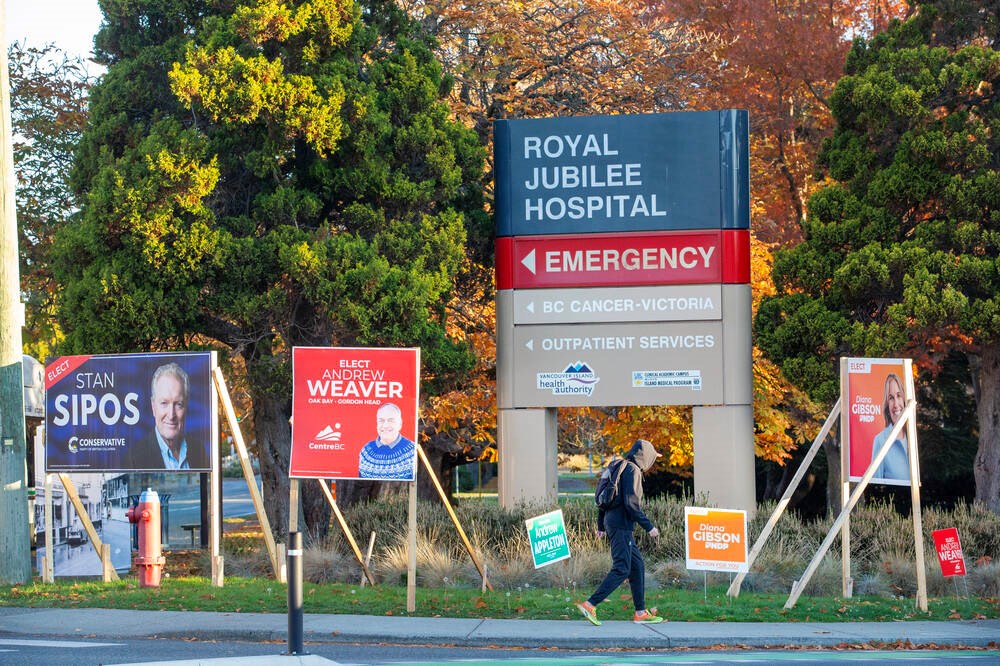
Wondering who to vote for in the Oct. 24 B.C. provincial election? Check out our guide to party promises on the hot-topic issues of health care, affordability, housing and public safety.
As B.C. goes to the polls on Saturday, here is a look at some of the promises made by the province’s political parties on four big topics: affordability and taxes, housing, health care and public safety.
We’ve included the parties that are running in five or more of Vancouver Island’s 15 ridings: B.C. NDP, Conservative Party of B.C., B.C. Green Party, and CentreBC.
OneBC, the Communist Party of B.C. and the Christian Heritage Party of B.C. are also running candidates on the Island. You can read more about their platforms on their websites.
Here are the links to each party’s platform if you want to learn more:
AFFORDABILITY AND TAXES
NDP — The party is campaigning on a host of cost-cutting measures. At the pump, it wants to cut gas prices by 30 cents a litre by reducing the motor fuel tax by 10 cents per litre and enabling B.C. utilities to cap excess profit margins. At the tills, it plans to mandate consistent per-unit pricing of items, cap retail margins on essential foods, and ban large grocery stores from blocking their competition. It has also committed to keeping the freeze on ICBC rate increases and investing in affordable child care. The party is proposing a tax increase on people with income of $190,000 a year or more.
Conservatives — The party plans to make the province more affordable by cutting income taxes by $1,000 a year per person and increasing disability assistance by $100 a month. Their platform promises tax credits for renovating multi-generational homes and improved access to affordable child care. It is pledging no new taxes “throughout the entirety” of Doerkson’s government, and to remove the PST from Canadian beer, wine and spirits for the duration of the trade war with the U.S.
Greens — The party is promising to boost the minimum wage, create public grocery stores (see platform), restart a $10 per day child-care benefit and move toward universal free child care by 2031. It also plans to pass rent control measures and improve public transit while making it free for those younger than 25 or older than 65. A one-time “Fair Share tax” would tax those with net wealth above $50 million. The party is also proposing an ongoing annual tax on net wealth above $50 million.
CentreBC — The party plans to cut income tax rates for the first tax bracket from 5.60 to 5.06 per cent, saving a dual-income household about $540 per year. It wants to create 20,000 new $10-a-day child care spaces and fund a 15 per cent increase in transit service by 2030. It also proposes raising the renter’s tax credit from $400 to $600 a year and indexing the credit to inflation.
HOUSING
NDP — To build more affordable homes, the party wants to speed up the permitting process for small residential builds and reduce development charges on multi-unit housing by up to $40,000 per unit. It’s proposing an Unsold Condo Tax on finished condos left empty for more than a year to push developers to sell them at affordable prices. Their platform also promises to invest in shovel-ready affordable housing projects and protect more housing through the B.C. Rental Protection Fund.
Conservatives — The party wants to get homes built faster by speeding up the approval processes and removing development charges, while holding municipalities to the density targets set out in their Official Community Plans. It hopes to shorten permitting times for communities looking to build family-oriented housing and simplify the building code (see platform for more details). It also plans to reverse changes to the Property Tax Deferment Program that saw interest rates hiked sharply.
Greens — The party promises to restart the Community Housing Fund and Indigenous Housing Fund, hoping to build or protect 26,000 housing units per year, as well as invest in the Rental Protection Fund. It also plans to introduce vacancy control, which would tie rent increases to a unit, rather than a tenant, so landlords cannot increase rent by evicting a tenant.
CentreBC — The party is campaigning on faster, more consistent approvals for building permits and a 50 per cent reduction in development charges on new rental and affordable housing builds. It plans to create a housing performance fund to encourage cities to meet approval timelines and housing targets, and a growth fund to cover the costs of growth-related infrastructure. It also wants to double the building of affordable homes to 20,000 units by 2031 and rebate the PST on building materials for purpose-built rental buildings. It pledges to help homeowners install heat pumps, improve insulation or add solar panels at no upfront cost.
HEALTH CARE
NDP — The party plans to expand the province’s capacity to train new medical staff, bring in care workers for seniors and triple recruitment of U.S. health-care workers. By co-ordinating regional wait-lists and investing in new surgical and diagnostic equipment, it wants to shorten wait times for surgery and medical imaging. The party has also promised to build seven new health-care facilities on the Island, and to make the shingles vaccine free for those who are 50 and older or immunocompromised.
Conservatives — The party is promising to introduce a health-care guarantee, ensuring public funding for treatment through private providers if surgical wait times are too long. It wants to recruit more health-care workers, keep rural ERs and maternity wards open and improve access to rural health-care transport. It is also campaigning on providing more long-term care beds, along with UPCCs in several areas, including five on Vancouver Island. Like the NDP, they have promised free shingles vaccines for seniors.
Greens — The party wants to establish a Community Health Centre, essentially a clinic run by a non-profit, in each riding in the province to provide better access to primary care. It promises to make all recommended vaccines available to everyone, fund more long-term care beds, and consolidate health bureaucracy. It says it would look at loan forgiveness and paid practicums for health-care students to recruit more workers into the medical sector.
CentreBC — The party is campaigning on providing a family doctor for everyone by 2031. It plans to add 600 nurse practitioners, certify 200 more internationally trained doctors, add five new MRI machines across the province, and schedule 15,000 more surgeries per year across the province. It also wants to create a $400 a month benefit for family caregivers and open 500 addiction treatment and recovery beds.
PUBLIC SAFETY
NDP — The party’s promises for public safety focus on repeat offenders and gang violence, with plans to double funding to programs targeting repeat offenders, pursuing immediate penalties on gang activity and illegal gun ownership, and launching task forces into retail theft and gang violence. They also plan to add 50 new Crown prosecutors and build new involuntary care beds.
Conservatives — The party is focusing on repeat offenders and ending the safe-supply approach to managing the drug crisis. They want to add 1,000 new law enforcement officers, strengthen bail and warrant enforcement, establish a dedicated repeat-offender court and speed up trials. They also plan to review and reform supervised consumption sites, “introduce compassionate intervention,” and allow police to enforce the Mental Health Act so officers can place people into mandatory treatment.
Greens — The party wants to “transform the policing and justice systems,” emphasizing accountability and equity through implementing the recommendations of reports on systematic racism, gender-based violence, and community safety (see the platform for more detail). It would continue safe-supply programs, increase access to supervised consumption sites, and fund community-based treatment services.
CentreBC — The party is hoping to add 500 RCMP officers and 60 Crown prosecutors and make the extortion task force permanent. It would fund outreach teams in downtown areas, build supportive homes, fund rent supplements, and add complex care spaces. It plans to create more detox and treatment beds, with a goal of people getting treatment within 14 days by 2030.