
CBC Ottawa asked voters early in the municipal election campaign about the issues you care about. Now, with days to go before voting day, here’s what the leading mayoral candidates have promised on four of those top issues. Today: infrastructure.
Whoever moves into the mayor’s office after Monday’s election will have a multibillion dollar question to grapple with.
When the city last reviewed the state of its roads, pipes, buildings and other assets, there was a $10.8-billion gap between the cost of repairs and renewal over the coming decade, and what the city has been budgeting to pay for it.
Council has only begun to make up the difference in new financing plans — and only for the highest priority needs.
Some of those assets are in a sorry state. Others don’t seem able to handle increasingly extreme weather. On Canada Day, for instance, the flooding that filled thousands of basements has made the state of stormwater infrastructure top of mind for voters in hard-hit west-end wards.
Meanwhile, residents moving into new subdivisions in Orléans, Barrhaven, Stittsville and Kanata are finding there aren’t enough new roads and transit to get them where they need to go. Neither are there recreation centres with enough space for their kids.
Here’s how the leading mayoral candidates are planning to close the funding gap and make sure infrastructure keeps up with growth.
Alex Lawson
Ottawa mayoral candidate Alex Lawson. (Francis Ferland/CBC)
Alex Lawson has not released a detailed infrastructure plan, saying no one has been transparent about what’s actually needed.
“We’re more than three months in and we haven’t actually seen what happened and what caused the flooding,” he said of the Canada Day storms. “Were the sewers undersized? Were they not cleaned properly?”
But he has made at least one specific infrastructure promise. He says he would get a southern ring road built to divert traffic from Highway 417 and take truck traffic out of rural villages.
That all hinges on getting provincial funding. While Ontario’s transportation minister has said there’s a case to be made for the idea, the Ford government has made no such commitment.
Mark Sutcliffe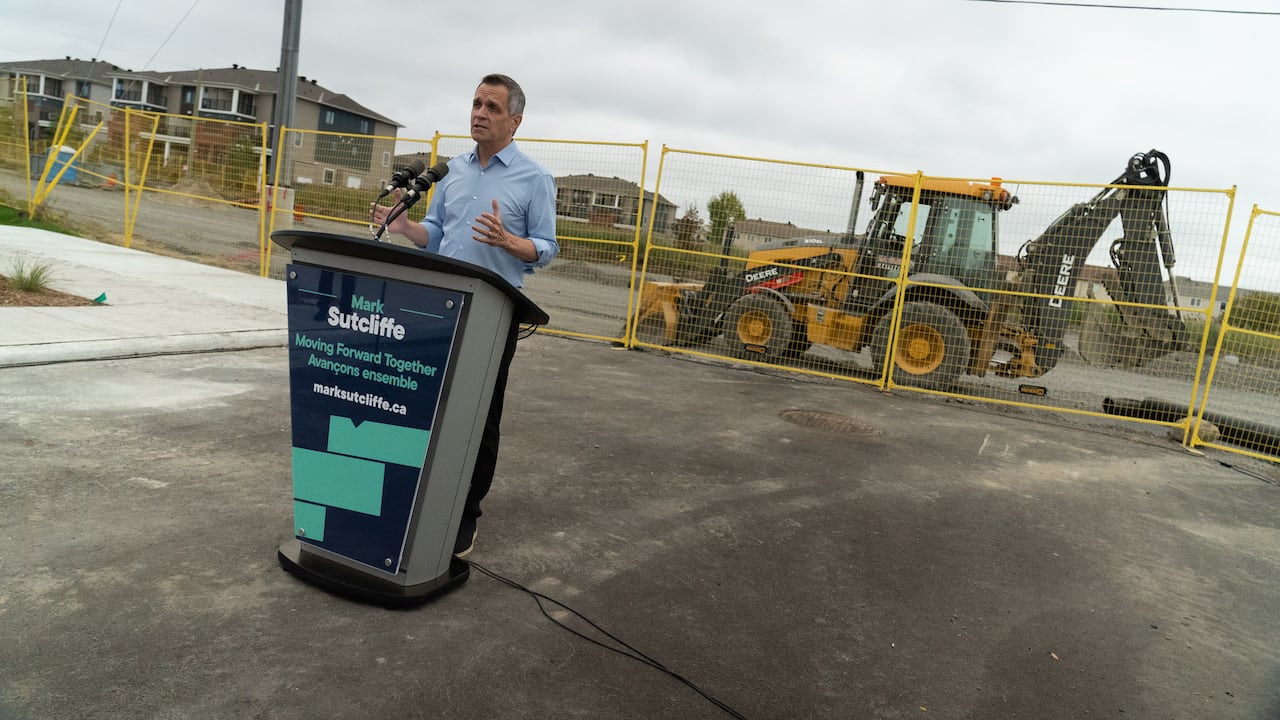
Mark Sutcliffe speaks in Barrhaven’s Half Moon Bay neighbourhood earlier in the campaign, where he announced his infrastructure plan in front of a major road project to serve the growing community. (Francis Ferland/CBC)
Mark Sutcliffe said he has a plan to spend $10 billion over a decade to fully close the infrastructure gap.
It’s not all entirely new money. More than half is already laid out in existing financing plans.
His plan includes $500 million to strengthen infrastructure in the face of extreme weather, including better storm sewers and ditches in flood-prone areas, as well as $500 million for roads and $400 million to renew or replace recreation facilities.
Sutcliffe said the funding will allow the city to more quickly move through a list of high-priority infrastructure projects in growing neighbourhoods, like widening Brian Coburn Boulevard in Orléans, Terry Fox Drive in Kanata and Earl Armstrong Road near Riverside South.
He said he would ensure roundabouts, traffic lights and sidewalks are in place before residents move into new communities. He’s also promising four new community and recreation complexes.
The big question is how he would raise all those billions of dollars. Sutcliffe said his plan relies on some combination of debt, water rates, development charges on new homes, tax revenue and savings he’s promising to find if re-elected, plus contributions from higher levels of government.
He hasn’t said how much would come from each source — including how much debt the city might have to take on if the feds and the province don’t pay up.
Sutcliffe supports a southern ring road too, though he too said it will depend on provincial investment.
Jeff Leiper
Mayoral candidate Jeff Leiper is proposing a one per cent infrastructure levy to help close a funding gap. (Francis Ferland/CBC)
Jeff Leiper is pinpointing exactly where he would find new money for infrastructure: taxes.
His plan calls for a one per cent levy on property taxes to raise $100 million over the course of a four-year term. That money could only be used for infrastructure, according to his plan. It would come over and above whatever tax rate council passes for other city services.
But that’s just a fraction of what’s needed to fill the infrastructure gap. Like Sutcliffe, Leiper said Ottawa will need help from other levels of government. But he said his levy will help make the case for federal and provincial dollars.
“It cannot just be on the Ottawa property taxpayer to find a billion dollars a year over the course of the next 10 or 11 years. That’s simply not feasible,” said Leiper.
“If we put our own skin in the game, if we have our own infrastructure levy… that will make it more likely that our federal and provincial partners will come on board.”
He didn’t name a Plan B would for a scenario where that money doesn’t come through.
More specifically, Leiper said he would devote $50 million to sewer and green infrastructure improvements in Bay, College and Knoxdale-Merivale wards, the three areas hardest hit by the Canada Day floods.
He’s also said he wouldn’t advocate for a southern ring road as a priority for Ottawa, calling it an expensive distraction from better transportation options.
Neil Saravanamuttoo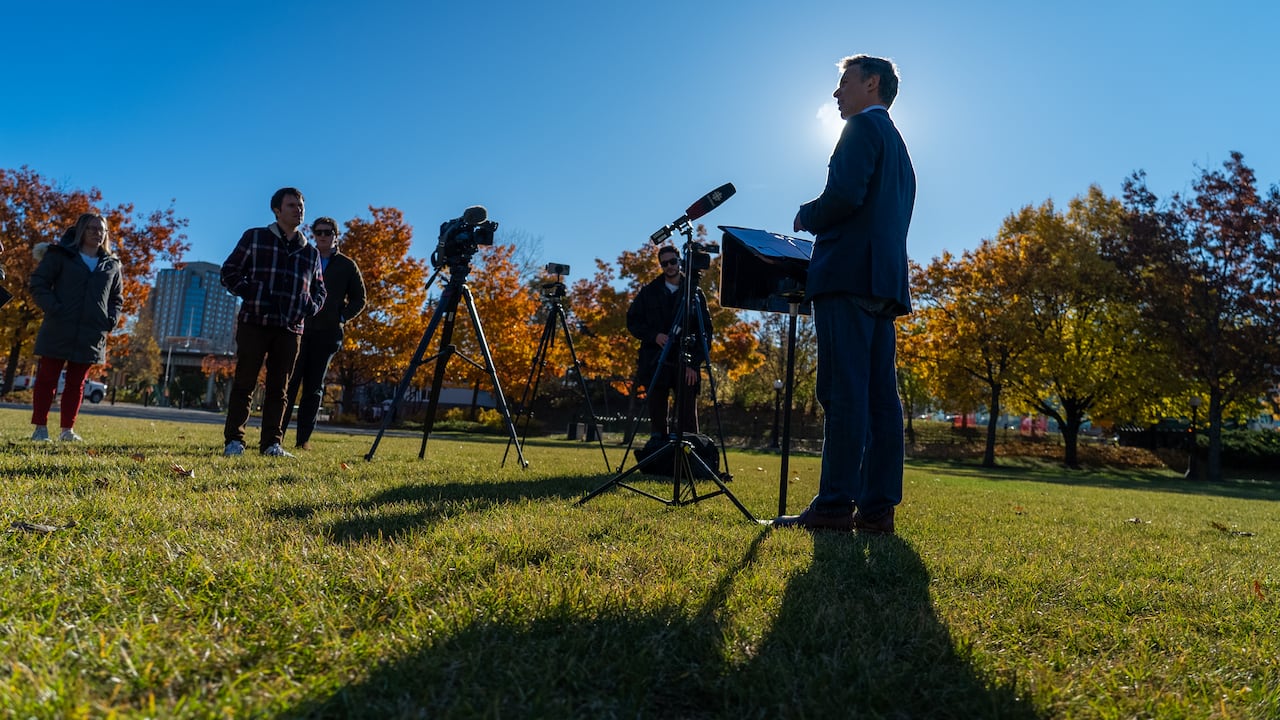
Neil Saravanamuttoo addresses the media in a campaign event on the final Friday before the election. (Francis Ferland/CBC)
Neil Saravanamuttoo has long been a vocal critic of city plans to keep up with aging infrastructure.
In his view, they aren’t clear, and it simply isn’t possible to know how much Ottawa actually needs to spend to close the gap.
Saravanamuttoo’s been confident that finding savings at city hall can cover a sizable chunk of the bill.
But what if those savings aren’t enough? He’s said the difference between that number and the cost of fixing Ottawa’s infrastructure would help determine his ultimate tax rate, a number he hasn’t pinned down.
He’s also called the Canada Day flooding a “wake-up call” for Ottawa, and promised to move faster to replace sewers and storm sewers that were overwhelmed by the storm.
He said he would also expand “nature-based” flood control measures, like tree planting and stormwater ponds.
But he hasn’t made many commitments to specific projects, saying Ottawa needs to have a public debate about what infrastructure the city needs to repair and move forward with.
The city’s needs are greater than it can handle on its own, Saravanamuttoo has said, calling for efforts to pare back the cost of infrastructure projects.
Saravanamuttoo said his priority is upgrading infrastructure in existing neighbourhoods rather than bearing the costs of servicing new suburbs sprawling into rural areas.
He said a southern ring road isn’t a top priority.