
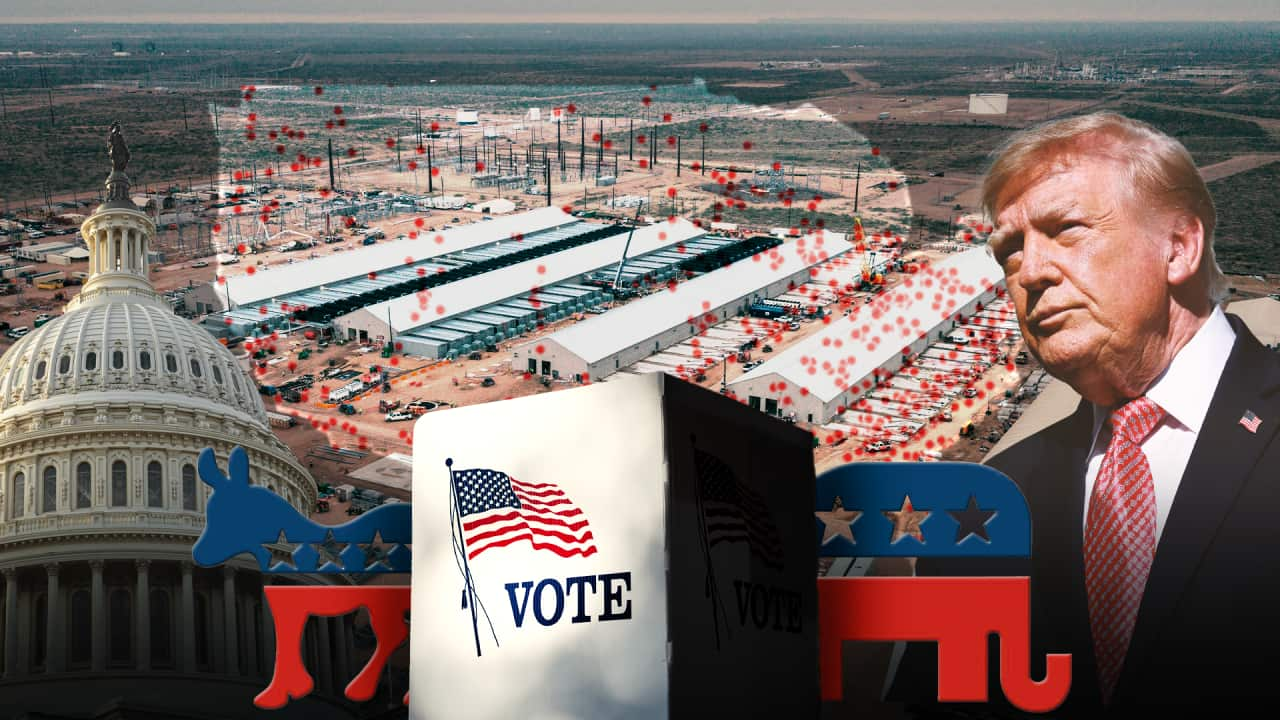
Just a year ago, few would have predicted what would become one of the surprise political battlegrounds — and unlikely unifiers — in the United States midterm elections.
The explosive growth of gigantic data centres across the country is troubling Republican and Democratic voters alike, creating an unusual point of agreement in an otherwise deeply polarised nation.
But with the data centre boom increasingly concentrated in Republican-leaning or ‘red states’, Republican officials face a political dilemma. Some are contending with growing opposition to the vast facilities in their communities, even as President Donald Trump vocally advocates for the rapid expansion of artificial intelligence (AI) infrastructure.
Mike Madrid, a Republican political consultant, tells SBS News: “Rarely have I ever seen an issue like this [that] becomes a social-political movement so rapidly and so intensely.”
It’s much bigger than the AI data centres. It’s the future that they’re powering that are causing a lot of angst and concern.
Your trusted source for staying up-to-date with the world around you. Get free daily news updates and analysis, straight to your inbox.
He says the issue was barely on voters’ radar a year or two ago but is now “front row and centre”.
Between January and August 2026, the proportion of Republicans who believed data centres negatively affected the quality of life of nearby residents jumped from 24 per cent to 42 per cent, according to a Pew Research Center survey.
Democrats remain more likely to view the facilities negatively, but the shift among Republicans points to a growing source of cross-party discontent.
“I think it has a lot to do with just the rapid pace upon which these things are being approved, particularly in red states,” Madrid says.
It could cost a lot of Republicans their congressional districts, their governorships, their Senate seats.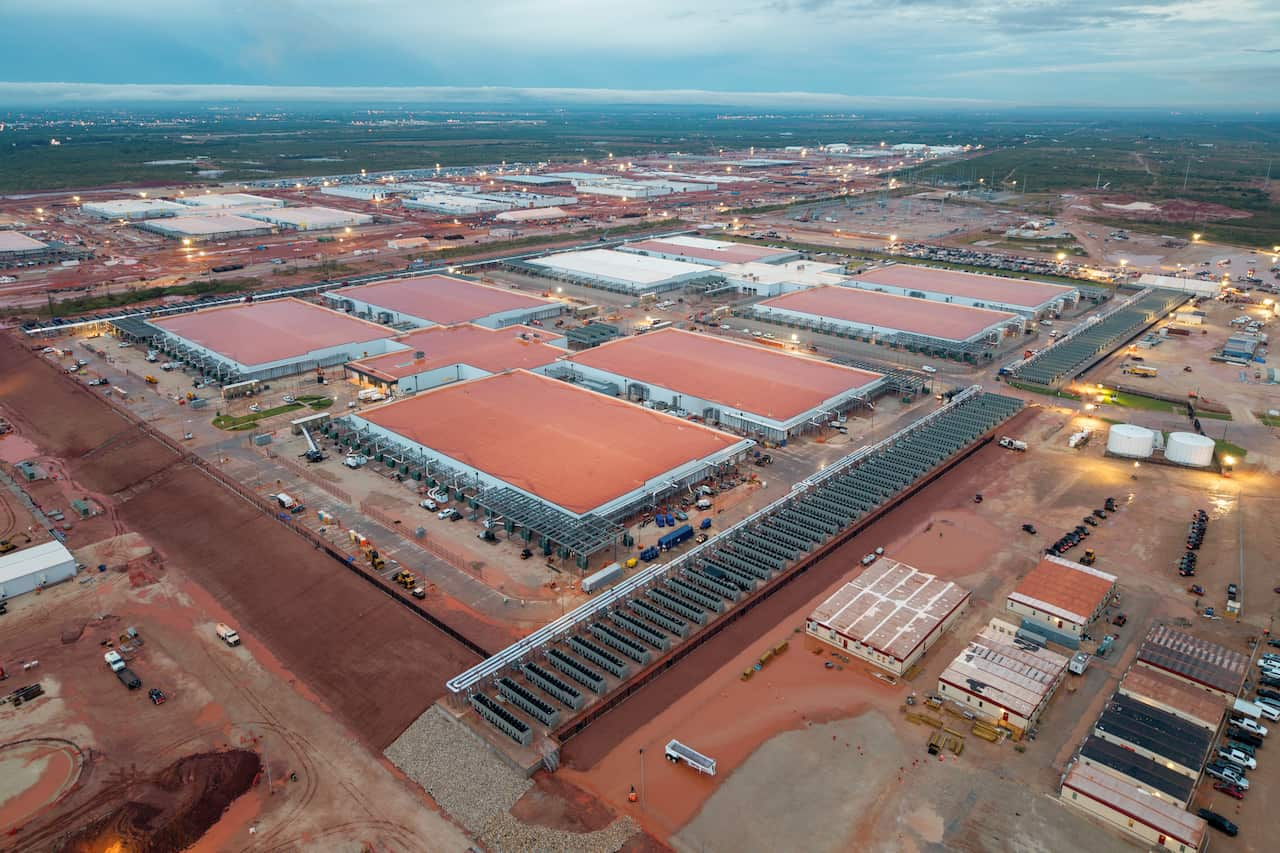 The Stargate AI data center in Abilene, Texas, is part of a $500 billion joint venture to build new infrastructure for companies like OpenAI, the maker of ChatGPT. Source: Getty / Bloomberg
In response to the shift in public sentiment, some Republican politicians are backing away from Trump’s pro-AI agenda.
Meanwhile, after months of struggling to find a message, Democratic candidates are increasingly seizing on opposition to data centres as a campaign attack line.
As the backlash grows, data centres are becoming an unlikely electoral flashpoint, pitting Trump’s AI ambitions against local concerns over energy use, water supplies and the impact on rural communities.
The data centre boom
The US has far more data centres than any other country in the world.
Thirty-eight per cent of Americans now live within about 8km of at least one operational data centre, with more than 3,000 such facilities across the country and another 1,500 in the development pipeline, according to the Pew Research Center.
By comparison, Australia has around 165 operational data centres, and their expansion is already attracting controversy.
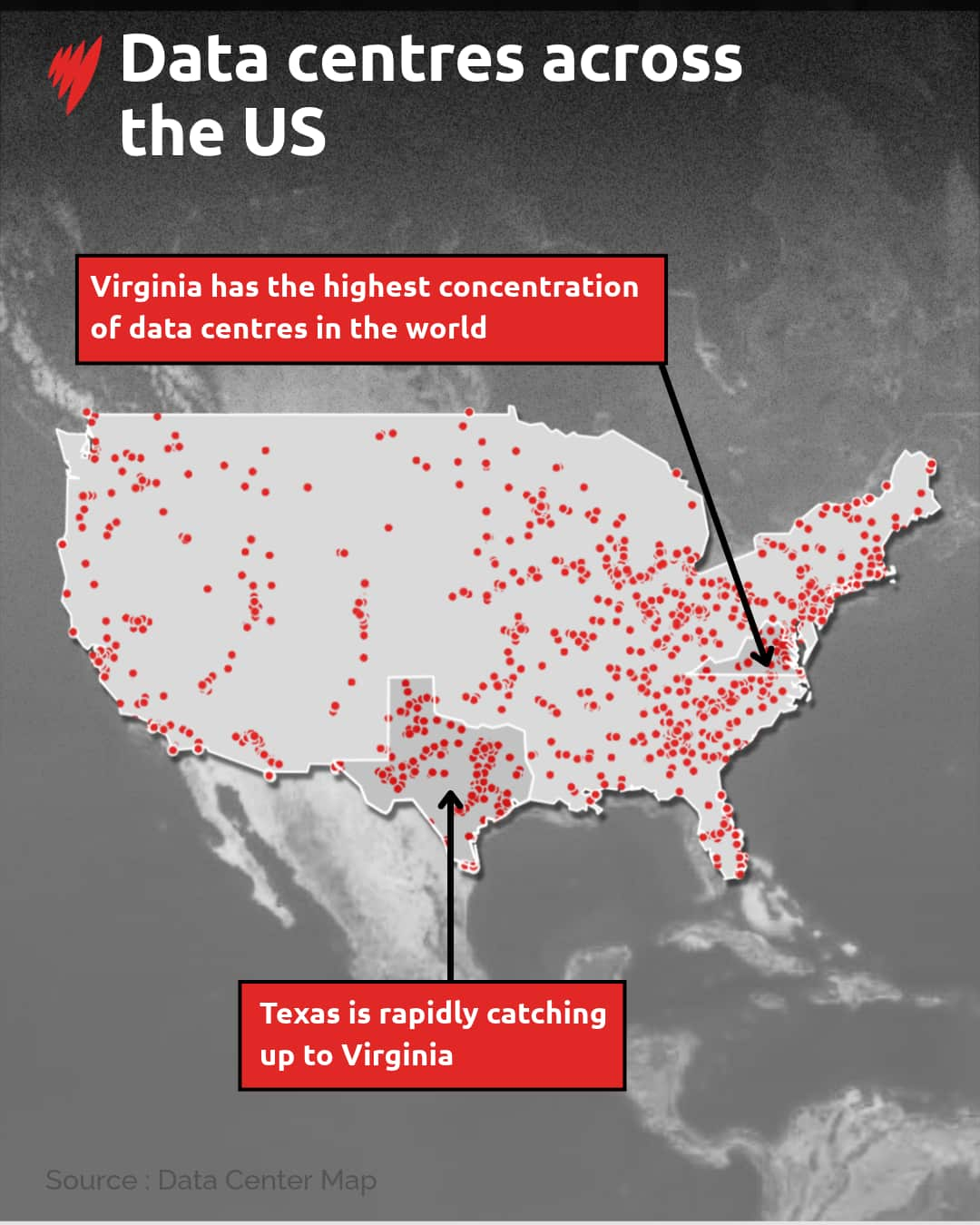
Increasingly, it’s rural Americans who are finding themselves on the front lines of the data centre boom.
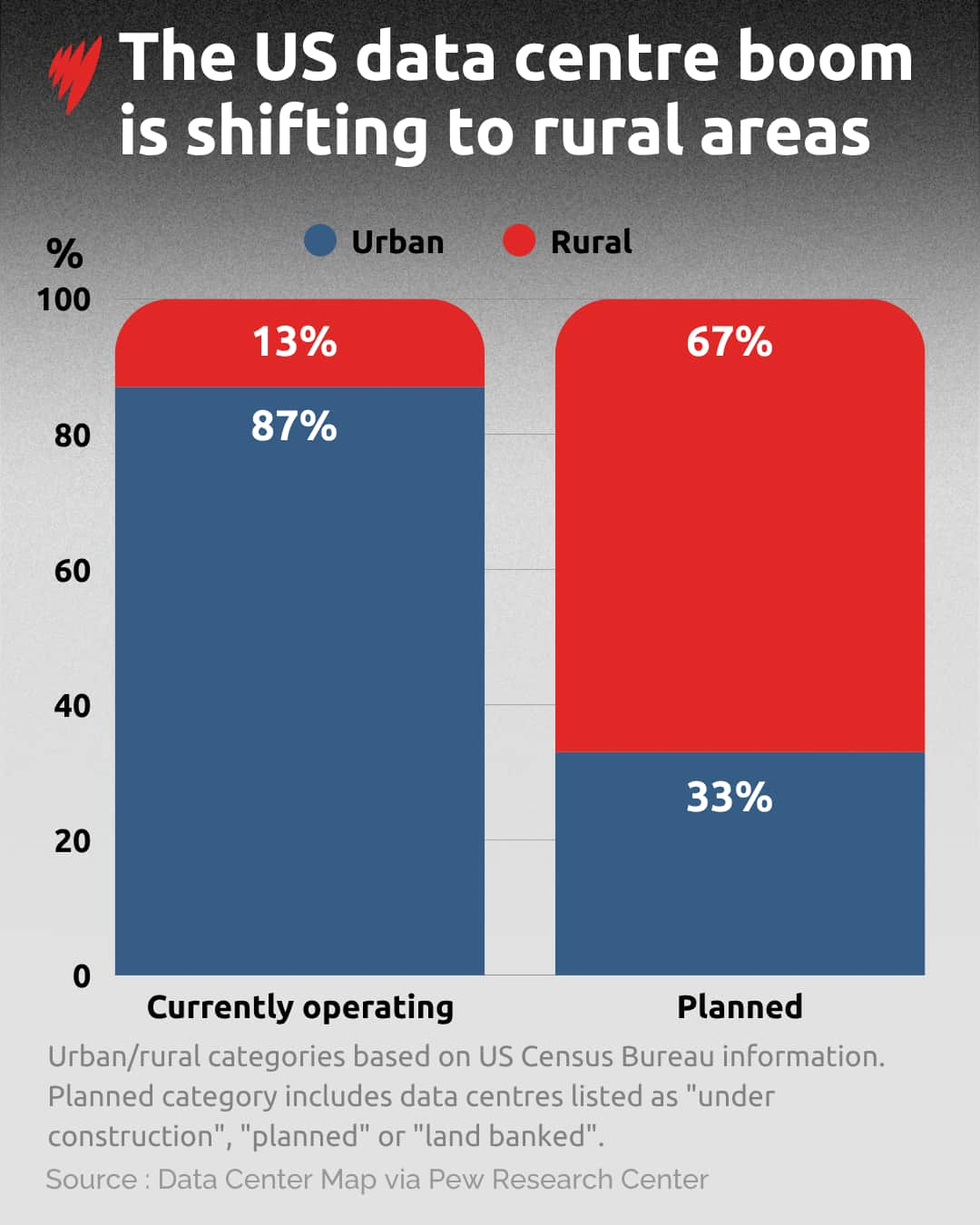
While 87 per cent of existing US data centres are in urban areas, most new developments are now planned for rural areas — where voters are more likely to lean Republican.
Outside Virginia, which has the highest concentration of data centres anywhere in the world, 92 per cent of data centre construction is in states Trump won in 2024, according to an analysis by energy data firm Cleanview Research.
Trump has been an unapologetic champion of data centre expansion, arguing that expanding data centre infrastructure is vital to maintaining US competitiveness in AI. He warned in August that communities that oppose them risk becoming “backwards and poor”.
“If we kill the golden goose, you will only have yourselves to blame,” he posted on Truth Social at the time.
“China could not be happier with this anti-data centre movement.”
READ MORE
Elections analyst Kyle Kondik, managing editor of an election forecasting site run by the University of Virginia Center for Politics, suggests Trump’s position on data centres has been at odds with his broader populist approach.
“On this issue, the president has not been populist at all,” he tells SBS News.
“So perhaps Democrats have more of an opportunity to bolster their own anti-establishment, populist positioning.”
The backlash against data centres
Much of the expansion is being fuelled by the AI boom, which is driving demand for hyperscale data centres.
The number of these large-scale facilities, which typically house thousands of servers that process and store vast amounts of information, has more than quadrupled in the US since 2016, according to Synergy Research Group.
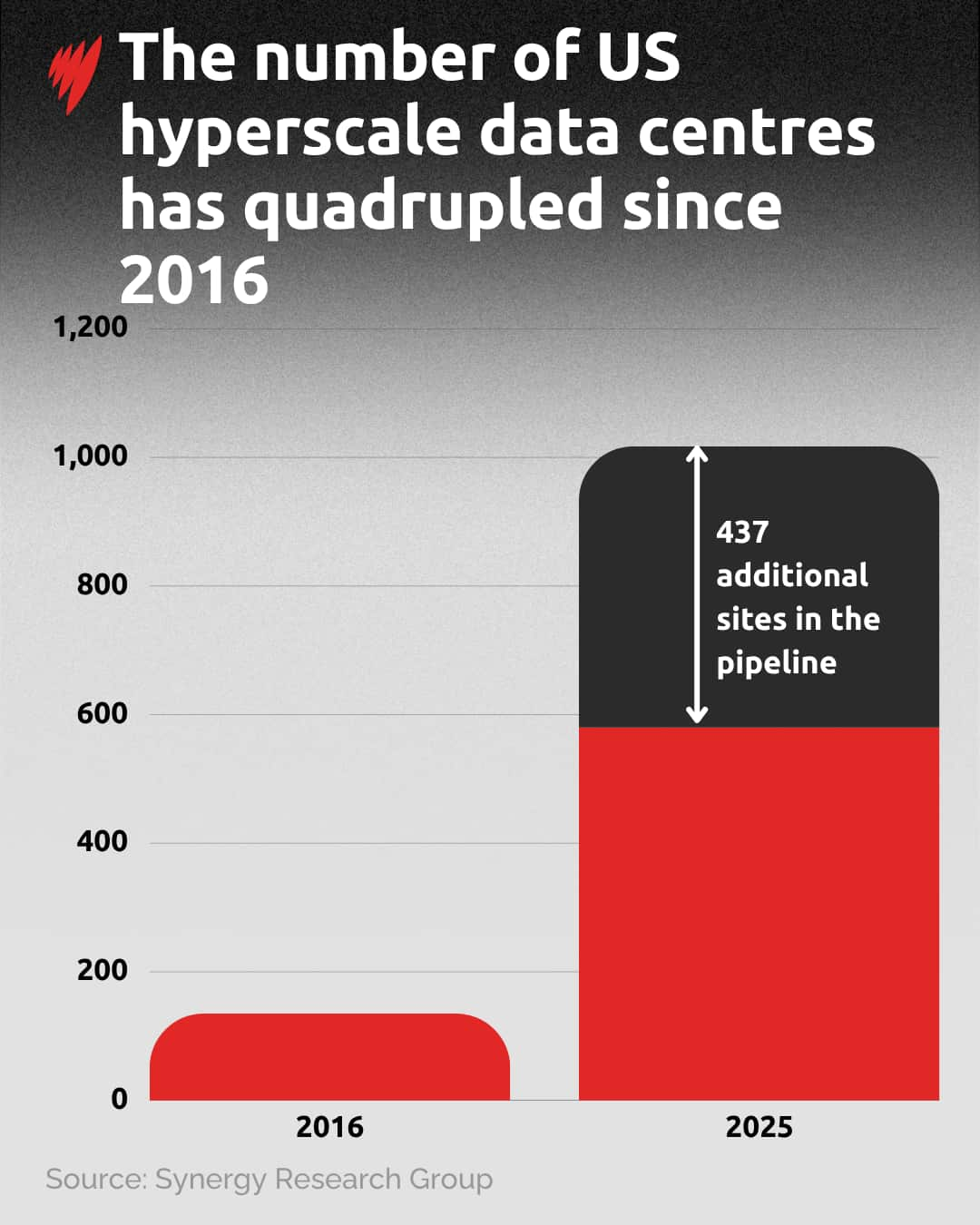
Olivia Shen, director of the Strategic Technologies Program at the United States Studies Centre, says hyperscale facilities differ in scale and resource demands from older data centres that have existed for decades without widespread attention or controversy.
AI models require enormous computing power and electricity, driving demand for ever-larger facilities.
Shen says these developments have caught some rural communities off guard, with residents raising concerns about immense resource consumption, noise, rising energy bills, and a lack of consultation.
“Imagine you’ve got a small farm you’ve had for generations, and then suddenly right next door there is this giant black box, but it stretches for kilometres, and it hums all day long with a kind of electricity,” she says.
What does that do to your groundwater that you’re using for your little farm? What does that mean for your enjoyment of your local environment?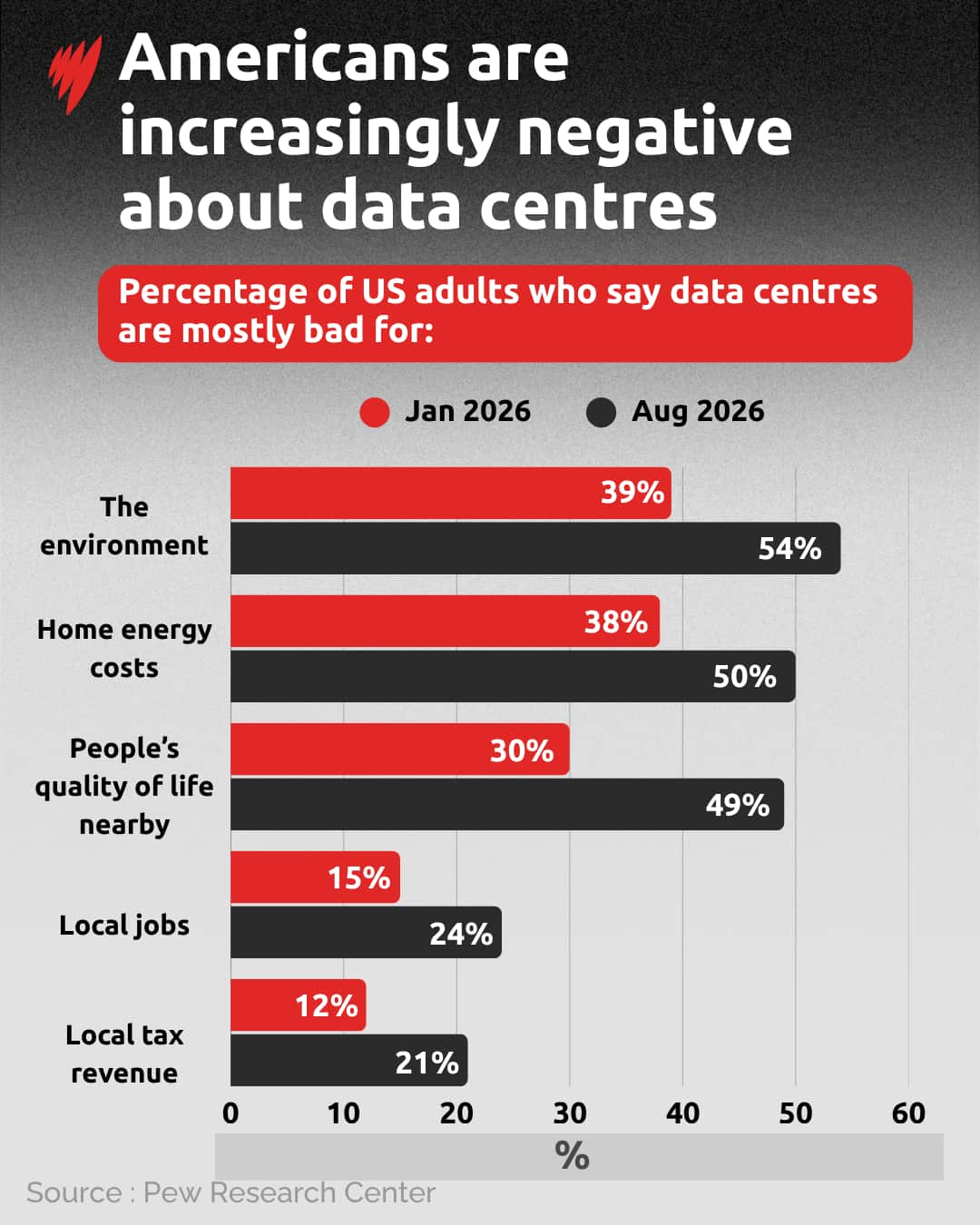
The sheer scale of the developments helps put the concerns into perspective.
The sprawling Switch Citadel data centre campus in Nevada, one of the largest data centre campuses in the US, occupies a site spanning 800 hectares — equivalent to roughly 1,120 football fields.
Virginia, a state roughly one and a half times the size of Tasmania, has more than twice as many operational data centres as the whole of Australia, with more than 450 more planned.
Could data centres turn red voters blue?
Republicans and Democrats in several states have recently adopted tougher rhetoric on data centres or proposed restrictions on new developments.
One of the most prominent reversals is happening in Texas, where Republican governor Greg Abbott has called for sweeping restrictions on data centres. He ordered a temporary pause on approvals for new electricity grid connections in August, before expanding the restrictions the following month.
READ MORE
Less than a year earlier, he had touted Texas as the “epicentre of AI development”.
With the 3 November midterm elections approaching, Abbott is facing a tighter-than-expected contest in the longtime red state against Democratic challenger Gina Hinojosa — who has dismissed his temporary pause as a “scam” that will end the day after the election.
She has branded data centres the “fight of this election season” and implored Abbott to impose a moratorium on new facilities.
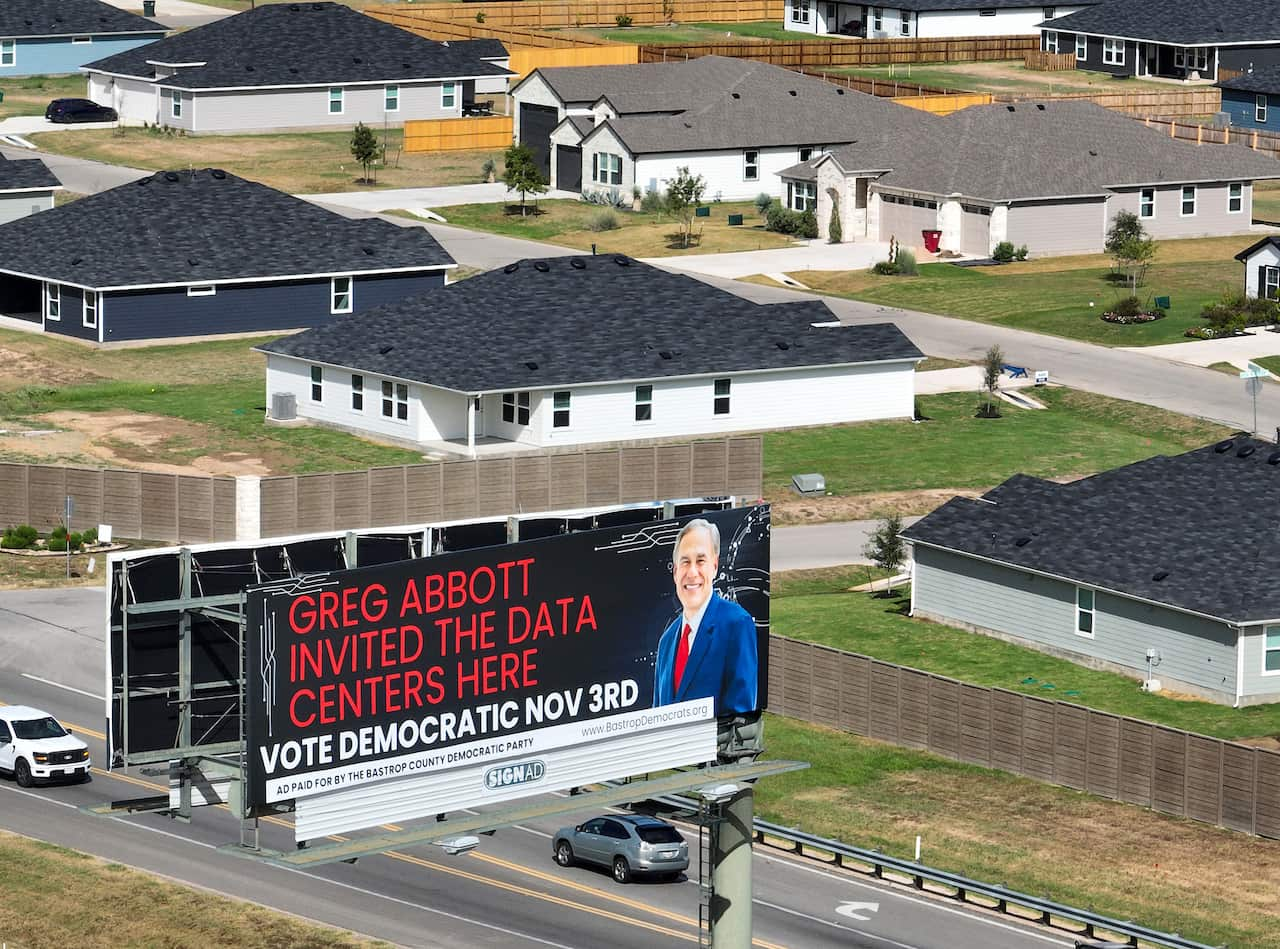 Democrats have invested significantly in attack ads targeting Republican incumbents over data centre development. Source: Getty / Austin American-Statesman/Hearst
Midterm elections typically swing against the party of the sitting president. With Trump’s approval rating under pressure amid the soaring cost of living and the war with Iran, Republicans were already facing a challenging electoral environment.
Chris Borick, professor of political science at Pennsylvania’s Lehigh University and director of its public opinion research lab, says the data centre debate could be the “new ingredient” that tips the balance against Republican incumbents in multiple closely contested congressional races, including several in Pennsylvania and Ohio.
He says he’s studied public opinion for decades, and he’s never seen an issue emerge so rapidly as a major concern for voters.
Nothing, in my mind, has an immediate comparison point to how data centres have evolved so quickly as a salient issue for voters across the country.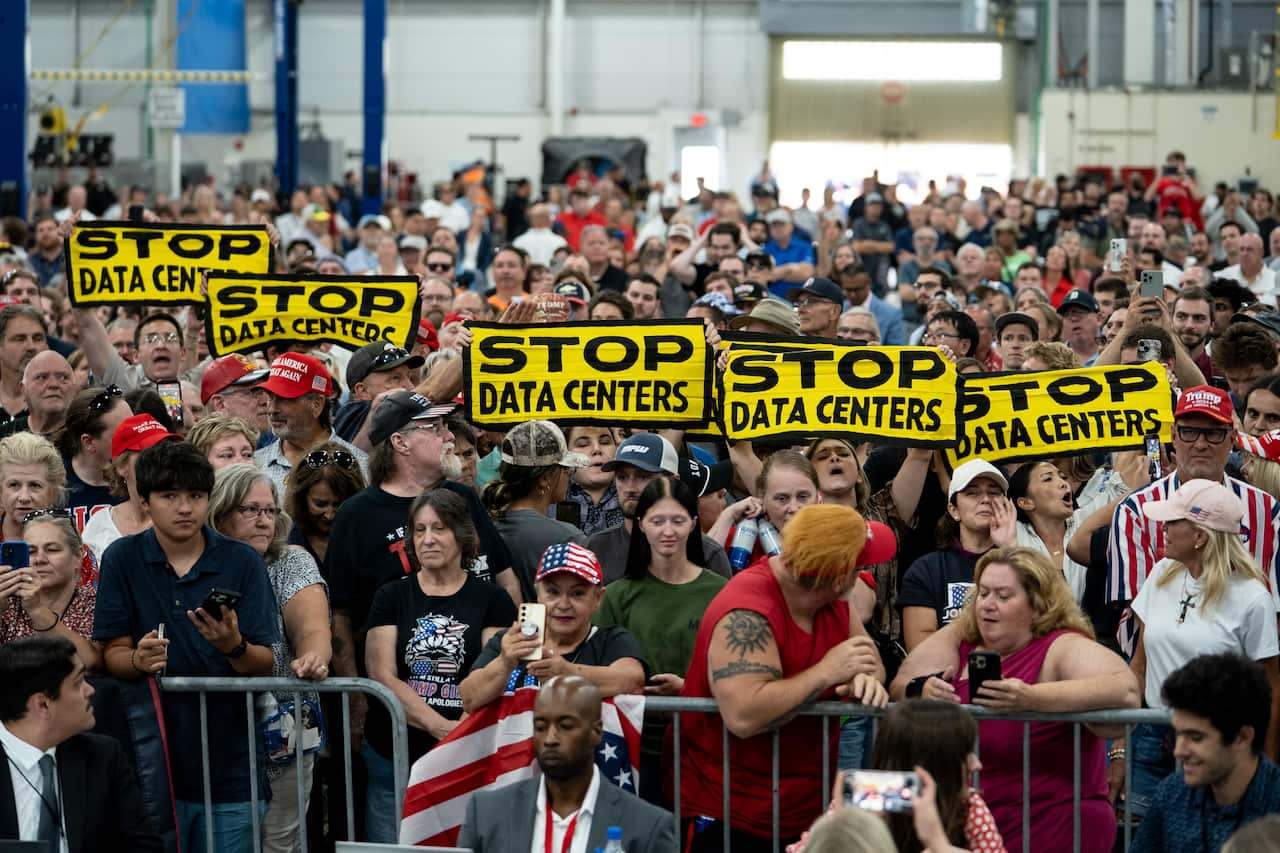 Protests against data centres, artificial intelligence and Big Tech are popping up across the United States. Source: Getty / Bloomberg
Earlier this month, The Economist published an analysis suggesting that opposition to data centres could even be shifting some of Trump’s loyal supporters towards the Democrats.
It found that 17 per cent of people living within 2km of a data centre who voted for Trump in 2024 now say they would support a Democrat, compared with just 6 per cent of Trump voters elsewhere.
“When there are races that are won on razor-thin margins, that shift is significant,” Borick tells SBS News.
An unlikely political unifier
Community backlash against data centres also ties into broader anxieties about AI, resource depletion, the potential loss of jobs, wealth disparities and the growing power of Big Tech.
David McCuan, professor of political science at California’s Sonoma State University, tells SBS News: “It does reflect a long-running trend of concerns about what we might broadly call ‘quality of life'”.
READ MORE
He says Big Tech has joined tobacco, the pharmaceutical industry and oil giants as “one of the big bad boogeymen of American politics”.
Those concerns are bringing voters from the opposite ends of the political spectrum into alignment, both locally and nationally, even when their broader political priorities differ.
In one of the most unusual examples, political adversaries Steve Bannon and US senator Bernie Sanders appeared at the same event last month to denounce tech billionaires and call for greater restrictions on AI.
READ MORE
Sanders, a left-wing independent, took the stage immediately after Bannon, a former chief strategist to Trump and a prominent right-wing podcaster, though the two offered different visions for resolving the issue.
Backlash against data centres is the “sole issue that unites both sides of the political spectrum” in this election, McCuan says.
[It] has really grabbed lightning in a bottle.
For the latest from SBS News, download our app and subscribe to our newsletter.