
The missing majority
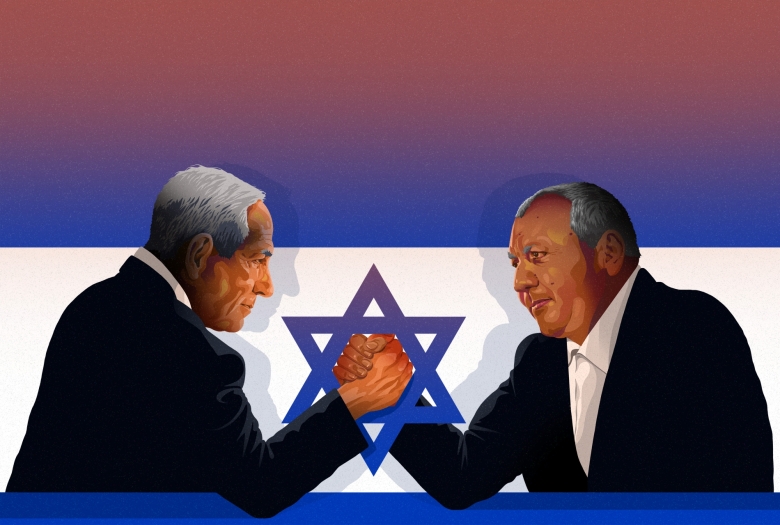
An unforgiving mathematical reality governs Israel’s national election. Under its nationwide proportional representation system, the entire country votes as a single district to fill the Knesset’s 120 seats.
The three main television polls published Friday give Netanyahu’s coalition 50 seats, 11 short of a majority. His opponents do better, but not by enough. The “change bloc” led by former army chief Gadi Eisenkot is projected at between 52 and 56 seats, still short of 61 in every survey. Polls have notoriously underestimated some votes, so a surprise is not out of the question. But those numbers mean something will have to give for one of the two sides to form a government.
On paper, 70 seats oppose Netanyahu. In practice, the opposition has promised not to count about a fifth of them. Three of the four opposition parties reject governing with Arab parties, and Avigdor Lieberman, a veteran politician and founder of the Yisrael Beiteinu party, rejects even their tacit support for a minority administration. He has also excluded the ultra-Orthodox parties, though Eisenkot has left room for a deal with them.
For their part, Arab parties are split over whether to join the government or support it from the outside. Mansour Abbas’ Ra’am party notoriously joined the short-lived Bennett-Lapid government in 2021, and some other parties have at times shown they could join Zionist opposition parties to stand against Netanyahu. But a partnership, even a discreet one, remains taboo and will likely give Netanyahu opportunities to fire across the opposition’s bow.
Brutal electoral math
Another key metric is the electoral threshold. To win, a party must clear a strict barrier: 3.25% of all valid votes cast. The consequences of this arithmetic are important. A faction that falls just a handful of votes shy of the line gets zero seats, discarding every ballot cast for it and raising the bar for rival coalitions to secure a 61-seat governing majority. This threshold trap creates an existential game of musical chairs, forcing fragmented parties to merge, sign tactical surplus-vote pacts, or withdraw entirely before election day.
In many ways, the Israeli political battle is as much a struggle between major parties and figures (Netanyahu vs Eisenkot) as it is a fight by smaller parties to survive brutal electoral math—with their fate potentially shaping the broader coalition chances for each side.
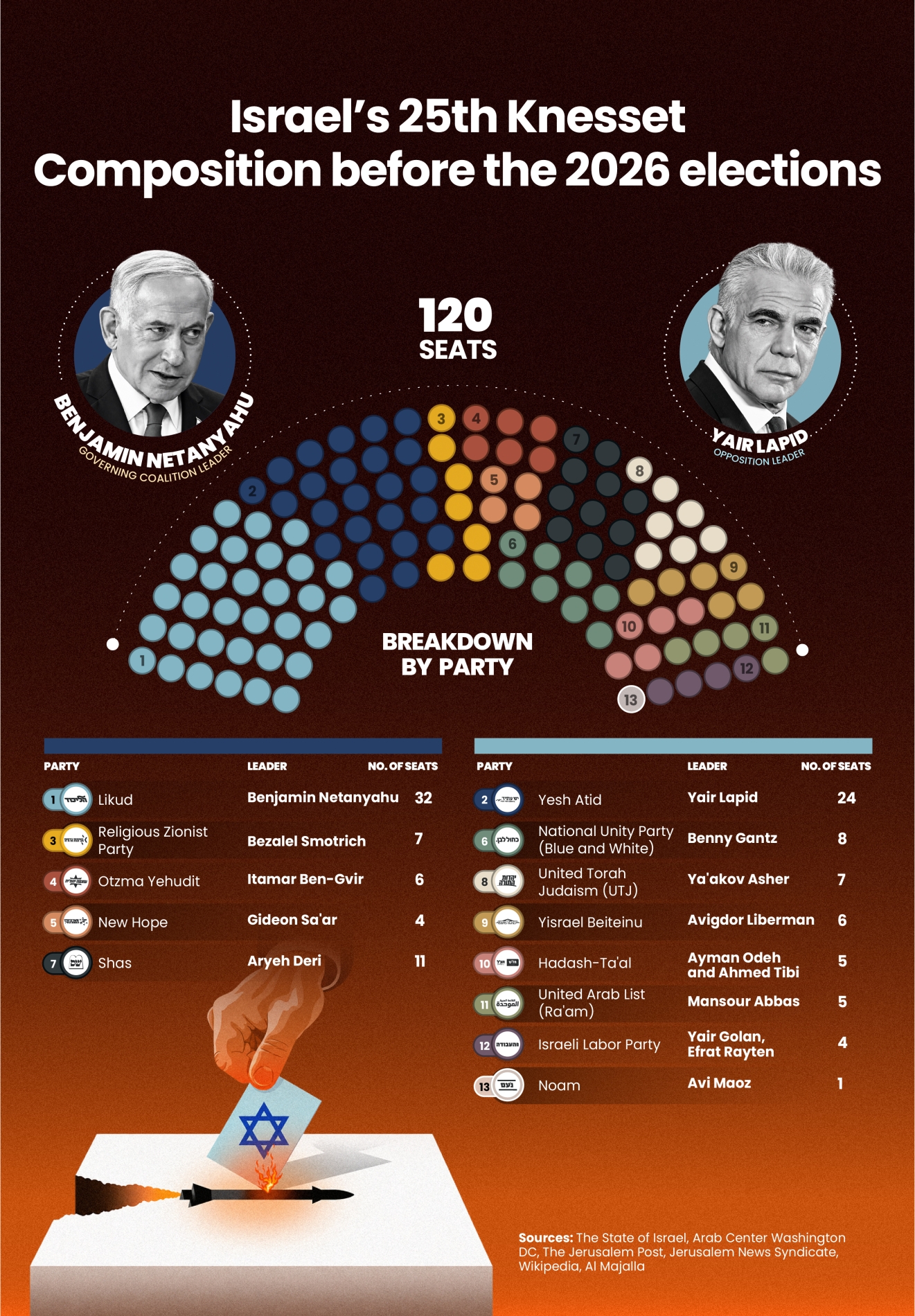
With these high-stakes mechanics, both camps have radically reshaped their ranks in the run-up to the 2026 election. Prime Minister Benjamin Netanyahu’s right-wing bloc anchored itself around a broadened Likud, reinforced by absorbing Gideon Sa’ar’s faction to expand its parliamentary base. Alongside Likud stand its traditional Ultra-Orthodox partners—Shas and United Torah Judaism—and a nationalist flank led by Itamar Ben-Gvir’s Otzma Yehudit and Bezalel Smotrich’s Religious Zionist Party. Netanyahu may hope those far-right parties have an untapped reserve of supporters not reflected in the polls.
Yet coalition unity remains fragile. Fearing that split far-right slates could fall below the cutoff and squander crucial ballots, Netanyahu pushed aggressively to engineer a pre-election merger between Ben-Gvir and Smotrich. Ben-Gvir flatly refused, wagering his faction’s independent momentum against the risk of electoral oblivion.
Across the aisle, the anti-Netanyahu camp undertook historic mergers to prevent vote wastage and mount a unified challenge. The centrepiece of this effort is a joint ticket headed by former Prime Minister Naftali Bennett and Yesh Atid leader Yair Lapid, who pooled their political capital on a shared slate. Notably, Bennet has been spearheading the campaign, while Lapid is (likely deliberately) taking a back seat, as the party likely seeks to attract right-wing voters disappointed with Netanyahu.
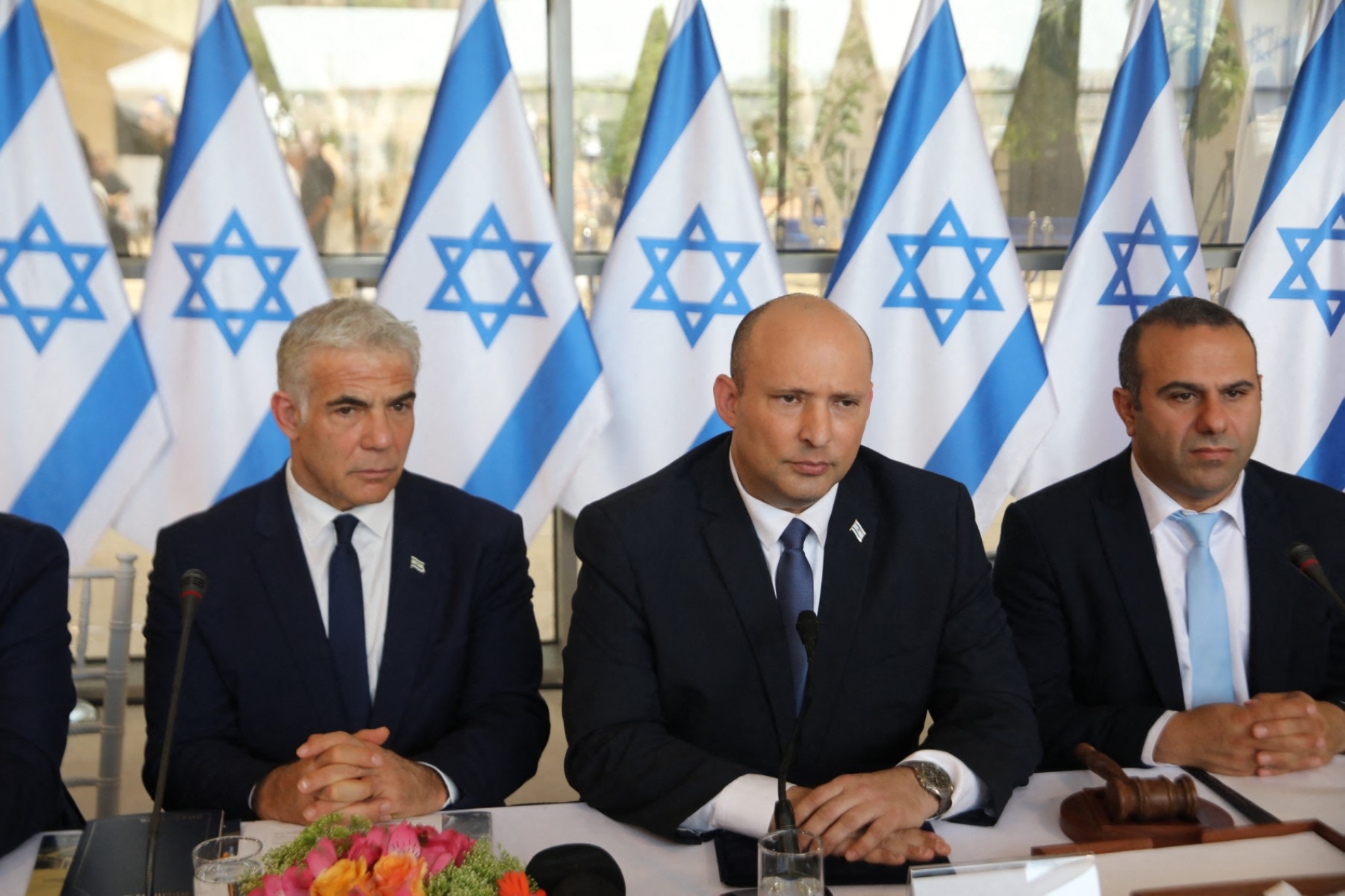 Israeli Foreign Minister Yair Lapid, Prime Minister Naftali Bennett, and Cabinet Secretary Shalom Shlomo attend a weekly cabinet meeting in Jerusalem on 29 May 2022.
On the Zionist left, the historically fragmented Labour and Meretz parties joined forces under Yair Golan to launch The Democrats. This revitalised left-wing union gave historic parties a new coat of paint.
Elsewhere, former military chief Gadi Eisenkot launched his own reform-minded list, while Lieberman maintained his secular-nationalist bastion. The harsh calculus of the threshold claimed its highest-profile casualty when Benny Gantz abruptly pulled his party from the ballot after merger talks foundered, bringing a dramatic close to his electoral efforts and showing how unpredictable Israeli politics are—a few years ago Gantz was a rising star; now he is no longer on the electoral map. To prevent cannibalising one another’s support, the five major opposition leaders signed a rare non-aggression pact, pledging to halt cross-party attacks and coordinate joint turnout operations.
Arab representation navigated intense legal drama before reaching the ballot. The Central Elections Committee initially disqualified both Mansour Abbas’s pragmatic Islamist faction, Ra’am, and a reunited Joint List. In a familiar institutional showdown, the Supreme Court unanimously overturned the bans, allowing both slates to mobilise their constituencies.
Underneath the tactical realignments lies a quiet generational transition. Longtime fixtures across the spectrum—including Gantz, former Knesset Speaker Yuli Edelstein, veteran Arab lawmaker Ayman Odeh, and ousted Ultra-Orthodox faction chiefs—have stepped aside or been pushed out.
Israel enters election day with two heavily fortified political blocs, each engineered to the decimal point to survive the electoral threshold. Yet this rigid math now collides with an exceptionally volatile campaign environment marked by technological disruption and pervasive security threats.