
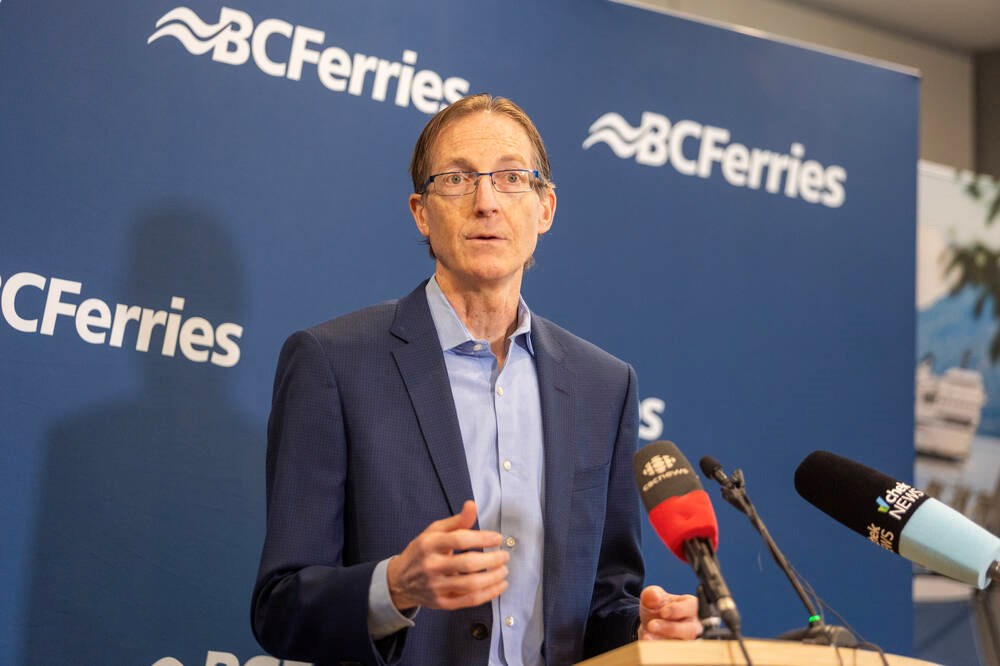
Jimenez’s ouster was announced in a statement by B.C. Ferries board chair Cathy McLay.
Nicolas Jimenez is out as CEO of B.C. Ferries in a sudden “leadership transition” initiated by the B.C. Ferries board on Tuesday.
Jimenez’s ouster was announced in a statement by board chair Cathy McLay.
Brian Anderson, the ferry company’s vice president of strategy and planning, has been appointed interim CEO.
Dallyn Willis, the company’s executive vice-president and chief financial officer, will assume Anderson’s responsibilities.
McLay said Willis will also lead a review of B.C. Ferries to “address growing demands on the system and deliver safe, reliable services for customers and coastal communities.”
No reason for Jimenez’s departure was given.
“The Board thanks outgoing CEO Nicolas Jimenez for his contributions to BC Ferries and wishes him success in his future endeavours,” said McLay.
Jimenez took on the top job at B.C. Ferries in 2023 after spending nearly two decades in senior roles at ICBC, most recently as CEO.
Jimenez became ICBC’s CEO in 2018, the same year that David Eby — then serving as B.C.’s attorney general under John Horgan — promised major reforms at that organization.
He became CEO of B.C. Ferries after Mark Collins was ousted from the position shortly after former NDP cabinet minister Joy MacPhail was appointed chair of B.C. Ferries’ board.
Eric McNeely, president of the B.C. Ferry and Marine Workers’ Union, said he’s “cautiously optimistic” that Jimenez’s departure could mean more change in the company’s upper management and a more stable workforce.
About 4,500 unionized workers at B.C. Ferries have gone about a year without a collective agreement, he said. “Maybe this will bring some labour peace to a system that is challenged with decisions that have been made.”
McNeely said “the timeline was a bit of a surprise,” but the union had anticipated Jimenez’s departure for some time, and that a review of B.C. Ferries was on the horizon.
Under Jimenez, the company embarked on procuring a new fleet of major vessels that will be built by a Chinese shipyard, a decision that drew criticism from provincial and national politicians.
Jimenez defended the decision at the time, saying the state-run shipyard in China’s Shandong province was selected after a global procurement process and his main focus was to get a good deal.
The cost of the vessels has not been disclosed by B.C. Ferries over concerns that it could compromise its ability to get good deals on future procurement.
B.C. Ferries has not been a Crown corporation since 2003, but receives major funding from the province. The company’s sole voting shareholder is the B.C. Ferry Authority. Four of the authority’s nine directors are provincial appointments, with the rest being a mix of local government and union representatives.