
 (Photo illustration by Bill Kuchman/The Bulwark | Photos: Getty, Shutterstock)
While it might feel to you as though this year’s midterm elections sneaked up on us, a handful of House Democrats have been preparing for this moment for years. One of the upshots of January 6th and the related attempts to disrupt the certification of Joe Biden’s 2020 presidential win was that congressional Democrats realized they could no longer count on American elections going smoothly. As a result, there is now significant infrastructure to track and respond to election disputes as they arise. Democrats are just hoping that they’re not missing anything.
Multiple lawmakers have expressed concern about the upcoming vote and tried to fortify what they see as vulnerabilities.
“The Department of Justice has been anything other than a bulwark. They’ve been an aggressor, and they continue to try to disrupt and throw, frankly, spaghetti at the wall,” said Rep. Joe Morelle (D-N.Y.). “But I think we’re prepared. I know we’re prepared, and we’re observing and watching every move they make.”
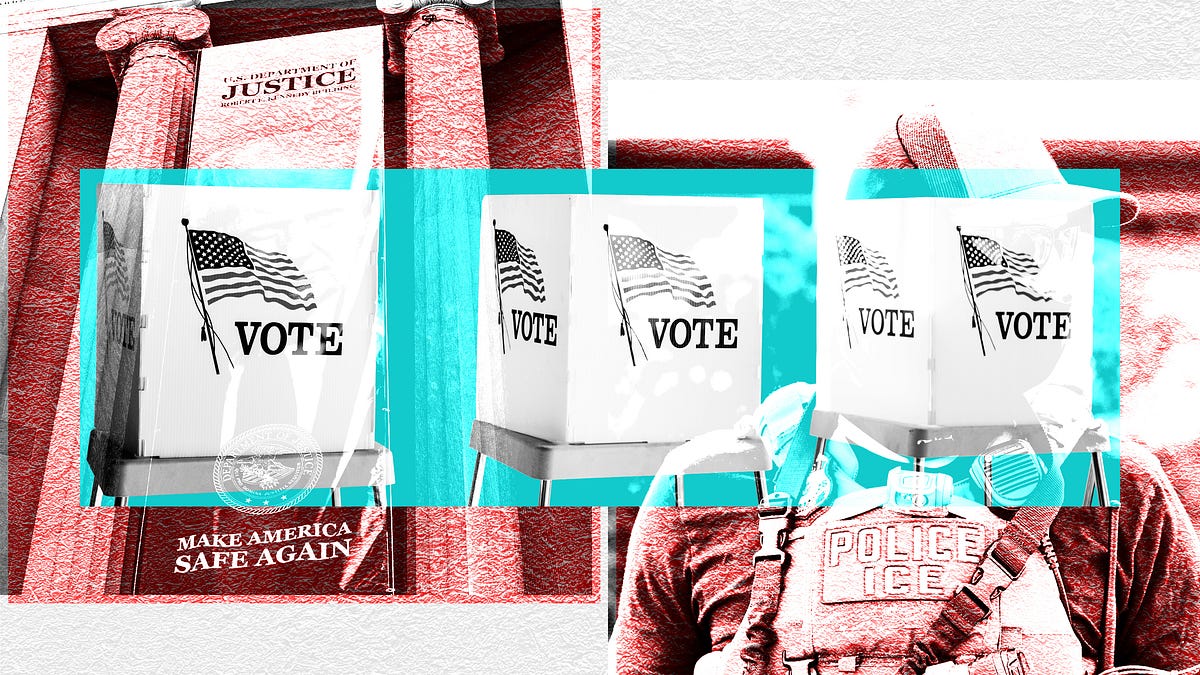
During the past year, the administration has sought to restrict mail-in voting, mused about deploying ICE agents and other federal law enforcement officers to polling locations, and much else. The expected flurry of lawsuits and election challenges is keeping Democrats and local officials up at night.
As I noted last week, Marc Elias, a Democratic election lawyer deeply involved in the party’s planning process to respond to disputes, said he’s expecting the Trump administration to use the same kind of flood-the-zone strategy that the president and his allies used after losing the 2020 election. “Those will be defeated,” Elias said.
Democrats are already working to preempt these anticipated maneuvers, which will put them in a better position to deal with other, less-predictable challenges that might come up on or after Election Day. Trained congressional staffers are being sent to races where Republicans or rogue election officials might try to contest unfavorable results. They are primarily going to serve as observers, taking contemporaneous notes and recording witness accounts that could become useful in court if results are disputed. While Democrats have enlisted nearly three hundred staffers for these roles, where they are ultimately sent will depend on which races have the most problems.
“I think it’ll be an expanded list beyond what we would typically do,” said a senior Democratic staffer on the House Administration Committee. “We could be somewhere between sixty or seventy districts.”
Morelle, who is the ranking Democrat on the House Administration Committee, repeatedly expressed confidence in his team’s ability to prevail over anything the administration throws their way. Over the summer and into the fall, Morelle has led shadow hearings to examine readiness efforts and take stock of resources in high-pressure districts across the United States.
But lawmakers are also feeling a bit nervy about the possibility that the federal government will use intimidation tactics at polling sites and ballot drop-off locations for mail-in voting. And they’re not thinking only about whether ICE agents will show up at polling stations.
Rep. Mark Takano (D-Calif.) told reporters that “ICE being deployed and even visible, even if it’s outside of the 200-foot perimeter” of a polling precinct or high-traffic ballot drop-off location, could intimidate key voter demographics.
“There’s some credible fear among American citizens who may be of Latino descent, who may be of Asian descent,” Takano said. “People might have legitimate fears that they could be apprehended by ICE.”
While voting is underway in many states, the Trump administration has already started to meddle, filing a lawsuit in the Alaska Senate race arguing that voters might not understand the difference between the two Dan Sullivans.
That’s the argument of a lawsuit filed by the Justice Department, contending that Alaska should delay the certification of its results in the event that incumbent Republican Sen. Dan Sullivan loses the race to Democratic challenger Mary Peltola by a margin less than or equal to the number of votes received by the other Dan Sullivan. A federal judge fast-tracked the suit, which the DSCC and Peltola campaign supported; it could be dismissed later this week.
Beyond House Democrats’ official efforts to prevent midterms meddling, Democrat-aligned groups like Indivisible are gathering names to mobilize election observers and protesters in key states in case of shenanigans.
While public polling generally indicates Democrats will perform well next week, a blue wave is not a sure thing. Regardless, there are widespread feelings among Dems that major blue victories are imminent, and most Democrats in Congress believe the president and his supporters are reacting to that narrative by preparing to fight to prevent it, however they can, from becoming reality.
Over the past week, Press Pass has done some revealing reporting on the super PAC formerly known as “Democrats for Mike Rogers.” Our most salient finding is that the organization is not actually made up of Democrats; it’s instead an astroturf operation funded by GOP megadonors and contracting for services from MAGA-connected firms.
On Saturday, the group attempted to definitively show that they are a grassroots operation after all by hosting a get-out-the-vote rally in Detroit. The event featured a rap performance, free food, and a bounce house. Could an astroturf organization do *this*?, they practically dared reporters to ask.
The answer to that question is, Yes. A source passed along pictures of the turnout at this rally/concert/bounce house event, and I in turn am passing them along to you.



I guess the “Democrats for Mike Rogers” were all just out of frame, laughing too.
Yesterday marked fifty-nine years since former Sen. John McCain’s (R-Ariz.) A-4 Skyhawk crashed over Hanoi, Vietnam. North Vietnamese forces captured him there and tortured him for more than five years.
McCain’s story and his refusal to break despite years of abuse are likely familiar to Press Pass readers, but my favorite account of it can be found in this famous profile of McCain written during the 2000 presidential campaign by David Foster Wallace.
After detailing McCain’s cinematically terrifying descent into a lake, his capture, and the beatings that followed, Wallace prompted readers to think hard about how they might act if, like McCain—the son and grandson of four-star admirals—they were offered the opportunity to return home early in the place of POWs captured before him. In DFW’s vintage style, it’s both serious and hilarious.
Imagine how loudly your most basic, primal self-interest would have cried out to you in that moment, and all the ways you could rationalize accepting the offer. Can you hear it? If so, would you have refused to go? You simply can’t know for sure. None of us can. It’s hard even to imagine the pain and fear in that moment, much less know how you’d react.
But, see, we do know how this man reacted. That he chose to spend four more years there, in a dark box, alone, tapping code on the walls to the others, rather than violate a Code. Maybe he was nuts. But the point is that with McCain it feels like we know, for a proven fact, that he’s capable of devotion to something other, more, than his own self-interest. So that when he says the line in speeches in early February you can feel like maybe it isn’t just more candidate bullshit, that with this guy it’s maybe the truth. Or maybe both the truth and bullshit: the guy does – did – want your vote, after all.
Read the whole campaign trail dispatch from 2000 at Rolling Stone. It’s a long one, so I recommend printing it out for a more comfortable read. (You can also read this story in the pages of Wallace’s essay collection Consider the Lobster, which is worth having on your shelf but can also be found in virtually any American public library.)