
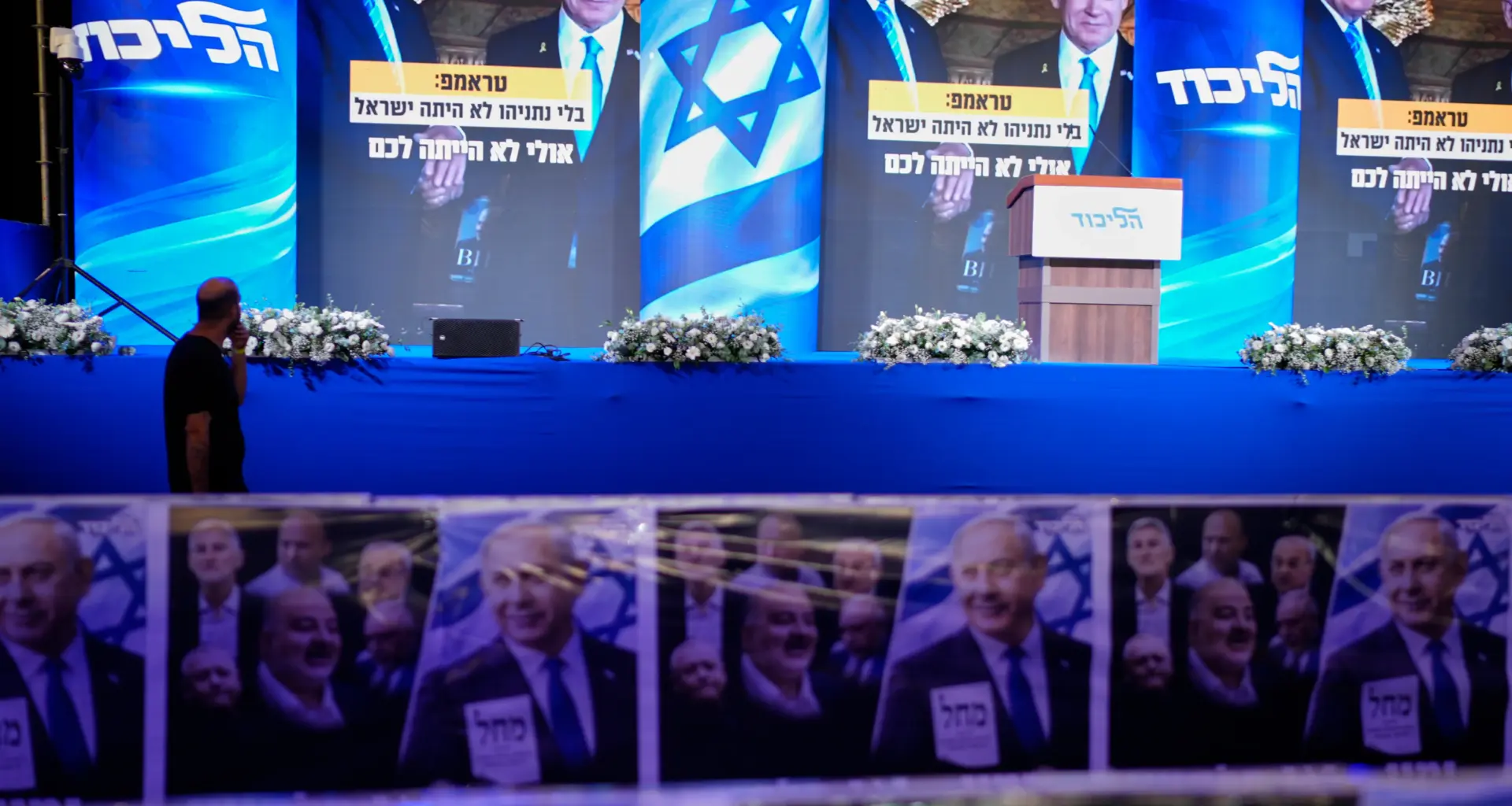
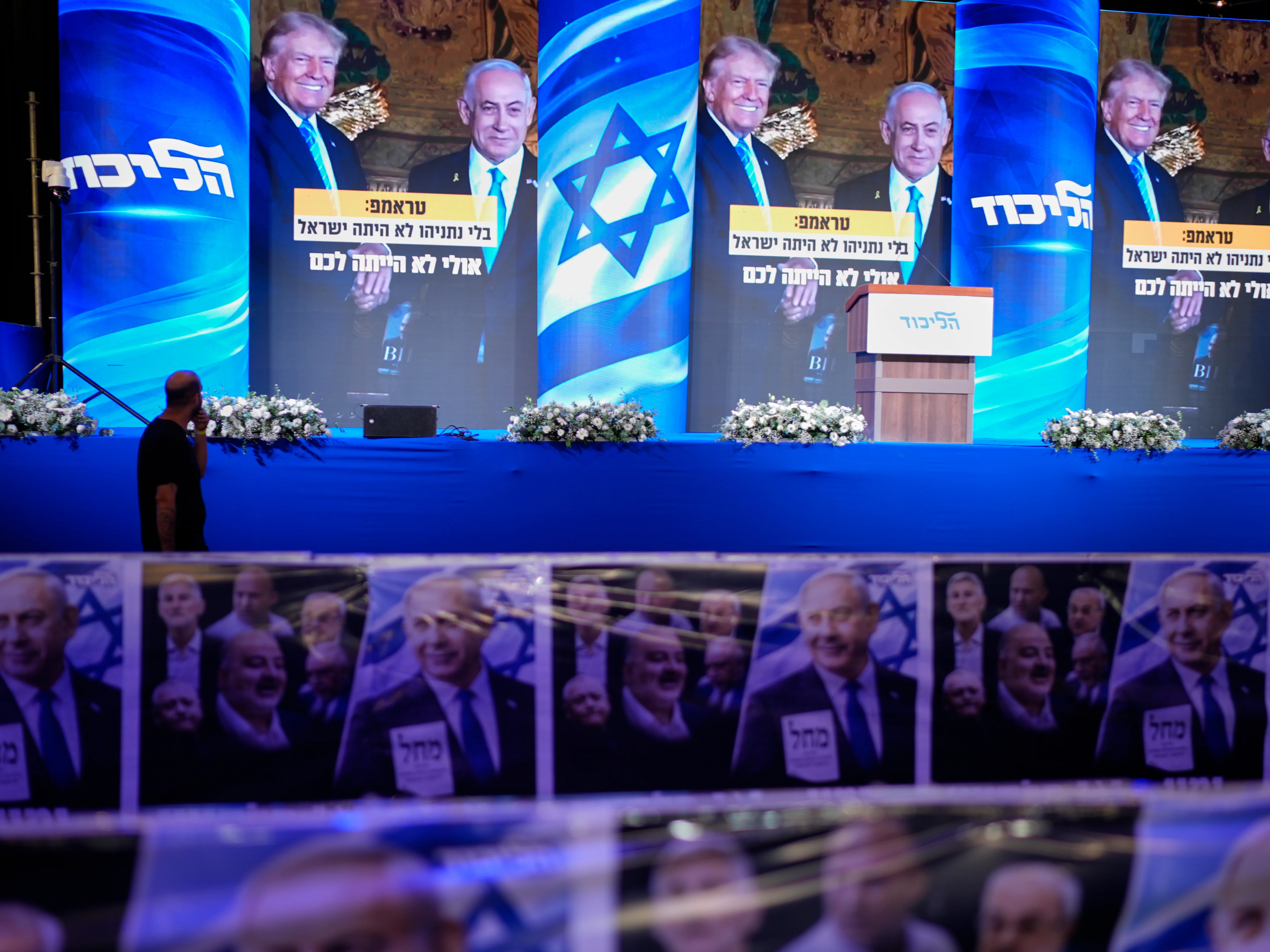
A video wall displays images of Benjamin Netanyahu with President Trump at a Likud party event before the release of the first exit poll results in Israel’s general election, in Jerusalem, on Tuesday. Image: David Goldman/AP
Israel’s voter turnout soars as Netanyahu faces a tight election
Israeli voters turned out in their highest numbers in more than two decades in a tense national election on Tuesday to decide whether to stick with Prime Minister Benjamin Netanyahu and his far-right coalition or change course.
Netanyahu was in a tight race with his top rival, Gadi Eisenkot, a center-right former military chief of staff, as exit polls appeared to swing slightly in one and then the other candidate’s favor.
Still, the final vote tallies may take some time. And even when they’re complete, if no bloc wins a majority, it could take days or weeks to decide who will be Israel’s next prime minister, as party leaders try to assemble a governing coalition.
Israelis consider this one of their most consequential votes in history — the first parliamentary election since the October 2023 Hamas-led attack and the start of the wars in Gaza and elsewhere in the Middle East.
Highest turnout in 27 years
The Central Elections Committee said 77.7% of voters cast ballots as of 10 p.m. — calling it the highest turnout since 1999.
Enthusiasm was high among voters seeking to replace Netanyahu, Israel’s longest-serving prime minister, with almost two decades in office across multiple tenures.
“ Important is an underestimation, because it’s much more than important. It’s crucial,” voter Naama Aaronsohn said of the election. “I’m worried. … What’s going to become of our country if there’s not a major change?”
Another voter, Itamar Ariel, cast his ballot for Netanyahu. He said there are problems in Israel but no one can replace him. It’s a matter of security for Israel.
But many Israelis question Netanyahu’s ability to keep them safe after the deadly Oct. 7, 2023, attack. They have been reeling from reports that the government had repeated warnings from countries in the region that Hamas was planning a major assault on Israel.
Israel’s subsequent wars in Gaza and the region, and its policies in the occupied West Bank, have badly strained its relations with many international governments, and public support for Israel in the United States has plummeted, worrying many Israeli voters.
Citizens in majority-Arab areas also took the opportunity to make their voices heard.
“This government it’s not good for us and … not good for anyone,” said Nur Abu Na, a 30-year-old nurse. There are two predominantly Arab blocs in the elections.
Netanyahu voiced alarm throughout the day, in multiple social media posts, alerting followers to the high number of Arab citizens of Israel who were voting. He urged his right-wing supporters to get out and vote too.
“Good outcome for Eisenkot” but too soon to tell
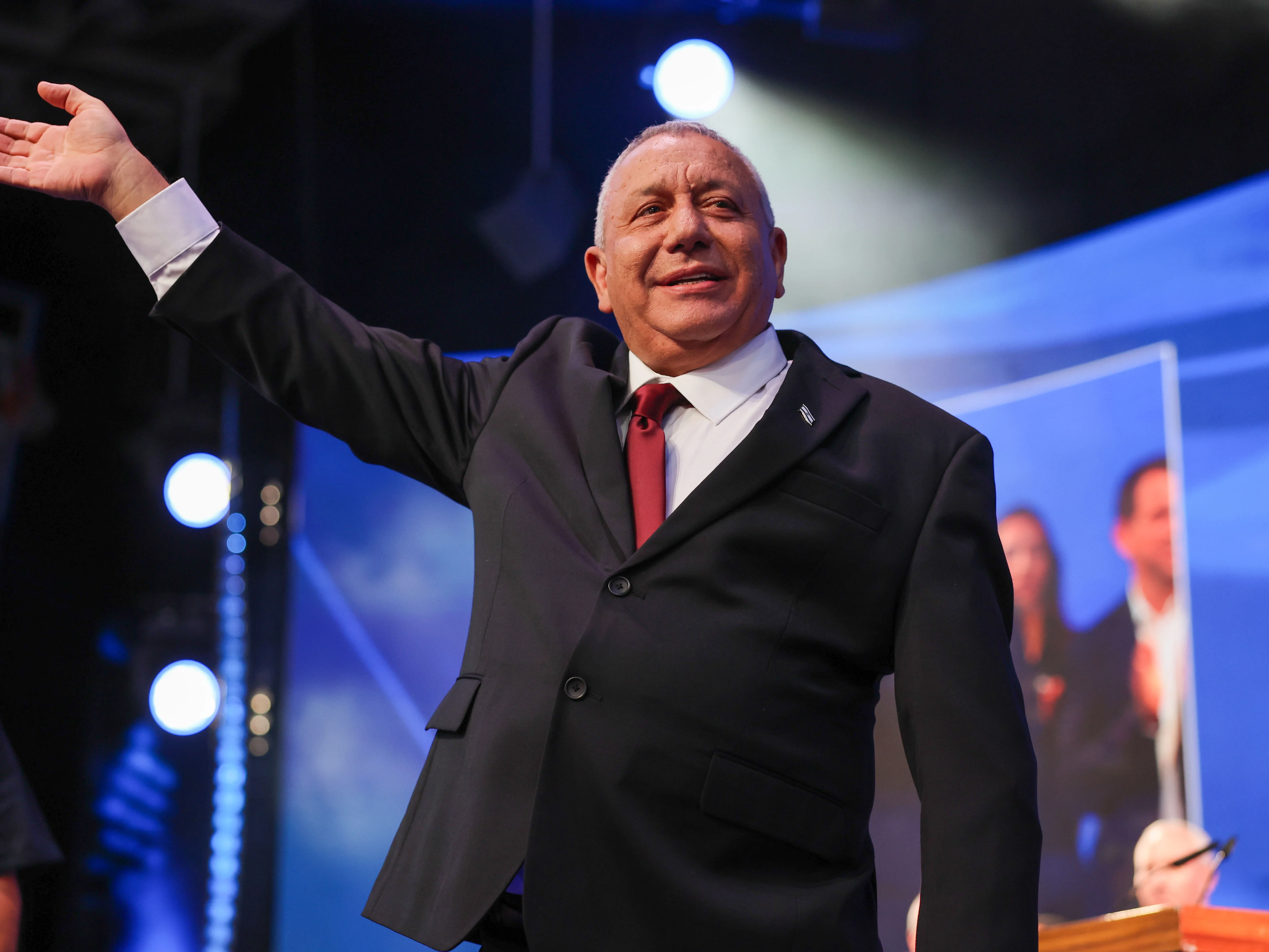
Gadi Eisenkot, leader of Yashar party and former military chief of staff, delivers a speech at the party headquarters in Tel Aviv, Israel, following the release of exit polls after Tuesday’s election. Image: Nir Keidar/Anadolu via Getty Images
The early exit polls suggested Netanyahu’s Likud Party won the most seats, with Eisenkot’s Yashar party coming second. No party won a majority in the 120-seat parliament, known as the Knesset.
The final results will depend on the math and negotiations among broader alliances.
Opposition leaders quickly reacted to the preliminary results, saying they suggested voters dealt a blow to Netanyahu’s coalition.
Shira Efron, an Israeli policy analyst at the Rand Corp. think tank, told NPR it was a “very good outcome for Eisenkot” and his recently formed party.
At an election party in Tel Aviv, Eisenkot’s supporters cheered as the first exit polls were announced after voting closed at 10 p.m. local time.
“”We made history! The public has voted for change,” Eisenkot said in a speech.
But votes will continue to be counted on Wednesday, and the electoral map could shift. Eisenkot’s bloc could lose, or have difficult political negotiations ahead if he is chosen to form a government.
“I’m anxious. Listen, the results are good, but they’re complex. It takes time before we have a full picture,” said opposition supporter Ophelie Namiech.
Netanyahu supporters hold out hope
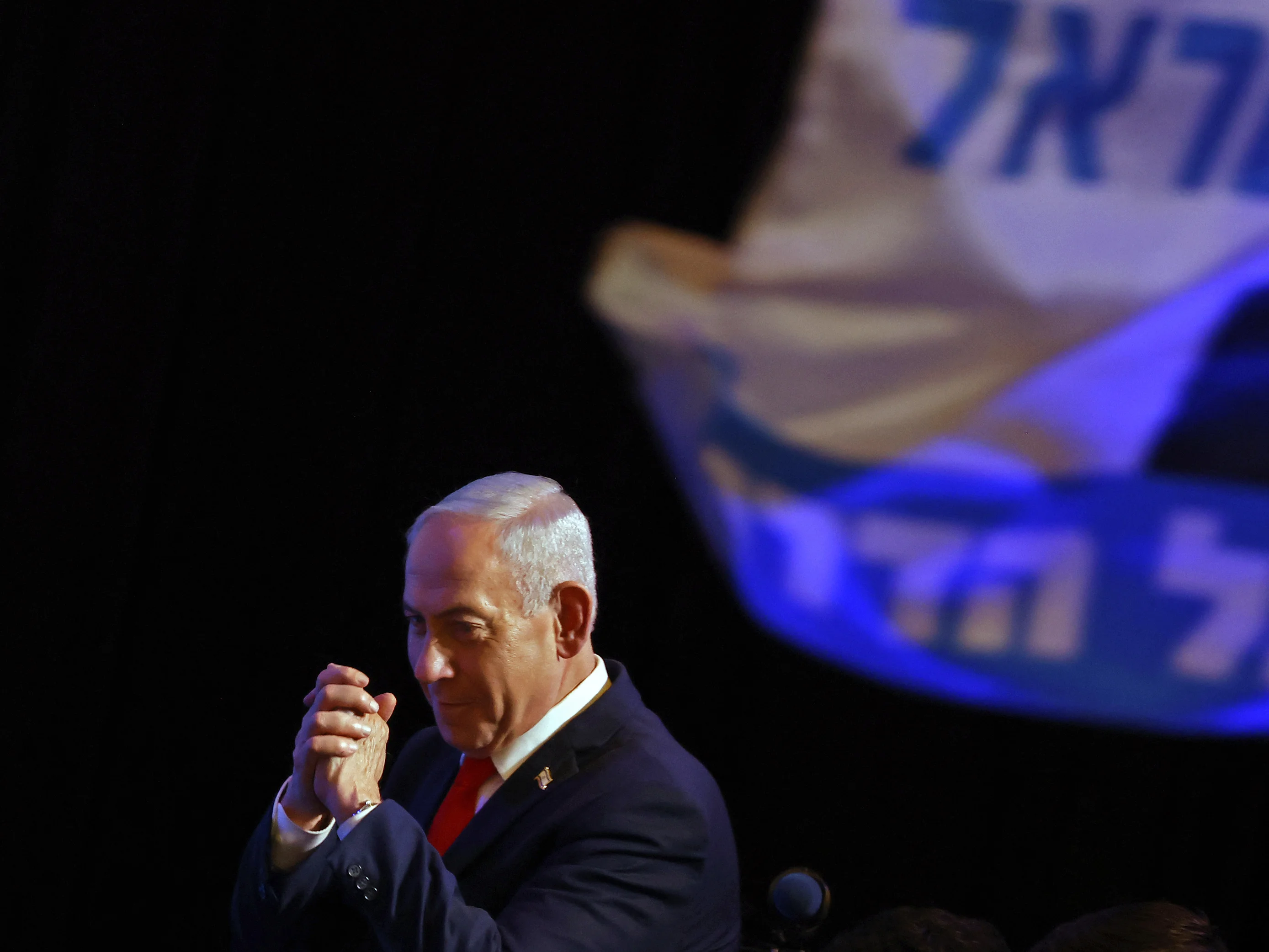
Israeli Prime Minister Benjamin Netanyahu gestures to his supporters at the election night rally after the first exit polls were announced Tuesday, in Jerusalem. Image: Jalaa Marey/AFP via Getty Images
At the Likud election night party in Jerusalem, giant screens played Hollywood-style videos of soldiers marching, airstrikes blowing up buildings and other destruction. Some clips appeared to show massive explosions of villages in Lebanon, where Israeli destruction of civilian infrastructure has drawn condemnation from human rights groups as potential war crimes, which Netanyahu’s government denies.
The videos also repeatedly showed President Trump shaking hands with and endorsing Netanyahu. The two leaders plan to potentially launch major attacks against Iran after the Israeli and U.S. midterm elections. Trump urged Israeli voters to reelect Netanyahu to “finish the job that we started.”
Netanyahu’s supporters were confident that their candidate, a master political survivor, would pull through.
“ I’ve been here many times at different campaigns where at the first hour, that’s what the exit polls show, and then you wait a little bit. And Prime Minister Netanyahu has had a knack of getting over the top when he needed it,” said Netanyahu supporter Elie Pieprz.
He said in the end, he believes that Israelis will stand by their current leadership at a time of war.
“Right now we’re in a war … as unattractive as that may be to sound internationally, that’s the reality,” he said. “I think it is much more likely that they [Israeli voters] will understand that Prime Minister Netanyahu needs to lead this war against Iran, particularly with President Trump, and will come together because they, we need to have a certain amount of unity.”
In the early hours of Wednesday, Netanyahu addressed supporters at the event. “Israel faces a singular historical opportunity, together with our partner President Trump, to remove the existential threat of Iran once and for all,” he said.
Netanyahu celebrated that Likud was voted to be the largest party in the Knesset, and said the party awaited final results, but vowed to form “a strong right-wing, national government.”
Daniel Estrin reported from Tel Aviv, Israel. Ruth Sherlock reported from Jerusalem. Samantha Balaban, Itay Stern, Shir David and Alon Avital contributed reporting in Israel.
Audio transcript
JUANA SUMMERS, HOST:
Voting in Israel has ended, and exit polls suggest most Israelis have voted against Prime Minister Benjamin Netanyahu. But the center-right opposition may struggle to build a governing coalition. Many Israelis have said this election is the most important in their history, and turnout has been the highest in decades. Two NPR correspondents join us now from Israel to help us make sense of the results and what we’ve heard so far. NPR’s Ruth Sherlock is in Jerusalem, and NPR’s Daniel Estrin is in Tel Aviv. Hi to both of you.
DANIEL ESTRIN, BYLINE: Hi, Juana.
RUTH SHERLOCK, BYLINE: Hi.
SUMMERS: Daniel, I want to start with you. I understand that you’re at a gathering of the main opposition party. Help us make sense of these initial exit polls.
ESTRIN: Yeah, all the main exit polls so far have the opposition bloc of center-right parties as the biggest bloc. This is a bloc led by Gadi Eisenkot. He is the former military chief of staff. And this bloc of parties is slightly ahead of Netanyahu’s bloc. He leads a group of far-right, ultrareligious parties. So this is very promising news for Eisenkot and his supporters. I want to play for you a little bit of what it sounded like at his campaign headquarters here when the initial exit polls were announced.
UNIDENTIFIED PEOPLE: (Chanting in non-English language).
ESTRIN: So his supporters there are chanting, “he is the next prime minister.” And Eisenkot said in a statement after the initial exit polls that they point to, quote, “a complete distrust in Netanyahu and the government of October 7.” That’s a reference to the Hamas attack three years ago. But the race is not over yet. We could see the map shift as votes are counted throughout the night. And I spoke with one activist with Eisenkot’s party, Ofili Namiash, and here’s how she put it.
OFILI NAMIASH: I’m anxious. Listen, the results are good. But they’re complex. It takes time before we have a full picture.
ESTRIN: But it is certainly a very, very confident mood here at the main opposition party gathering.
SUMMERS: Ruth, over to you now. I know you’re at Netanyahu’s election night headquarters in Jerusalem. What are you seeing and hearing?
SHERLOCK: Well, Netanyahu’s supporters certainly aren’t giving up yet. You know, he is Israel’s longest-serving prime minister, and people here say there are still many votes to be counted. Here’s Netanyahu supporter Elie Pieprz.
ELIE PIEPRZ: I’ve been here many times at different campaigns where at the first hour, that’s what the exit polls show, and then you wait a little bit, and Prime Minister Netanyahu (ph) has had a knack of getting over the top when he needed it.
SHERLOCK: This political survival is part of Netanyahu’s story after the October 7 attacks. Few in Israel thought he’d remain in power because of questions over the security failures that led to Israel’s deadliest day. But he managed to keep his far-right coalition together, and he responded, of course, with the devastating war in Gaza and the conflicts in Lebanon and Iran. And in this election, he’s run on this idea that these wars show he’s the only leader with the mettle to keep Israelis safe. He got a last-minute endorsement from President Trump, and now his supporters here say they want to see a broad coalition government, one possibly with Eisenkot in it, but with Netanyahu at the helm.
SUMMERS: I mean, it’s still really early. It’s too early, in fact, to call the election. But, Daniel, when might we have a clearer sense of who has won?
ESTRIN: It’s going to take all night for votes to be counted. By tomorrow morning, local time, the vast majority of the votes will have been counted. And so, one thing to look for is whether two small right-wing parties get enough votes to make it into the Parliament. That could actually shift the map and not in Eisenkot’s favor. Another thing to look out for is Israeli soldiers’ votes. They have been casting ballots in territories where they’re serving – in Gaza, in Lebanon, in Syria. So as those votes continue to be counted for several days, that could also tip the scales in this race.
But the main thing to look at now is if Eisenkot, the center-right opposition leader, manages to get the opportunity from Israel’s president and is tasked to start negotiating with other parties to try to form a coalition government, the big question is – will he turn to Arab-led parties? Those parties had a very strong finishing in this election so far, according to the exit polls. And yet his right-wing allies, Eisenkot’s camp, has been very resistant to rely on Arab-led parties for political support. So we’re going to have to see if they make any kind of deal in order to form a coalition government. We could see many surprises here, Juana. One potential option could be some power-sharing deal, as Ruth mentions. There could even be a stalemate and a repeat election next year.
SUMMERS: Wow. OK, so as we watch and wait for the final results, remind us about the stakes of this moment. No matter how this election goes, what might it mean for the region, as well as for those of us here in the U.S., Ruth?
SHERLOCK: Well, look, this election has very clear and obvious stakes when it comes to a potential resumption of the war in Iran. Netanyahu has campaigned on a promise to “finish the job” – that’s a quote, direct quote – in Iran, if he’s reelected, and Trump has also suggested this could happen. And there are, of course, you know, big questions about how this changes lives for Palestinians. None of the leading parties here say they believe in a two-state solution with Palestinians. Eisenkot has promised a clampdown of settler violence in the occupied West Bank, but, you know, he says soldiers will continue to remain in Gaza, that Hamas has to be defeated and that they will remain in Lebanon for the foreseeable future. So this election, the other thing to consider here is that it does have a major significance for Israel’s relations with the U.S. in this region and the world. You know, many are hoping Eisenkot will strike a more conciliatory tone to try to end Israel’s global isolation that the war in Gaza has really brought about.
SUMMERS: NPR’s Ruth Sherlock in Jerusalem and NPR’s Daniel Estrin in Tel Aviv, thanks to both of you.
SHERLOCK: Thank you so much (ph).
ESTRIN: Thank you, (inaudible).