
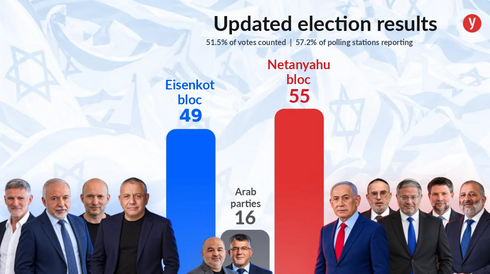
Prime Minister Benjamin Netanyahu’s political bloc lost a seat in Israel’s latest election count Wednesday morning, as the predominantly Arab Joint List gained ground at the expense of far-right National Security Minister Itamar Ben-Gvir’s Otzma Yehudit party. The shift left Netanyahu’s bloc with 55 projected seats, further from the 61-seat majority required to form a government.
With 51.5% of votes counted and results received from 57.2% of polling stations, the bloc led by former military chief Gadi Eisenkot stood at 49 seats, while the two Arab parties held a combined 16. Neither of the two main political camps had secured a majority in the 120-member Knesset, and the preliminary figures continued to change as additional ballots were processed.
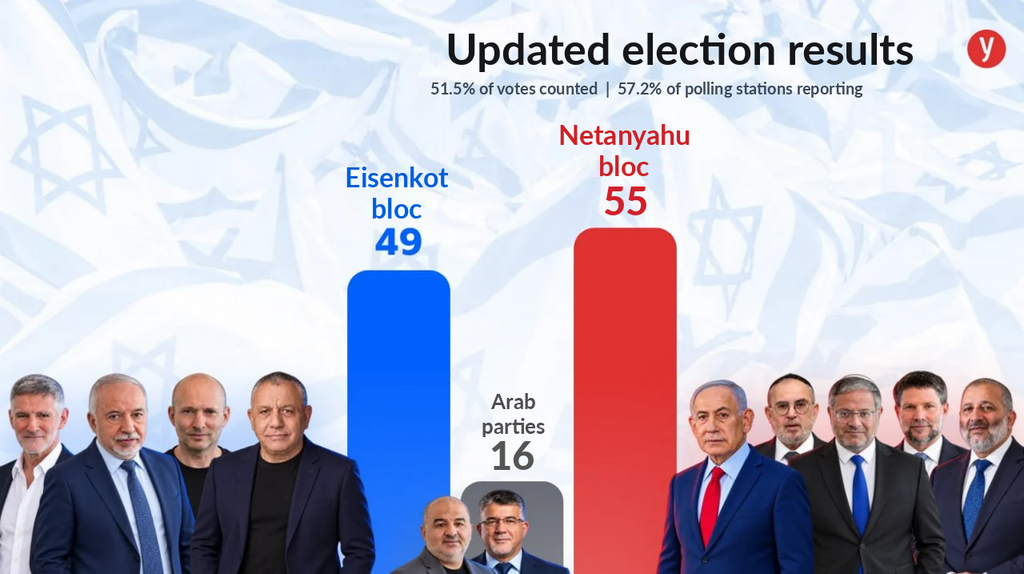
Likud remained the largest party with 27 projected seats, followed by Eisenkot’s Yashar! with 21. The Joint List rose to 12 seats, while former Prime Minister Naftali Bennett’s Beyachad party stood at 11. The Democrats and United Torah Judaism were projected to win nine seats each, followed by Avigdor Lieberman’s Yisrael Beytenu with eight, Shas with seven, Otzma Yehudit and the Religious Zionism-Zehut alliance with six each, and Ra’am with four.
The latest figures marked another shift in the balance of power. Earlier Wednesday morning, Netanyahu’s bloc had stood at 56 seats and the Arab parties at 15. Otzma Yehudit’s loss of one seat and the Joint List’s gain brought the Netanyahu bloc down to 55 and the Arab parties up to 16. Eisenkot’s bloc remained unchanged at 49 seats.
The results also differed from the television exit polls published when voting ended at 10 p.m. Tuesday, which initially suggested a narrow advantage for Eisenkot’s bloc. The shekel weakened sharply as the preliminary results emerged, reflecting uncertainty surrounding the country’s political future.
Despite more than half the votes having been counted nationwide, the geographical distribution of reported results remained uneven. As of the 7:55 a.m. update, not a single polling station had been counted in several cities, including Kfar Saba, Ra’anana, Rahat, Sakhnin and Kafr Qasim.
That means the emerging national picture does not yet fully reflect voting patterns across the country. The inclusion of ballots from cities that have not reported any results could change the relative strength of individual parties and affect the distribution of parliamentary seats.
Early municipal results had shown United Torah Judaism leading in Jerusalem and Eisenkot’s Yashar! ahead in Tel Aviv and Haifa. Likud led in Tiberias, Ashdod, Rishon LeZion and Kiryat Shmona. Those local figures, like the national projections, remain provisional.
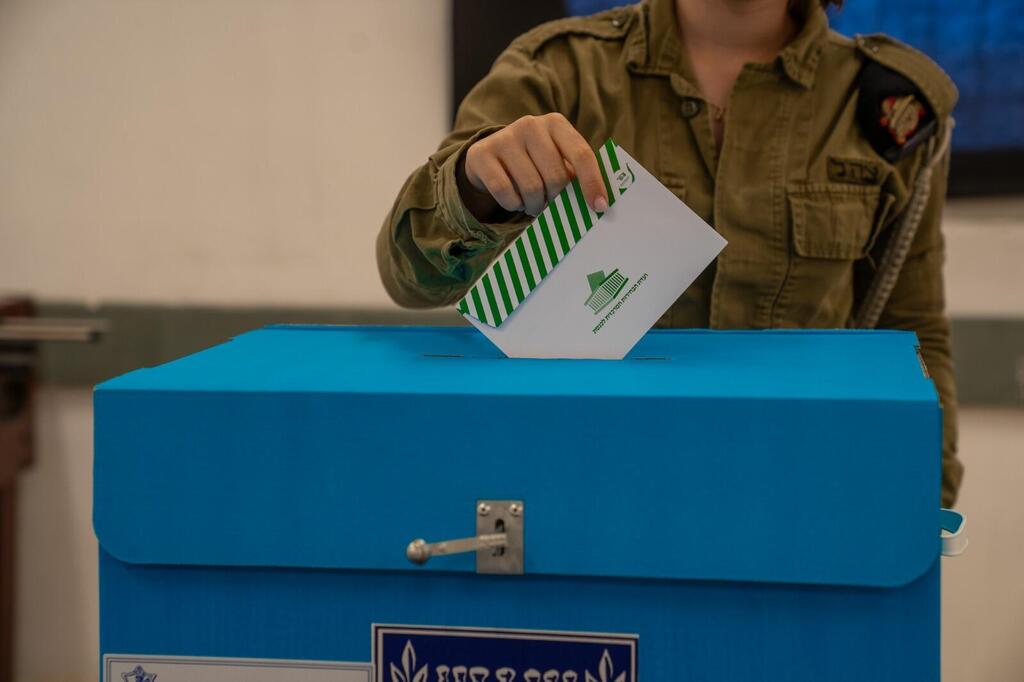
The IDF reported Wednesday morning that 79.9% of military personnel had exercised their right to vote, an increase of 6.2% compared with the previous Knesset election.
According to the IDF Spokesperson’s Unit, more than 890 military polling stations operated across bases and units throughout Israel, with approximately a quarter of them mobile. Voting began last week and continued throughout Election Day, including at military installations and in active combat zones.
Soldier voting at an IDF polling station
(Photo: IDF)
The military said the extensive deployment was intended to ensure that service members could participate in the democratic process regardless of their location or operational assignments.
The high military turnout could also be significant for the final election results. Ballots cast at military polling stations are counted through Israel’s double-envelope voting system, which requires additional verification before the votes are added to the nationwide totals.
Election officials have prepared for an estimated 600,000 to 650,000 double-envelope ballots this year, including votes cast by soldiers, reservists, diplomats, hospital patients and displaced Israelis. Their estimated volume represents roughly 15 Knesset seats’ worth of votes, although no seats are allocated separately from this category. Historically, these ballots have tended to favor Zionist parties across the political spectrum and can alter the final allocation of seats.
U.S. President Donald Trump also weighed in Wednesday morning, sharing a statement on Truth Social attributed to Irving C. Schwartz that credited Trump’s endorsement of Netanyahu with reversing the political momentum against him.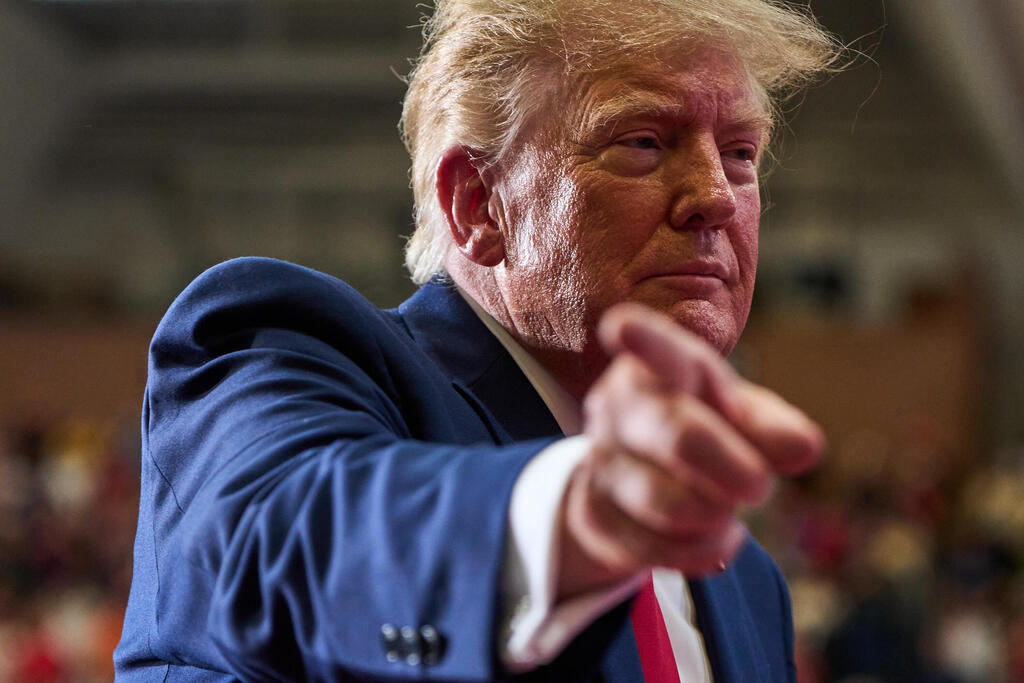
US President Donald Trump
(Photo: AP Photo/Julia Demaree Nikhinson)
“When President Trump endorsed Bibi Netanyahu, the whole tide turned, and now, rather than a decisive defeat for a Great Prime Minister, it looks like a big come-from-behind stalemate, or even a WIN for Netanyahu. It all took place AFTER the Endorsement by President Trump, who only wants what is good for the Middle East, Israel, and the United States of America!” the statement read, signed by Irving C. Schwartz.
The message came as the partial official count showed Netanyahu’s bloc ahead of its main rival, reversing the narrow advantage initially projected for Eisenkot’s bloc in election-night exit polls. Neither bloc, however, had reached the threshold required to form a government.
The changing election results cast a different light on speeches delivered by the two main political rivals overnight. Eisenkot addressed supporters relatively early, shortly after the television exit polls were released, declaring that Israelis had voted for political change and calling on Netanyahu to step down.
“We have made history,” Eisenkot told supporters. “I stand before you deeply moved. This morning, the people of Israel went to the polls in a referendum on the leadership that will guide Israel in the coming years. Tonight, we received our answer: The public chose change.”
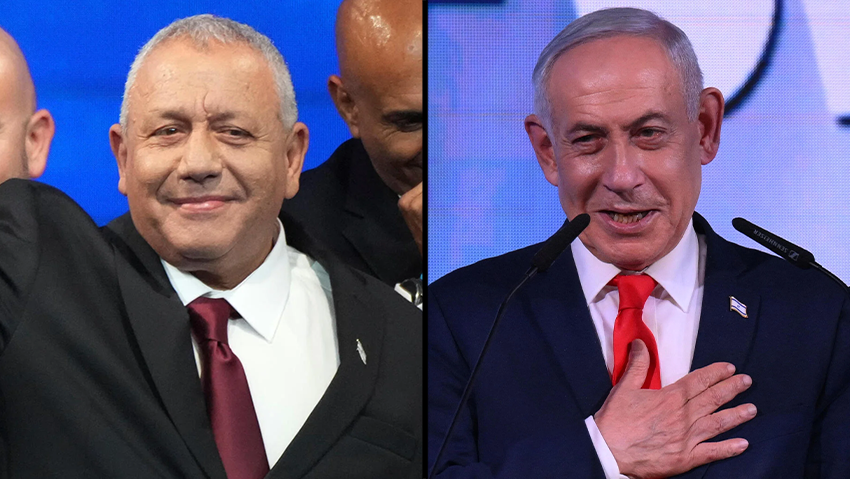
Gadi Eisenkot and Benjamin Netanyahu
(Photo: AP Photo/Ariel Schalit, Jewel SAMAD / AFP)
Eisenkot accused Netanyahu’s coalition of losing the public’s confidence. “The coalition of failure has lost the people’s trust. The Israeli public voted against Benjamin Netanyahu continuing as prime minister,” he said. He also appealed to senior security officials to stand firm. Throughout his speech, supporters repeatedly chanted, “The next prime minister!”
As the night progressed and official votes began to be counted, Eisenkot’s bloc appeared to lose some of the advantage suggested by the initial exit polls. Netanyahu, meanwhile, addressed supporters at the International Convention Center in Jerusalem, celebrating Likud’s emergence as the largest party in the preliminary results.
Netanyahu called for the unification of what he described as Israel’s Zionist political forces, arguing that cooperation was necessary to confront external security threats. “The Zionist majority must come to its senses and unite. Only that way can we guarantee Israel’s future,” he said.
He also twice thanked his “loyal partners” in the outgoing governing coalition, an apparent signal that he had no intention of abandoning his existing political allies in negotiations over the next government.
Despite the growing number of votes counted, the results remain provisional. The remaining regular ballots, including those from cities where counting had not begun as of the early morning update, could shift the distribution of seats among parties.
The double-envelope ballots will require separate verification to prevent duplicate voting before being included in the national tally. That process could continue into Friday, meaning the current projections may change further in the coming days.
Even after the final count is completed, Israel’s next government will not be determined automatically. President Isaac Herzog must consult the newly elected parliamentary factions before assigning a lawmaker the task of forming a governing coalition. With Netanyahu’s bloc currently six seats short of a majority and Eisenkot’s bloc further behind, negotiations among the parties will determine whether a viable government can be assembled.