
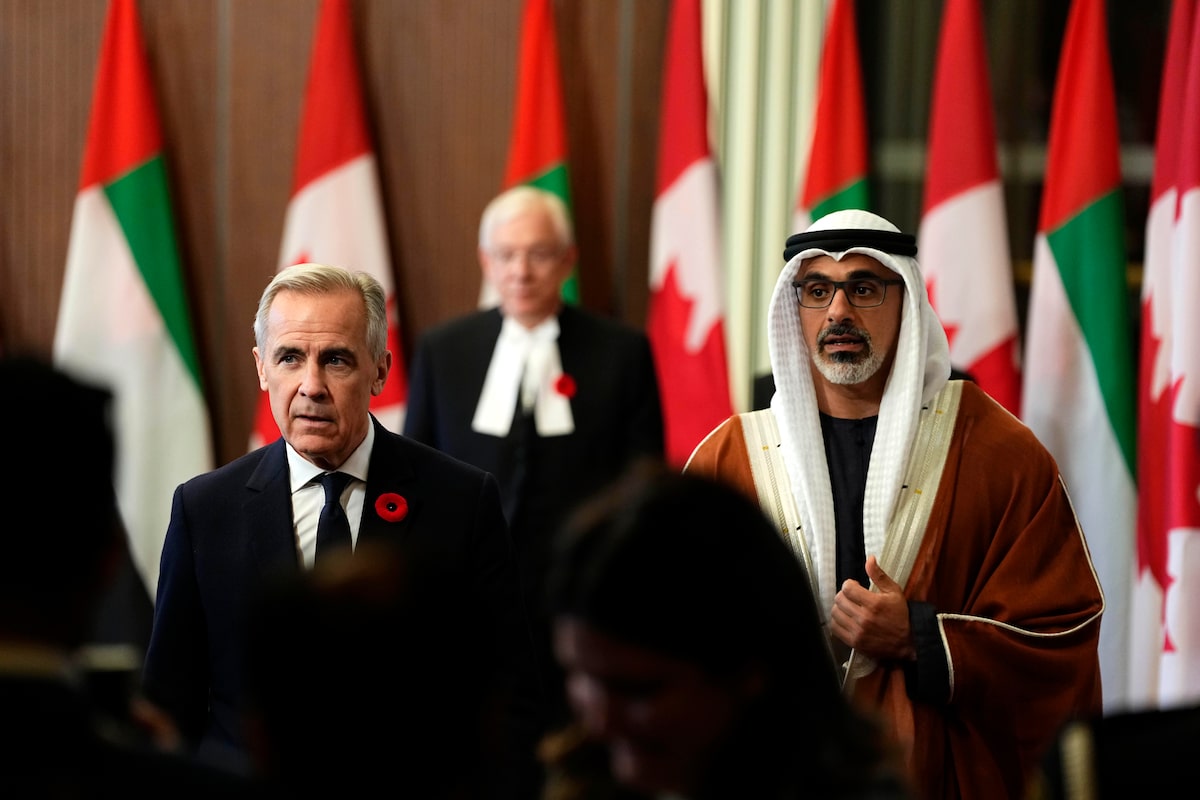
Prime Minister Mark Carney and Sheikh Khaled bin Mohamed bin Zayed Al Nahyan, Crown Prince of Abu Dhabi, U.A.E., after a welcoming ceremony on Parliament Hill in Ottawa on Tuesday.Justin Tang/The Canadian Press
Prime Minister Mark Carney signed a free-trade agreement and defence co-operation pact Tuesday with the United Arab Emirates, and agreed to launch negotiations on an extradition treaty with the Gulf state’s government, one that human-rights groups have accused of jailing dissidents.
An extradition treaty would make the UAE a formal extradition partner. That would give it the ability to ask Canada to hand over people who are wanted in the UAE for conduct considered crimes in both countries.
The Prime Minister, seeking foreign capital as he works to reduce economic reliance on the increasingly protectionist United States, is counting on the UAE to deliver on a pledge made last fall to invest $70-billion in Canada. Ottawa has not clarified over what time period this money will flow into the country.
Crown Prince Sheikh Khaled bin Mohamed bin Zayed Al Nahyan, the son of the UAE president, and other senior Emirati officials were in Ottawa for a two-day visit this week that included a Monday evening dinner hosted by Mr. Carney and attended by Canadian business leaders.
Neither Mr. Carney nor Sheikh Khaled took questions from the media Tuesday as various pacts were signed. The trade deal had been concluded in July.
Canada and UAE sign free trade deal, signal investment deals in energy sector ‘very soon’
Mr. Carney announced a new strategic partnership with the UAE Tuesday, and his office said the defence pact would pave the way for joint exercises, defence industrial co-operation, information exchanges, and co-operation in cybersecurity and military education and training. Canada and the UAE said they would create a “Joint Military Committee” to guide this collaboration.
Civil liberties watchdog Freedom House rates the UAE 18/100 on its freedom index, noting “limited elections are held for a federal advisory body, but political parties are banned, and all executive, legislative, and judicial authority ultimately rests with the seven hereditary rulers.” The civil liberties of both citizens and non-citizens, “who make up an overwhelming majority of the population, are subject to significant restrictions.”
The defence co-operation agreement is already sparking criticism from human-rights activists and Sudan support groups. Many human-rights advocates and other analysts have alleged that the UAE is the main weapons supplier to Sudan’s paramilitary Rapid Support Forces, which have perpetrated massacres and other atrocities in the Darfur region.
The UAE has repeatedly denied that it supports the RSF militia, but United Nations investigators have found that military equipment and mercenaries were sent to the RSF on cargo flights from airports in the Gulf state. One UN report found that the mercenaries were trained and financed in the UAE. Weapons from UAE-based manufacturers have often been documented in the RSF arsenal in Sudan.
UN investigators find evidence of UAE links to Sudan war
“Such serious allegations cannot be sidelined as Canada pursues a closer partnership with Abu Dhabi,” the Montreal-based Raoul Wallenberg Centre for Human Rights said in a statement this week. “Canada must confront this record directly.”
Paul Champ, an Ottawa-based lawyer who often represents Canadians imprisoned abroad, said it was deeply troubling to hear Canada has agreed to begin negotiations on an extradition treaty with the UAE, a country he said is regularly criticized by the United Nations and human-rights groups for its record.
“The UAE craves legitimacy in the West but the reality is that it is not a democracy and does not have the same respect for due process, human rights and the rule of law,” Mr. Champ said in an interview Tuesday. “Signing an extradition treaty would send the wrong message to the UAE as it suggests Canada is comfortable with the UAE’s human-rights record.”
“Canada’s extradition laws allows Canada to negotiate extraditions on a case-by-case basis with any country in the world. There should be some hard questions for the Carney government about why they view this as a wise agreement,” Mr. Champ said.
He said it appears the UAE is on a campaign to sign extradition treaties with Western governments, noting Belgium, Sweden, Ireland and Netherlands all signed extradition treaties with Gulf country in the last couple of years.
Senior Carney aide Angad Singh Dhillon appointed Canada’s next UAE ambassador
If a treaty were concluded, a UAE extradition request would go before a Canadian judge, who would have to be satisfied there is enough evidence that the person would face trial had the alleged crime happened in Canada. The justice minister would then personally decide on whether to surrender the person to the UAE, and the person could appeal both decisions to the provincial court of appeal.
Mr. Carney’s office said the new Canada-UAE trade deal is expected to enter into force in 2027. It said the agreement will reduce or eliminate tariffs on more than 99 per cent of existing Canadian exports to the Gulf country.
That means new markets for Canadian farmers growing pulses and canola, manufacturers of industrial machinery and power generation equipment, the aerospace sector, and other industries, the Prime Minister’s Office said.
“The agreement will also address non-tariff barriers, create a more predictable environment for trade and investment, and expand market access for Canadian goods and services, including in the industrial, agricultural, forest, fish and seafood, environmental, and engineering sectors,” the PMO said.
Dubai ports giant DP World signs memorandum of understanding to help develop Port of Churchill
In 2025, Canada’s two-way merchandise trade with the UAE was $3.5-billion, with $2.8-billion in exports and $679.1-million in imports, the government said.
The Prime Minister’s Office pointed to three UAE investments in Canada as evidence that the Gulf country is delivering on its $70-billion promise, noting that Dubai-based port operator DP World Ltd. has signed a memorandum of understanding with the owner of Manitoba’s Port of Churchill to explore further development of an expanded northern shipping corridor that could include container traffic. The PMO also noted a new energy co-operation agreement between state-owned Abu Dhabi Future Energy Company and Natural Resources Canada, “establishing a cooperation framework in the energy sector,” as well as an agreement between Invest in Canada, the federal investment promotion agency, and the Abu Dhabi Chamber of Commerce and Industry to facilitate business connections and visits.
The PMO did not say how much investment commitment these three announcements comprise.
The Gulf region, with its trillions of investment capital, is one of several priority regions for Canada, along with Europe and Asia, as it seeks to diversify trade away from the increasingly unreliable U.S. under President Donald Trump, and attract foreign investment in energy, infrastructure, artificial intelligence and resources.
Mr. Carney visited the UAE in November, 2025, the first Canadian prime minister to visit the Emirates in more than 40 years.