
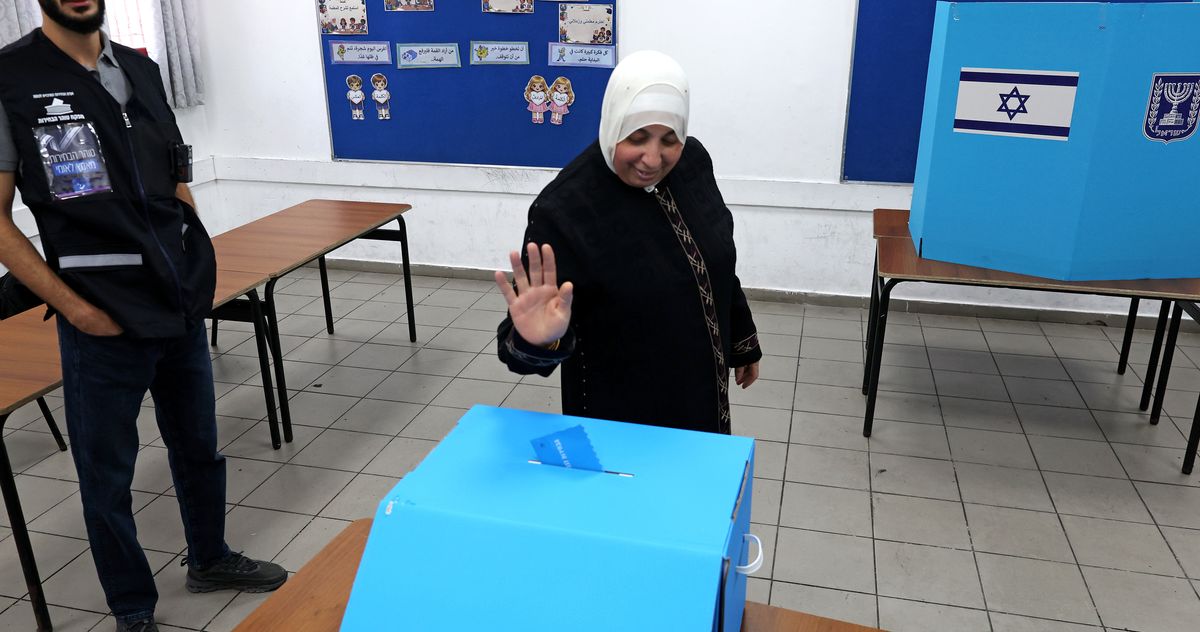
Photo: Jamal Awad/Picture Alliance/Getty Images
Shaima Kaabneh, a young Palestinian activist who lives in the West Bank village of Taybeh, has been visited twice daily for months by a particularly violent settler named Yedidya Cohen. Early yesterday morning Kaabneh posted a photo to her Instagram story of Cohen crouched on the ground outside her home clad in his typical camo face-covering and baggy T-shirt with prayer-shawl fringes swaying above dirtied jeans. Over the the photo, Kaabneh wrote the following message in English:
Good morning ❤️ 🌞
Today is election day, and all our hopes are that the government will change and that the situation will improve. WE hope this day marks the beginning of a new chapter filled with hope and positive change. We dream of a day when everyone can live in safety and dignity, when people’s voices are heard and their rights are respected, and when decisions are made for a better future for everyone. 🕊️❤️
We hope these elections will bring hope for a future with more justice and peace, and mark the beginning of a better reality and a dignified life for every human being.
The election to which Kaabneh referred was not an election in which she can participate. She is not a citizen of Israel. But it is the only election that can meaningfully impact whether or not Cohen continues showing up each day to terrorize her and her family with the intention of pushing them off their land.
The debate leading up to this election was dominated by the usual diametrically opposed worldviews. Many mainstream outlets described the election as the most significant in Israel’s history. The argument was made repeatedly that Israel’s democracy was on the ballot. On the other side, anti-Zionists, especially those in the diaspora, insisted that no matter the results of the election, Israel’s government will hasten no significant changes for Palestinians either in Israel or on its borders. Everyone predicted that there would be no clear winner, and in this they were vindicated. But no one foresaw the shocking voter turnout of the Arab-Israeli parties — even the highest turnout projections for that electorate were exceeded. In an election that broke turnout records across every demographic, the Arab-Israeli electorate was the highest of all with 78.8 percent.
According to all exit polls, Benjamin Netanyahu’s Likud party has won the most seats — 27, according to mainstream outlets — but it lacks a clear path to the 61-seat majority it would need to establish and lead the next government. Opposition leader Gadi Eisenkot’s Yashar party trails Netanyahu with either 21 or 22 seats, but it isn’t evident how he could form a majority coalition either, especially if he keeps his campaign promise not to sit with the Arab parties. All told, the Netanyahu bloc has an estimated 53 seats to the opposition’s 49. There will be enormous pressure on Eisenkot to form a unity government (that is, a government with the two largest parties that ran against each other) with Netanyahu. Already, commentators are theorizing about the possibility of Eisenkot and Netanyahu establishing a rotating premiership till the next election four years from now. Eisenkot also swore before the election that he would never agree to sit with Netanyahu. Campaign promises are made to be broken. Let’s hope he breaks the right ones.
In either case, there is a glimmer of hope for the Arab population.
It is no secret that Bezalel Smotrich, who has served as finance minister in Netanyahu’s coalition since 2023 and who also oversees settlement affairs in the West Bank, has established a regime of impunity for settler terrorists like Cohen who operate as key actors in Smotrich’s plans for the region. Last September, Smotrich held a press conference with settler leaders at which he presented what he called a “Sovereignty Plan” map, which showed how he intended to use settlement expansion to annex 82 percent of the West Bank and to eliminate Palestinian communities in Bethlehem, Salfit, and Qalqiliya. The plan Smotrich unveiled at that meeting called for the expulsion of about 450,000 Palestinians. So far, he has succeeded in expelling 42,322.
Voters also registered a protest against Netanyahu, whose fascistic policies and projects will outlive his tenure in office — in Gaza most of all, but also in the West Bank and inside Israel itself. In the days preceding the election, he unintentionally made it very clear that the existential threats Israel faces stem from his disastrous stewardship. In an interview on the Friday afternoon before the election, he sounded alarms about the threats of impending sanctions for settler violence. He conceded that Israel must prepare for the inevitability of these sanctions, which could crush the Israeli banking system. He also warned of the impending loss of American military and civilian aid, which has numbered in the billions of dollars annually for years — two shocking concessions that imply Netanyahu knows his policies have damaged Israel irrevocably. Netanyahu explained that Israel would have to create a “circumventing economy” based on cryptocurrencies — a proposal so idiotic that it in itself would have been enough to upset the national economy.
At the same time, Netanyahu made overt, desperate attempts to provoke an attack from Iran before the elections, which would have forced the country to reschedule the vote (at the potential cost of Israeli lives). And as if all these antics weren’t enough, he also posted an AI-generated image of Tel Aviv beneath a nuclear mushroom cloud and warned that nuclear destruction is what awaited an Israel without him at its helm. All this served to cement the opposition bloc’s distaste for the havoc Netanyahu brings.
Opposition-bloc voters want normalcy, and if they cannot have it, they at least want its mirage. Netanyahu spent much of his campaign boasting that he has led Israel into a seven-front war since October 7. This was an apparent expression of certainty that he had not run his own population ragged by forcing much of the country to serve in reserve units for wars that never end. When opposition bloc voters described this election as the most significant in Israeli history, they meant that it would either secure an exit from Netanyahu’s hamster wheel of eternal battle or else strap the country in forever.
Neither the Netanyahu bloc nor the opposition bloc includes Palestinian citizens of Israel, who account for 20 percent of the Israeli population. Each bloc has accused the other of being a Trojan horse for Palestinian citizens. Netanyahu spent much of election day warning that the Arabs were surging into the polls — a racist attempt to galvanize his supporters to get out the vote. And he wasn’t wrong. Many Palestinian Israelis have stayed home on election days in the past. Since the advent of the State of Israel, Arab-Israeli parties have averaged between three and 15 seats each election. Exit polls indicate that this year they will have secured 19. If either one of the two blocs would sit with the Arab-Israeli parties (and if the Arab-Israelis would agree to sit with them), that bloc would glide to an easy victory. But, as of this writing, that seems unlikely.
Over the next few days, the president of Israel, Isaac Herzog, will have the duty of deciding who gets to try to form a government first. Herzog’s responsibility is to try to oversee a transition that is as seamless as it can be. His influence can go a long way in pressuring either bloc leader to make serious concessions to its opponent or to the smaller parties that are in play. If, within the next 90 days, neither bloc can manage to form a government, then the country will be forced to schedule another election. (Who can forget the streak between 2019 and 2021, when Israel was forced to schedule four elections in half as many years?)
Where does all this leave Kaabneh and her family? The good news from Monday is that neither Smotrich nor his fellow hard-liner Ben Gvir is likely to be a part of any governing coalition. The opposition bloc will not sit with them, and Netanyahu will not be able to fit them into a coalition that would secure 61 seats. The money that Smotrich has used to outfit settler terrorists with drones, guns, and ATVs, and to secure them with farms with sprawling fields that once belonged to Palestinian shepherds, was money secured in the direct aftermath of the last elections in 2022. At the start of each government, the premier essentially bribes the heads of the various parties in his coalition with slush-fund money from the national budget, which they are empowered to use for their pet projects in exchange for promising to remain inside the government. It makes a great deal of difference that, as a result of this election, both Smotrich and Ben Gvir have no way to serve in the next government, barring another election that produces different results. Over the next 90 days, it will become clear whether their expulsion will stick.
The majority of Israelis voted on Monday to oust Netanyahu. But, as Americans know too well, the popular vote is not always decisive. The pioneers who divined a coalition government for the first Jewish state had a wicked sense of humor. It is almost inevitable in such a configuration that small parties secure outsize power. Perhaps the Palestinian Israeli electorate will be rewarded for evincing astonishing faith in democracy by voting on behalf of their brothers and sisters who have no such power.
Sign Up for the Intelligencer Newsletter
Daily news about the politics, business, and technology shaping our world.
Vox Media, LLC Terms and Privacy Notice