
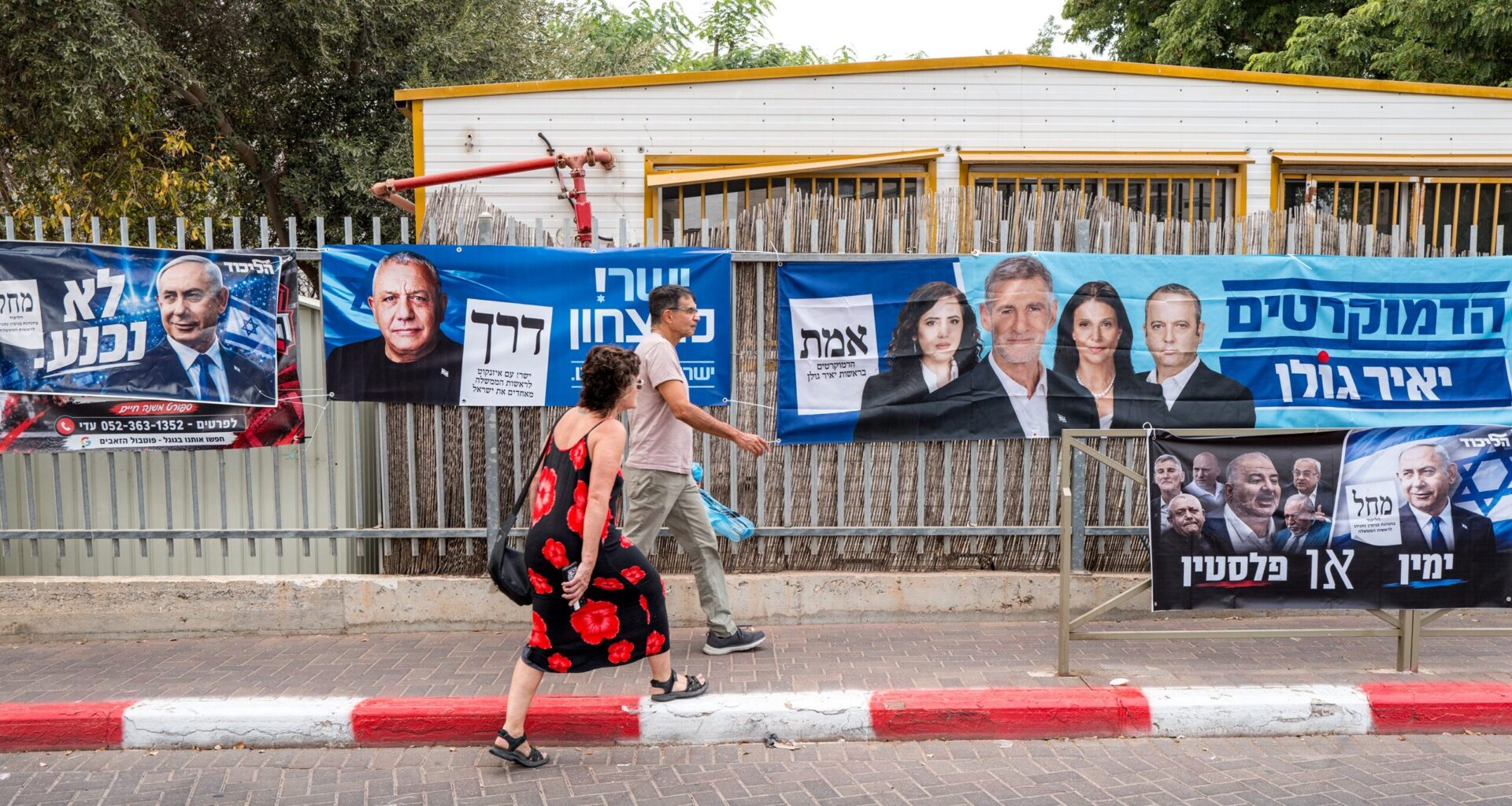
With Netanyahu’s bloc short of a majority and Arab parties holding a potential balance of power, rival leaders face difficult choices over coalition deals, a unity government, or another election
Israel faced a political deadlock Wednesday, a day after its general election, with neither Prime Minister Benjamin Netanyahu nor his opponents securing a clear path to the 61 seats needed for a majority in the 120-member Knesset.
With approximately 85.6% of votes counted, preliminary results indicated that Netanyahu’s right-wing and ultra-Orthodox bloc would win 53 seats, eight short of a majority. The four-party opposition bloc, led by former Israel Defense Forces chief of staff Gadi Eisenkot and his Yashar party, stood at 48 seats, while the predominantly Arab Joint List and Ra’am parties held a combined 19 seats, potentially giving them a decisive role in determining the next government.
The figures could still change. Approximately 600,000 special double-envelope ballots, including votes from soldiers, hospital patients, and other eligible voters who cast ballots outside their regular polling stations, had yet to be counted Wednesday afternoon. Official results must be published by November 4.
Once the results are formally published, President Isaac Herzog will consult representatives of the parliamentary factions before selecting the lawmaker he believes has the best chance of forming a government. The candidate will have 28 days to assemble a coalition, with a possible 14-day extension. If unsuccessful, another candidate could receive the mandate.
With Netanyahu’s bloc lacking a majority and his opponents divided over cooperation with Arab parties, four scenarios could determine Israel’s political future.
Netanyahu Manages to Secure a Majority
“It appears the Netanyahu bloc has more mandates than the opposition and he will be given the mandate to form a government,” Roni Rimon, a strategic adviser and partner at the public relations firm Rimon Cohen & Co., told The Media Line. “It is not clear that all members of the opposition will recommend Eisenkot to the President.”
Netanyahu’s advantage in seats does not guarantee that Herzog will give him the first opportunity to form a government. The president is not legally required to select the leader of the largest party or bloc, and the recommendations of party leaders will help shape his decision.
The opposition to Netanyahu has long been fragmented, encompassing parties from the left, center, and right, along with Arab parties that oppose his government but differ considerably from one another on national security and other issues. Netanyahu has repeatedly used those divisions to his political advantage.
“There is no chance that Bibi will be prime minister; that era is over,” said Eran Vigoda-Gadot, a professor of public administration and political science at the University of Haifa. “The opposition will form a minority government with Arab support from outside.”
There is no chance that Bibi will be prime minister; that era is over
Yet Netanyahu has been written off politically several times before, only to return. Israel’s longest-serving prime minister has demonstrated considerable skill in coalition bargaining and could seek support from parties currently aligned against him.
He will calculate his needs and operate accordingly; this includes approaching political foes. He doesn’t keep score.
“Netanyahu has no inhibitions,” said Rimon. “He will calculate his needs and operate accordingly; this includes approaching political foes. He doesn’t keep score.”
One potential target would be former Prime Minister Naftali Bennett, who once headed the Yesha Council, an organization representing Jewish settlements in the West Bank, and previously served as a Netanyahu ally.
Bennett now leads B’Yachad, an electoral alliance between his Bennett 2026 party and former Prime Minister Yair Lapid’s Yesh Atid. He has ruled out joining a Netanyahu-led government, making such a partnership highly unlikely under the parties’ current positions.
Netanyahu could nevertheless try to appeal to Bennett’s right-wing background and his opposition to establishing a government dependent on Arab parties. Any agreement would require a major political reversal.
Opposition Bloc Forms Government With Arab Support
Arab voters emerged as one of the election’s most consequential forces, with turnout estimated at approximately 80%, according to Israel’s Channel 12. Overall turnout reached 77.7%, the highest since 1999.
The surge followed years of tensions over government policies toward Arab citizens and Palestinians, concerns about violent crime in Arab communities, and opposition to the Netanyahu government’s conduct of the war in Gaza.
The Joint List and Ra’am were projected to secure 12 and seven seats, respectively, giving Arab-led parties their strongest combined parliamentary representation ever. Together with the 48 seats projected for the four-party opposition bloc, they would account for 67 lawmakers, theoretically enough to replace Netanyahu.
But those numbers do not automatically translate into a viable governing majority.
“If the Arab parties recommend Eisenkot, the opposition will have a solid majority to try and form a government,” said Rimon. “This is not an impossible scenario. The Arab parties may decide, without even negotiating, that their wish to remove Netanyahu from power is so great that they will support Eisenkot.”
Joint List leader Yousef Jabareen indicated Wednesday that his alliance was prepared to help remove Netanyahu, potentially supporting an alternative government from outside the coalition. Ra’am leader Mansour Abbas signaled openness to joining an Eisenkot-led government if a workable agreement could be reached.
The obstacle lies partly within the four-party opposition bloc itself. Yisrael Beitenu leader Avigdor Liberman has explicitly rejected both a coalition with Arab parties and a minority government dependent on their support. Bennett has also ruled out reliance on Arab parties.
Eisenkot has set conditions for cooperation, including recognition of Israel as a Jewish and democratic state, acceptance of the values of the Declaration of Independence, and support for national service obligations for all citizens. It is unclear whether any agreement with the Arab parties could satisfy those requirements.
Historically, Arab parties have generally remained outside Israeli governing coalitions, reflecting ideological disagreements, opposition from Jewish political parties, and their own reluctance to participate in governments whose policies toward Palestinians they oppose.
That precedent changed in 2021, when Ra’am, led by Abbas, joined the coalition established by Bennett and Lapid to replace Netanyahu. The government collapsed in 2022, and Netanyahu returned to power following that November’s election.
There is also precedent for a minority government supported by Arab lawmakers from outside the coalition. In the 1990s, Prime Minister Yitzhak Rabin relied on such support after losing his parliamentary majority.
Israeli law does not require a prospective government to obtain 61 affirmative votes in its initial confidence vote. A majority of lawmakers participating in the vote is sufficient, potentially allowing a minority government to take office if enough members abstain.
“This won’t be simple, but it is the lesser evil,” said Vigoda-Gadot. “The first step will be to remove Netanyahu from the political map and then make progress as a minority government with support of pragmatic members of the Arab parties.”
Such an arrangement would demand compromises from parties that disagree sharply over Palestinian statehood, security policy, and the relationship between Israel’s Jewish majority and Arab minority.
Democrats leader Yair Golan has urged opposition leaders to cooperate with Arab parties, arguing that their electoral support should not be excluded from efforts to form a new government. Whether Eisenkot can persuade Bennett and Liberman to reconsider their positions could determine the viability of this scenario.
A Unity Government
A government combining Likud with some of Netanyahu’s current opponents could offer another route out of the deadlock.
The possibility has surfaced in Israeli political discussions, particularly following the failure of either major bloc to secure a parliamentary majority. Yet the leaders of the main opposition parties have repeatedly ruled out serving under Netanyahu, including in a rotation arrangement.
The prime minister remains a deeply polarizing figure. His opponents blame him for failures preceding the Hamas-led attack on October 7, 2023, and criticize his handling of the wars that followed. Netanyahu is also standing trial on corruption charges, which he denies.
Disagreements over military conscription pose another challenge. Netanyahu’s ultra-Orthodox coalition partners have sought to preserve exemptions for religious students, while opposition parties generally favor expanding military service obligations among ultra-Orthodox men.
Arab participation raises separate disputes over national service, equality, and security policy, complicating efforts to build a coalition spanning Israel’s political spectrum.
The opposition has many more promises to break
“The opposition has many more promises to break,” said Rimon. “Netanyahu only has one promise that he made to his partners on the far-right that he will form the next government with them.”
National Security Minister Itamar Ben-Gvir and Finance Minister Bezalel Smotrich, both prominent figures on Israel’s far right, are particularly controversial among opposition parties.
A broader coalition might require Netanyahu to exclude one or both of them, potentially opening the door to negotiations with more moderate parties.
Ben-Gvir has already warned Netanyahu against forming a unity government with Eisenkot, calling such an arrangement a serious mistake. A deal that excluded his Otzma Yehudit party could fracture Netanyahu’s existing political alliance.
The Arab parties’ projected gains could also increase pressure on opposition lawmakers who oppose cooperation with them, encouraging some to reconsider their position toward Likud.
Vigoda-Gadot doubts that Eisenkot would accept such an arrangement.
“I see zero chances for this,” said Vigoda-Gadot. “Eisenkot will not make any deal with Netanyahu, specifically a deal which will give Netanyahu the premiership.”
For many opposition leaders, replacing Netanyahu remains the principal objective binding together parties with otherwise conflicting political agendas.
“The deletion of Netanyahu from the political map and ending the long era in which he served as Prime Minister and made such a dramatic and deep impact on Israelis is the main goal of the opposition and the other goals derive from this,” Vigoda-Gadot added.
A unity government would require a substantial reversal of political commitments. An arrangement excluding Netanyahu but including Likud would present a different possibility, although it would depend on a leadership change or a break within the party.
Elections … Again
If neither Netanyahu nor his opponents can establish a government, Israelis could find themselves voting again in early 2027.
The country has been through a similar cycle. Between April 2019 and November 2022, Israel held five general elections as successive political blocs struggled to assemble durable parliamentary majorities.
Under Israeli law, a second candidate can receive up to 28 days to form a government if the first fails. If that effort also collapses, lawmakers have a further 21 days to rally at least 61 members behind another candidate, who would receive 14 days to form a government. Failure to do so would trigger a new election.
Throughout that process, Netanyahu would remain caretaker prime minister until a new government was sworn in.
“Eisenkot understands there is no need for another election that will not bring a different result,” said Vigoda-Gadot, explaining why the opposition might eventually prefer a minority government supported by Arab parties.
Such a government would face considerable obstacles, including its members’ ideological differences and the political risks of relying on Arab lawmakers to maintain parliamentary support.
Another election would carry risks of its own. Israel could remain under a caretaker government for months, with no guarantee that another vote would produce a more decisive result.
For Netanyahu, that would mean remaining in office without having secured a new parliamentary majority. For his opponents, it would mean risking the electoral gains that brought them within reach of replacing him.
President Herzog, meanwhile, urged political leaders Wednesday to approach the coming consultations with an open mind rather than allow the deadlock to trigger another election.
We must do everything we can, certainly after yesterday, to avoid another round of elections
“One thing must be clear, and I said this before the elections too: We must do everything we can, certainly after yesterday, to avoid another round of elections. So, I expect everyone who comes here to come with an open mind,” Herzog said on Wednesday.