
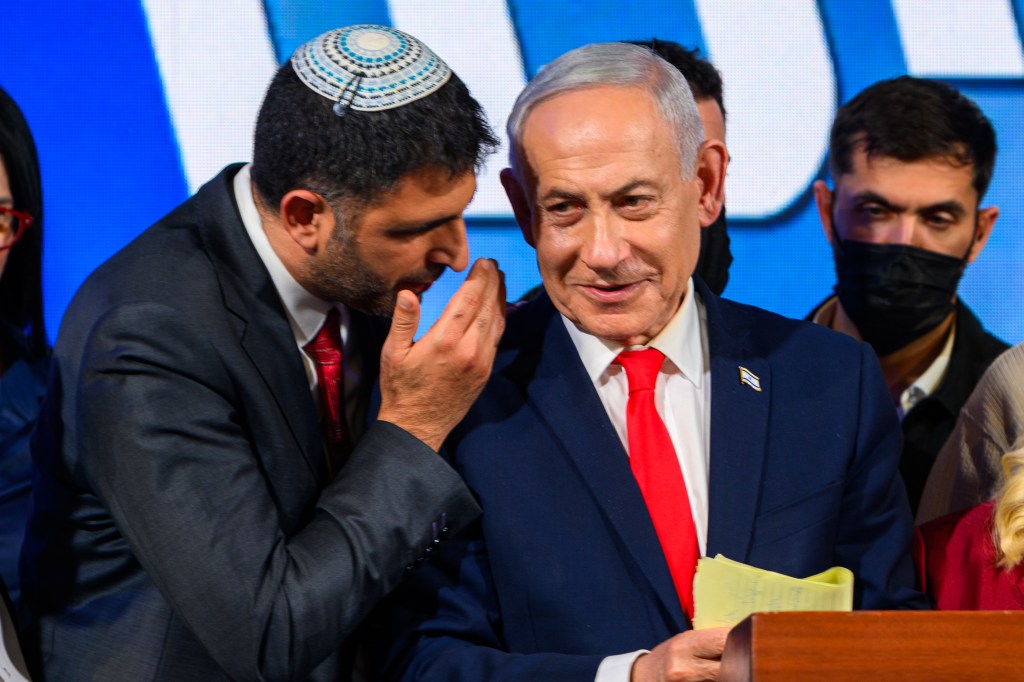
UPDATE… 9.05 am PT. As Israeli election ballots continue to be counted the result is increasingly pointing to deadlock as parties opposed to incumbent Prime Minister Benjamin Netanyahu and his right-wing bloc pull ahead.
As of 5.15pm local time, with around 85% of the vote counted, opposition parties have won 67 seats, including 19 for the Arab parties, while Netanyahu’s coalition led by his Likud party have 53 seats.
Netanyahu’s biggest rival Gadi Eisenkot’s bloc has won 48 seats, while his Yashar Party has won 21, against Likud which has 26 seats, making it the leading party even if its bloc has failed to win a majority.
The results have seen Palestinians with Israeli citizenship, who make up roughly 20% of Israel’s population, potentially propelled to the position of kingmakers in an election viewed as a turning point in the country’s 78-year history.
For Eisenkot to find a path to power, he will need the support of both Arab parties, the Joint List and the Arab List. However, he has previously rejected the idea of joining forces with them due to a “lack of shared values”. It remains to be seen if they can come to an agreement to work together.
Focus is now on the results of some 600,000 absentee ballots, accounting for 10% of the votes and cast mainly by Israeli military personnel, the counting of which will begin at midnight local time.
There was a 77.7% voter turnout on Tuesday, which was the highest since 1999, according to the Central Elections Committee.
Previously…. 2.10am PT. The election in Israel remains on a knife-edge and there is still a strong chance Benjamin Netanyahu could be asked to form the next government.
Last night’s exit poll indicated that Netanyahu’s Likud Party plus right-wing bloc and challenger Gadi Eisenkot’s coalition were neck-and-neck, but with well over half of votes now counted, it appears that Netanyahu has a slender lead. Likud is projected to remain largest party in the Knesset, the Israeli parliament.
As of this morning, Israeli news networks are now projecting Netanyahu’s bloc to win 55 seats, with Eisenkot’s trailing on 49.
Neither would have enough to form a majority government so Israel President Isaac Herzog would therefore be tasked with commanding one of them to attempt to form a government with other parties, of which there are more than 30. This is what happened at the previous election. There is a strong chance Netanyahu could be the one given this task. Whoever is tasked with forming the next government has 28 days to make a coalition, although they can request a 14-day extension if extra time is needed. If they fail after this time, Peres can choose another candidate.
Neither Netanyahu nor Eisenkot have declared victory but overnight both told supporters they should be the one to form a government.
“The right-wing bloc has a clear, decisive majority among the Zionist public, among the Jewish public and all those who support the Jewish state,” said Netanyahu.
Eisenkot, on the other hand, said “the public has chosen change,” branding Netanyahu’s group a “coalition of failure.”
Eisenkot has an anti-Netanyahu bloc of support, many of whom are furious with Netanyahu for his handling of October 7 and the subsequent war with Iran and Lebanon. Netanyahu’s bloc is comprised of Likued plus right-wing and orthodox Jewish parties.
Notably, parties led by Israel’s Arab minority – who often identify as Palestinian citizens of Israel – are projected to outperform expectations. There is a chance these parties could act as Kingmakers if Eisenkot’s bloc is prepared to work with them.
Americans will also be watching with interest ahead of the mid-terms. According to BBC News citing Republicans Overseas, Israel estimates about half a million Israelis with American passports can vote in both polls.
Earlier this week, Israeli cinema professionals, a mostly liberal-minded community that has repeatedly been pegged back by the Netanyahu administration, spoke to us about their hopes and fears ahead of the election.