

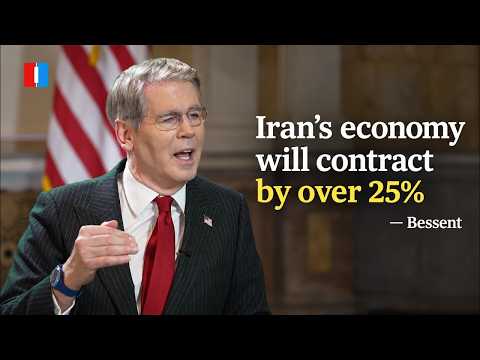
Their assessments follow a prediction by US Treasury Secretary Scott Bessent, who told Iran International that Iran’s economy would shrink by more than 25% between March 2026 and March 2027.
Iranian-American economist Ali Dadpay told Iran International that he found Bessent’s forecast plausible, particularly as Tehran attempts to finance wartime spending by expanding the money supply.
That risks accelerating inflation and weakening the rial further, he said, creating a cycle of rising prices, falling purchasing power and declining economic activity.
Mohamad Machine-Chian, an Iran International economist, offered a stark comparison.
“The United States lost about 26% of its output in the Great Depression, over four years, from 1929 to 1933. Secretary Bessent is describing a loss of Great Depression size in twelve months,” Machine-Chian said.
Iran’s economy contracted by 21.6% in 1980, the first year of the Iran-Iraq War, World Bank data shows.
How much worse could it get?
Even the severe sanctions of 2018 and 2019 produced a smaller cumulative contraction of approximately 12%, despite oil exports plunging from about 2.7 million barrels per day to roughly 650,000.
Economic output was already approximately 10% lower in spring 2026 than a year earlier, according to figures from Iran’s Statistical Center.
For the economy to contract by more than 25% over the full year, the decline would have to accelerate considerably.
Machine-Chian estimated that even with an 8% contraction over the summer, output would have to fall far more sharply during autumn and winter for the annual decline to approach Bessent’s forecast.
The disruption of oil exports is central to that outlook. Energy intelligence firm Kpler reported no new Iranian crude loadings since late August, while revenue from earlier shipments is running out.
But the damage extends beyond the oil industry. Factories depend on imported materials, transportation companies require replacement parts, and businesses need financing to sustain operations.
As supplies and revenue dwindle, manufacturing, construction and other industries face further disruption.
The cost for ordinary Iranians
The economic deterioration is already visible in the price of everyday necessities.
Food prices in September were more than double their level a year earlier, according to Iran’s Statistical Center. Eggs cost three and a half times as much, rice nearly twice as much, and official bread prices in Tehran have doubled.
“The minimum wage increased 60% this year while inflation approached 90%,” Machine-Chian said. “In dollar terms, a minimum-wage worker now earns approximately $61 a month, compared with $96 a year earlier.”
He also warned about savings being eroded. With the dollar costing two and a half times as much as a year ago, money held in rials has lost approximately 60% of its value against the US currency.
Further disruption to imports could bring shortages of medicines, industrial materials and vehicle parts, potentially forcing factories to reduce production or close and putting more jobs at risk.
Dadpay described a possible future resembling aspects of the economic crises in Venezuela and Zimbabwe, where severe currency depreciation and inflation pushed people toward dollars, gold, secondhand markets and barter.
As production declines and essential goods become harder to obtain, even those who remain employed could struggle to afford basic necessities.
Sanctions policy analyst Max Meizlish expects pension payments and civilian services to come under pressure as revenues decline, while military and security personnel could continue receiving salaries.
That could allow the Islamic Republic to preserve institutions central to its political survival even as living standards deteriorate.
Political consequences
Economic devastation does not necessarily translate into political collapse, particularly if Tehran can preserve its security institutions and access to financial channels abroad.
Washington has not fully targeted the Chinese financial institutions facilitating Iranian transactions, partly because of concerns about wider economic consequences, Meizlish said.
“It’s just not clear that this level of economic constraint on its own will be enough to produce some sort of measurable political change,” he said.
Dadpay argued that years of economic mismanagement and decisions prioritizing the survival of the political system had left Iran particularly vulnerable to the current crisis.
“As long as Islamic Republic is in place with this mindset, with this dynamic of decision-making, this is what’s going to happen,” he said.
For ordinary Iranians, the consequences are already evident in collapsing purchasing power, dwindling savings and rising prices.
Whether Bessent’s forecast proves accurate or not, the economic damage could outlast the confrontation that has accelerated it.