
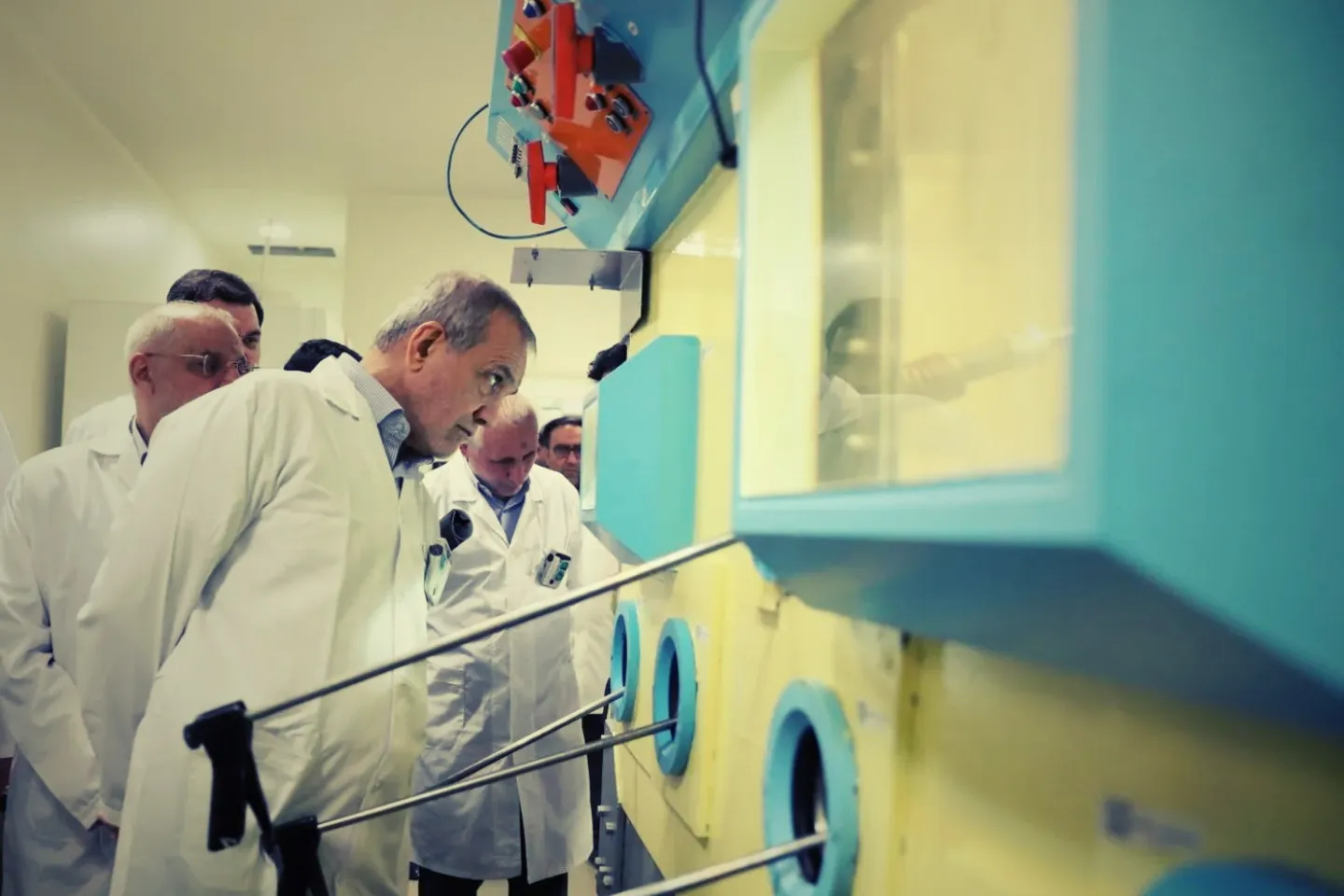
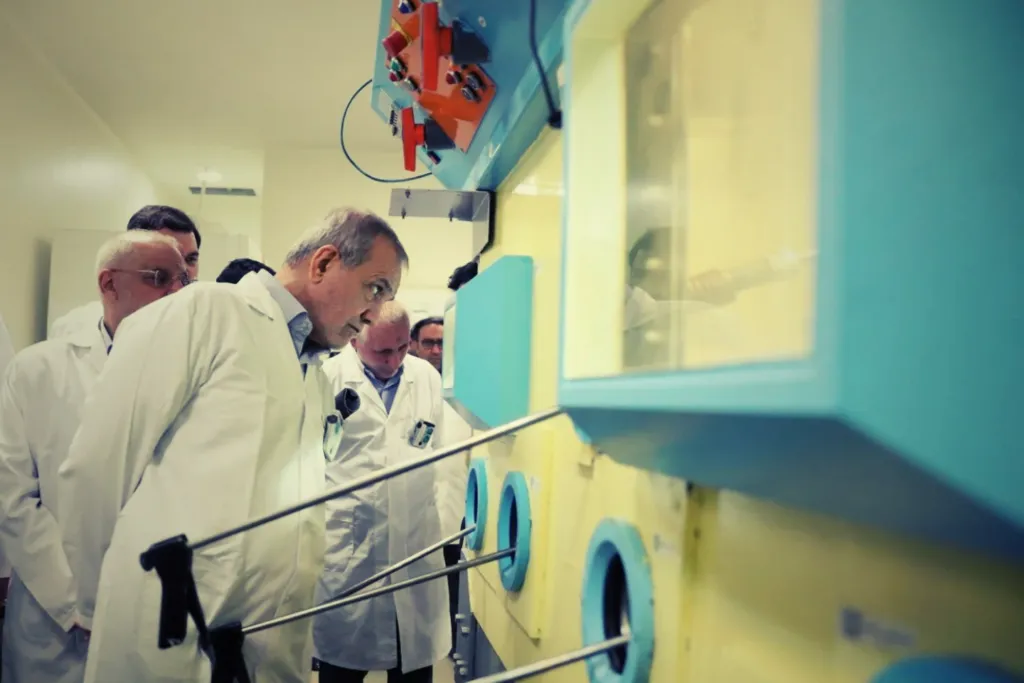
 In November 2025, Iranian President Masoud Pezeshkian, seen here visiting the Atomic Energy Organization of Iran, said Tehran will rebuild its nuclear facilities “with greater strength.” At a UN Security Council meeting on Tuesday, UN nuclear chief Rafael Grossi said there is no indication Iran has tried to repair or reconstruct its nuclear facilities damaged in US and Israeli military strikes in 2025 and 2026. (Photo by Iranian Atomic Energy Organization; modified)
Iran now faces one of the most consequential nuclear decisions. In less than a year, the United States twice used military force to destroy key infrastructure and prevent Tehran from acquiring a nuclear weapon. These strikes have set Iran’s nuclear program back by severely degrading its nuclear enrichment capacity. But they have not eliminated the scientific expertise, industrial capacity, and political motivations that sustained the program for decades. Still, the attacks exposed the weakness of Iran’s previous strategy, which thought that by advancing its program but remaining below the nuclear threshold, Tehran was effectively deterring attacks from its adversaries. It failed.
Tehran now must choose between three main broad options: Dismantle its nuclear program, weaponize it, or rebuild its latent nuclear capacity while still being under the nuclear threshold. Despite its evident failure to deter foreign adversaries, the third path remains the most plausible. Dismantlement would require Iran to abandon three decades of technological investment in exchange for uncertain external guarantees of nuclear fuel delivery. Weaponization, meanwhile, would invite further military strikes and trigger a nuclear arms race in the Middle East. In contrast, rebuilding a latent capacity is already a tested strategy for Iran, allowing it to preserve its technological autonomy and leverage while avoiding immediate costs of acquiring a nuclear arsenal.
Dismantling. The first—and least likely—option resembles the so-called Libya model. Under that arrangement, Libya agreed to dismantle key elements of its nuclear infrastructure and transfer sensitive enrichment equipment abroad in return for sanctions relief and improved relations with the West. Applied to Iran, such a scenario would require Tehran to dismantle its enrichment facilities and renounce domestic uranium enrichment in exchange for sweeping sanctions relief, trade, access to civilian nuclear reactors, and guaranteed supplies of nuclear fuel from abroad.
At first glance, this scenario appears attractive: It would reconnect Iran to the international economy, including for its civilian nuclear infrastructure. And it would also address Washington’s central proliferation concern by sharply reducing Iran’s capacity to produce fissile material for a nuclear weapon. In practice, however, several reasons explain why Tehran would have extreme difficulty accepting the full dismantlement of its enrichment capacity.
First, the Iranian leadership has long viewed the Libyan case not as a successful model but a cautionary tale of the West’s broader goal for regime change. In a 2011 sermon, Iran’s late supreme leader Ayatollah Ali Khamenei strongly criticized Muammar Gaddafi for dismantling Libya’s nuclear program, noting that he “collected all his nuclear equipment on the heels of empty threats, loaded it onto a ship and handed it over to the Westerners, saying to them: ‘Take it!’ Then they decided to attack Libya and take their oil.” For Iran’s leadership, the lesson was clear: Dismantlement did not produce lasting security; on the contrary, it left Libya more vulnerable once its bargaining leverage had disappeared.
This concern is reinforced by a broader and deeply rooted skepticism in Tehran about the credibility of US commitments and external guarantees. In February 2010, for example, Ali Akbar Salehi, then head of the Atomic Energy Organization of Iran—the main government agency responsible for overseeing and operating Iran’s civil and defense-related nuclear infrastructure—advised President Mahmoud Ahmadinejad that Iran should begin enriching uranium to 20 percent to produce fuel for the US-supplied 5-megawatt-thermal Tehran Research Reactor in northern Tehran. Salehi warned that Iran could not assume that other countries would sustainably supply the necessary fuel and argued that allowing the reactor to run out of fuel would be an “embarrassment” for the country. Maintaining an indigenous enrichment capability has therefore been viewed not only as a technological achievement for Iran, but also as a hedge against dependence on foreign supply.
The experience of the Joint Comprehensive Plan of Action (JCPOA; or Iran nuclear deal) further strengthens this perception. When Iran and the United States signed the agreement in 2015, many in Tehran, including Khamenei, remained skeptical that Washington would uphold its commitments under the nuclear agreement. When the first Trump administration withdrew from the Iran nuclear deal, opponents of the agreement were vindicated. From Tehran’s perspective, the episode demonstrated that even a negotiated agreement endorsed by a sitting US administration could be reversed by its successor. From this recent history, it seems very unlikely that Iran would accept dismantling its enrichment program in return for the promise of sanctions relief or nuclear fuel for its nuclear program.
Weaponizing. In a second and less likely scenario, Iranian leaders may conclude that the country has already absorbed the costs associated with approaching the nuclear threshold—sanctions, sabotage, diplomatic isolation, and two wars—without obtaining the deterrent protection of possessing an actual nuclear weapon. From this perspective, continuing to remain just short of the bomb could appear unsustainable and weaponization the only option to restore deterrence. While Tehran might attempt to rapidly produce a nuclear weapon using its remaining nuclear materials, acquiring a single device would not necessarily translate into a credible nuclear deterrent. Therefore, while the weaponization and rebuilding options are not mutually exclusive, their distinction lies in Tehran’s main objective.
Ever since the October 7 attacks against Israel, and the deterioration of the strategic environment in the region, public calls for revising Tehran’s nuclear doctrine have intensified. A year later, in October 2024, as Iran and Israel had a second round of missile and drone exchanges, 39 Iranian lawmakers publicly urged Ayatollah Khamenei to permit a revision in the country’s defense doctrine. Public opinion also appeared to shift toward weaponization. A survey conducted between February and May of 2024 found that more than 69 percent of Iranian respondents supported their country pursuing nuclear weapons. By August 2025, that figure had risen to 73 percent. The new Iranian leadership may now conclude that a nuclear deterrent is necessary to deter foreign aggression in the future.
A breakout decision would be a high-risk, high-reward path for Tehran.
In practice, if Tehran recovers its 60-percent enriched uranium, the destruction of its enrichment infrastructure would not necessarily eliminate the possibility of a future nuclear test. The stockpile could still hold enough fissile material for a crude device, although Iran would still have to process the highly enriched uranium into a weapons-usable form, assemble a functioning explosive package, and prepare an underground test site. A nuclear test would generate political shockwaves throughout the region.
But the weaponization scenario would also risk triggering a nuclear arms race in the Middle East. Saudi officials have repeatedly threatened to acquire their own nuclear weapons if Iran develops a bomb. This would put Iran into a nuclear arms race with Saudi Arabia and Israel, both of which have superior conventional firepower, better financial resources, and stronger military alliances.
Rebuilding. The third, and most likely, scenario is a return to pre-June 2025 threshold status, in which Iran reconstructs its nuclear capacity but refrains from crossing the finish line. Publicly available information indicates that Iran is rapidly rebuilding its pre-war nuclear infrastructure and working to finish a more fortified enrichment facility at Pickaxe Mountain. Rather than abandoning enrichment or rushing toward the bomb, Tehran could seek to restore a latent nuclear capability while making the program more resilient to future attack. Rebuilding the program may not represent a credible means of restoring deterrence, but an effort to preserve Iran’s nuclear options while avoiding the other alternatives.
The threshold status offers Iran a compromise between two unattractive alternatives. Dismantlement would mean surrendering a decades-long national nuclear enterprise, in exchange for sanctions relief and external guarantees that the Iranian leadership views as inherently unreliable. This scenario would also carry substantial symbolic costs. Internationally, it could be portrayed as a capitulation under military threats. Domestically, it could look like a humiliating abandonment of a program that successive Iranian governments have defended as a sovereign right and the symbol of Iran’s modernization.
The weaponization path, too, carries the risk of renewed military confrontations, further diplomatic isolation, and a proliferation cascade in the region. But the threshold path would provide Iran with greater room for diplomacy.
By remaining within the Nuclear Non-Proliferation Treaty (NPT) and accepting robust international inspections, Tehran could negotiate limits to its nuclear program, stockpile, and inspections in return for verifiable sanctions relief, trade, and foreign investment. That flexibility could prove especially valuable after the enormous damage that the sanctions and the two recent wars have done to the Iranian economy. Early estimates have placed the cost to Iran’s economy as high as $270 billion. With reconstruction likely to require substantial capital, Tehran will have strong incentives to seek sanctions relief and renewed access to international markets. A threshold strategy would not only allow Iran to retain its nuclear leverage, but also to use negotiated constraints on the program to secure the economic resources badly needed for recovery.
Moment of truth. The recent war with the United States and Israel produced mixed lessons for Tehran. Iran’s threshold status failed to prevent military attack. But nuclear weapons themselves played little to no role in the conflict, and there is no public evidence that either the United States or Israel threatened nuclear use despite some concerning rhetoric about destroying Iranian civilization. For a large part, Tehran was able to retaliate using large barrages of conventionally armed ballistic missiles, drones, and other capabilities developed domestically.
Iranian strategists could therefore reach a different conclusion than advocates of weaponization. Rather than cross the nuclear threshold and enter the unknown, Iran may be better served by preserving a latent nuclear capability while investing in more survivable and effective conventional forces, particularly ballistic missiles and drones that played a central role in Iran’s wartime response.
The destruction of Iran’s nuclear facilities may have bought time for Washington, but military force alone cannot resolve the Iranian nuclear challenge. If the United States is to prevent an Iranian nuclear arsenal, the central policy challenge is therefore to alter the incentives surrounding that choice. Any durable agreement would need to combine verifiable limits on enrichment and uranium stockpiles with robust inspections and tangible economic benefits for permanent restraint, while preserving substantial costs for a move toward weaponization. Without such an arrangement, repeated military strikes may delay Iran’s program without resolving the calculation that sustains it and could ultimately strengthen the argument inside Iran’s political system that only nuclear weapons can provide lasting security.