
What began as a 75th birthday adventure became an uncertain journey through the Middle East after canceled flights left a Detroit traveler stranded in Oman, where encounters with strangers challenged his fears about revealing his Jewish identity.
I have, except for the Covid year of 2020, been visiting Israel yearly since 2016. My visits have ranged in length from three weeks to six months in length. I typically fly from Detroit to Boston, visit my sister for a few days, and then continue to Tel Aviv (TLV) either directly on ELAL or via Istanbul on Turkish Air. This year, as a 75th birthday present to myself, I decided to fly west to visit friends in several countries before arriving in Israel six weeks later. The plan was to travel through six countries I had never previously visited: El Salvador, Japan, Thailand, Laos, India, and Abu Dhabi, then back to Israel. I carefully developed an itinerary of flights and lodging. The flights were on seven different airlines.
I departed Detroit before dawn on January 28, 2026. The trip was blessed from the start and throughout the following four weeks. There were no flight delays, no misdirected baggage, great weather, friendly people, no food-related G.I. issues. There were welcoming and supportive friends at each destination and amazing sightseeing, all conforming to my best hopes. The first three weeks of February were consumed by visits with friends in El Salvador, Japan, Thailand, Laos, and India. These friends had been acquired through decades of hospitality which I had offered to exchange students, foreign medical grads, and my Airbnb guests.
The friend in El Salvador was David Sinai, an Israeli resident who was my Airbnb host in Israel. He and his Latvian wife, Lauma, had become dear friends. The friend in Japan was Bob White, a high school classmate with whom I had maintained a friendship for decades. Bob and his wife Kazuyo escorted me to Thailand and Laos, but in Thailand I also was a guest of K.P. Wongboon, who had been an exchange student in my house in Michigan. The friends in India were the Vyas family, many of whom I had hosted as they did medical rotations in Michigan. I also had friends in Amman who had done medical rotations in Michigan.
Eventually I found myself on my own in India. But my high school friend, Tim Gautherat, had lived in northern India for forty years. He greased the rails so things would go smoothly as I travelled solo. During the last week in February, I arrived in Kerala state where I was to become an elective inpatient at an ayurvedic clinic in the forest. I was undergoing panchakarma – a metabolic reset and cleansing with special focus, in my case, on prostate issues. The treatments included a strict vegetarian diet, laxatives and colonics, numerous herbal extracts and teas, massages, meditation and deep rest. I was scheduled to depart the clinic after ten days of treatment to visit the city of Kochin before taking a flight on Etihad Airways to TLV via Abu Dhabi.
At the clinic I had become part of a clique of inpatients which took its meals together. We were from the US, Israel, Germany, India, and Peru. At dinner on the evening of February 28, three days after my 75th birthday, exactly one month into the trip, everything suddenly changed. Although my phone was off for Shabbos, one of the other guests announced that the U.S. and Israel had launched large scale strikes against targets in Iran. He said there were airspace closures throughout the Middle East. We adjourned to our rooms to fire up our laptops and phones. Indeed, I soon confirmed that my flight with Etihad Airlines from Cochin, India to TLV via Abu Dhabi had been cancelled. The following morning, I asked the clinic for an extension of my stay so that I could sort things out. Through the internet, I learned that thousands of Israelis were struggling to get home from foreign locations. ElAl was just starting to design a plan to extract Israelis from foreign locations, but priority was being given to those holding ElAl flight tickets. I was not one of them. I also learned that many Israelis in India were flying to Western Europe to stage themselves for flights from Athens or Lisbon or Barcelona to Cyprus. I didn’t want to get into that crush. I decided to seek the most direct route to Israel, perhaps through the friendly countries of Egypt or Jordan.

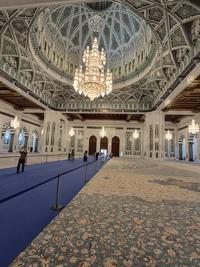
The Sutltan Qaboos Grand Mosque with largest prayer bug in world when finished (now 2nd largest). Chandelier with more than 50,000 Swaroski crystals. This is where I started the conversation with a male docent who wanted to know my faith background.
After much research and many false leads, I found a flight on Oman Air from Cochin, India to Amman, Jordan via Muscat, Oman. Because of extremely limited availability of ongoing flights, a three-day layover in Muscat was necessary. I booked it. I also found and reserved an Airbnb not far from Muscat’s airport. I was no longer travelling according to a pre-determined itinerary. I was a 75-year-old solo Jewish traveler, about to improvise my way through a Muslim country during a war.
I arranged for a taxi to take me from the Ayurvedic clinic in the forest of Kerala to the Ginger Hotel in the city of Cochin, two and a half hours away. It was within walking distance of the University of Cochin and had an elevated railway connection to the port and airport. After spending a few days exploring Cochin while waiting for my flight to TLV, I boarded my Oman Air flight on 12 March 2026. It took me away from India and away from my preset itinerary. Three and a half hours and 1,500 miles later I found myself in the spacious, modern, clean Muscat Airport. My first order of business was to find a currency exchange booth so that I could buy some Omani Rial (OMR).
At the small currency exchange counter there was an elderly customer in front of me. Although negotiating in English, I could tell by her accent that she was French. I was not in a hurry, but she was taking a long time because she was asking many questions about currency, taxis, hotels, etc. I gathered that she was becoming confused and flustered, so I asked her what she was trying to accomplish. I learned that she was trying to return to her home in Lemans, France but, like me, had been blown off course by the conflict. She had a flight reservation late the following day and, in the meantime, needed a hotel close by. She appeared to be in her eighties. I considered her dilemma and after thinking about the jeopardy of her dealing alone with unfamiliar currency, taxis, and hotels, I shared my concerns with her and extended an invitation to stay with me at my Airbnb for the night. She looked directly at me in silence for a good half minute and then said, “It’s been a while since I’ve been propositioned so, but you are right. My husband will not learn of this. Let’s go.”
We took a taxi to my Airbnb and after some difficulty finding the door and gaining entry, we learned that there was only one bedroom. I offered to stay on the couch in the living room, but she insisted that she would take the couch. After a cup of tea and some exchange of our histories we said goodnight. She left the next day. Needless to say, I acquired a standing welcome to the home of Claudine Viguier in Lemans.
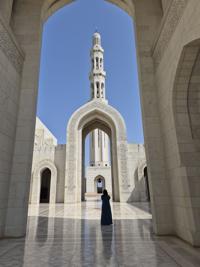
Sultan Qaboos mosque campus view. This area can accommodate 20,000 people but I was one of only a half dozen visitors because the skies were closed to tourists.
The next day I was notified by Oman Air that my ongoing flight to Amman had been cancelled indefinitely due to the widening scope of the conflict. The airspace was closed. I was stranded in Oman. Perhaps I should have followed the crowds to Athens or Barcelona. But I hadn’t, so I resigned myself to an extended stay in Oman.
The Airbnb would not do. I was not happy with its price, location, or condition. I started searching on the internet for a hotel room. Because tourism had ground to a complete halt, the hotels were desperate for revenue. Using the travel website, Agoda, I found a fabulous room at the Alyas Muscat Hotel on Al Marafah street in the Al Ghubra neighborhood for the incredible price of $30 a night, about 10% of its normal rate. I booked it for a full week but – at that price – was prepared for an indefinite stay. Accordingly, I searched for and found a high-end bicycle to rent. I also started studying about the notable attractions in the area. I learned that if I saw nothing else, I should visit the Muscat Opera House and the Sultan Qaboos Grand Mosque. Glancing at the map I saw that the Mosque was a mere two miles away, barely ten minutes by bicycle. I learned that non-Muslim visitors are permitted in the mosque from 8:00am to 11:00am daily except Friday. Entry was at no cost.
The following morning, I bicycled to the mosque, locked up my bike, and entered the mosque compound. It was virtually empty of visitors. There may have been a half dozen visitors in an area that, I was informed, could accommodate 20,000 people! Although of modern construction (1995 to 2001), it was deliberately designed to embody centuries of Islamic architecture. It is the nation’s principal mosque, conceived and gifted by Sultan Qaboos bin Said (b.1940 – d.2020). Built of Indian sandstone, the dominant feature is a central minaret with a dome reaching 300 feet toward Jannah, also known as Dar al-Salam, the Garden of Peace, or heaven. I made my way across a broad plaza to the main dome entrance where I doffed and shelved my shoes. I entered the central prayer hall through ornately carved Burmese teak doors and stared into the magnificence of the space. From the center of the dome apex hangs a chandelier over forty feet in length comprised of over 50,000 Swarovski crystals. The chandelier is so long and large that it has its own permanent internal ladder that a man uses to refresh light bulbs. I walked beneath the chandelier and stood under it, looking upward. As one’s eyes travel inward from the outer edge of the dome, one first sees a transition zone where the dome’s weight is supported. The eyes then cross a ring of windows at the base of the dome allowing natural light into the space. This is followed by a circuit of stalactite-like ornaments that form a cornice between the windows and the dome field. Finally, the eyes reach the apex from which the chandelier is suspended. If I had my druthers, I would have eaten a psycho-active mushroom and lay down on the carpet under that dome for a few hours of profound absorption.
Had I lain on the carpet under that chandelier I would have been laying on the largest hand-knotted Persian carpet ever commissioned (at the time). It is 46,000 square feet, weighing 21 metric tons. It has 28 colors and shades produced with traditional vegetable dyes. Its fabrication took 600 Iranian women nearly four years, tying 1.7 billion knots.
While I was absorbing the magnificence of the space, I was approached by a gentleman in an Omani collarless dishdasha and an embroidered kumma, a round cap. He introduced himself in English, saying he was a volunteer docent and asking me if I spoke English. I said that I did and we shook hands. He said his name is Hamed and asked if I would like to be shown around the mosque. I said that I would and he gestured me to walk beside him. As we walked, he began describing to me the features of the mosque that I just gave over to you. He then began speaking about the Muslim faith, telling me that it is not only a religion but also a legal system. Then he said, “If I may ask, so that I can tailor my presentation, what is your faith background?” I froze. I was not prepared for this question. I was suddenly filled with anxiety. How often does a Jew visit Oman, visit this mosque? What are Hamed’s sentiments about Judaism and Jews? I had no clue. I improvised a reply that was basically a lie. I told him that I really did not have a religious heritage and was sort of a new age type. He pretended to accept this response, and we continued the tour for another few minutes before he pointed out some other tourists who had just arrived and said he would attend them. We parted company and I left the prayer hall. I donned my shoes and skulked off. I found a bench in the plaza and sat down to assess my feelings. With my elbows on my knees and my chin in my hands, I stared at my well-travelled boots. I felt unclean. I felt I had despoiled a holy place with a lie and had acted with cowardice. After about twenty minutes I resolved to go back into the prayer hall and tell Hamed the truth; that I was a Jew.
As I was walking back, I encountered Hamed in the plaza talking with some people. I waited a few minutes for them to finish and then I signaled to Hamed that I wanted to have a word with him. I said, “Hamed. listen, you caught me off guard when you asked about my faith background. I didn’t know what to say because I am Jewish. I was nervous about revealing that.” He looked at me and said, “Why don’t we sit down and have some coffee. Come with me.” I followed him to a library where we found comfortable padded benches. He fetched a tray with a metal pitcher of hot coffee and a plate of dates. Then he asked, “Why were you afraid to reveal that you are Jewish?” I said bluntly, “I thought this might lead in short order to my death. I thought you might have a curved dagger under that dishdasha.” He laughed heartily and this exchange followed:
“Listen, Jon, I don’t have to kill you. Allah already has that all arranged. Three punches and your out.”
I asked, “What do you mean by three punches?”
He said, “The first punch was by the Babylonians 586 years before Isa”
I said, “Isa, is that your word for Jesus?”
He replied: “Yes, Isa ibn Miryam, Jesus son of Mary. The second punch was by Adolf Hitler in the 1930s and 1940s.”
“And the third punch?” I asked.
“We shall see. It is not up to me; it’s up to your people. We share the same one God. Your people seem to have a knack for making him very angry. It’s their disobedience in my opinion. So don’t worry about my dagger.” He then refilled my coffee, put some dates in front of me, and then retrieved a booklet in English about the precepts of the Muslim faith. He said, “I’m leaving this book with you. I will put my phone number on the last page. If you need anything while you are in Oman don’t hesitate to call. Safe travels my friend.”
My time with Hamid completely revised my outlook about being a Jew in a Muslim country. I came to feel much more comfortable. One of the reasons I had rented a bike was so I wouldn’t have to use buses or taxis where I might encounter some challenges because I was from America or looked like a Jew. Now that I was more comfortable, I took a taxi to the opera house. The opera house, while not as impressive as the Grand Mosque, is a significant cultural asset and quite handsome. But this is not meant as a travelogue, so I won’t get into its legacy.
While continuing to wait for the skies to reopen to commercial aircraft I settled into a routine in the neighborhood. The bellhops knew I would stow my bicycle under a stairwell in the lobby. The maids knew I wanted less than daily housekeeping, just water bottles and teabags left at my door. I found an Indian Restaurant around the corner where the mature headwaiter attended to me with a high level of ability and pride in his profession. And because there were so few tourists to be seen, I never had any problem getting a table by the window.
It was the last week of Ramadan, so there were no Arabic restaurants open during the day, hence the Indian restaurant. I did not know if I would still be there for Eid al-Fitr when everything opened again, but in fact I was.
The airlines were struggling to reopen. I had secured a reservation on a flight with Saudi Air through Riyadh to Amman, but it was cancelled before departure day. The same thing happened with a flight on Royal Jordanian direct to Amman. Finally, I secured a reservation on EgyptAir for a flight on Wednesday, 25 March to Sharm El Sheikh via Cairo. Sharm el Sheikh is at the bottom of the Sinai Peninsula. I had last been there in 1980 by bicycle from Haifa. The first available flight was 25 March, so this meant I would be in Oman for the beginning of Eid on 20 March. The arrival of Eid was amazing. The energy and activity level just exploded. I enjoyed walking the neighborhood, hanging out at the mall, and cycling along the seacoast where I could see tankers stacked up and idling because of the closed Strait of Hormuz.
Fittingly, my Omani visa was set to expire at midnight on 25 March. My flight would be departing only 90 minutes before expiration. Any delay that kept me in Oman past midnight could complicate matters.
Finally, departure day arrived, with a 10:20pm departure to Cairo. I had time that Wednesday to return the bike, say goodbye to the hotel and restaurant staff, and buy some Iranian saffron in tiny gift jars at a nearby spice shop. I also fulfilled the request of a young lady-friend of mine in Israel. She studies Arabic culture and language at Tel Aviv University. She had asked me to purchase a Koran for her. I found one at a bookstore. It had some nice gilt scrolling on the cover. At 7:30pm a taxi took me to the airport, leaving three hours for security and such. Aside from the personal and carry-on screening we are all accustomed to, Omani authorities conduct an exit interview at the airport. It is the last step before walking to your gate. Arriving at the interview point at about 8:45pm, I stood in line. It seemed to take only two or three minutes per person. When my turn came the official asked me if I had enjoyed my visit to Oman. I assured him I had. He saw that I was ticketed to Cairo. He then began thumbing through my passport page by page. He came to a page that caused him to alert. He looked at me and asked me to step aside. He told me he was going to ask a supervisor something, and he made a hand signal to someone far away. He then began processing other passengers while I stood by. I was concerned but acted cool and calm, not asking any questions. Finally, after ten long minutes, two men about 45 years old wearing long dishdashas came over and had a quiet conversation with the agent who held my passport. They took the passport from him and wagged a finger at me to follow them. We stepped over to a quiet corner and, after looking at my passport, one of them interrogated me while the other one studied my demeanor. It went as follows:
“We see you’ve traveled to Israel previously. How many times have you been there?”
I decided I could not remain cool and calm unless I was completely honest.
“I’ve been there four or five times.”
“Why do you go there?”
“I am retired and, as you see, I do a lot of foreign travel in many parts of the world. I have many friends in Israel, so I visit them.”
Silence, then the one who had been studying me asked: “Is that the Quran in your pocket?”
I had completely forgotten that I had placed the Koran I had purchased in the top left breast pocket of my four-pocket safari jacket. I did not know that it was peaking out of the pocket where the gilt scrolling was visible.
I said, “why, yes, it is.”
“Do you read Arabic?”
“No, I don’t. I purchased this at a friend’s request. A friend in Israel.”
“Does he read in Arabic?”
“It is she. She is studying Arabic culture and language at Tel Aviv University.”
“Is she a Jew or a Muslim?”
I was getting anxious that I might find myself in Oman with an expired visa if I was delayed or not permitted to board my flight. The expired visa could give them a pretext to detain me further. I tried to remain calm and replied honestly.
“Yes, she is a Jewish Israeli with an interest in peaceful co-existence.”
“It seems she is very broad minded” One of them responded.
I saw in this last question an opportunity for humor, which I had often seen my father-in-law – Bob Alpern – put to good use when in a bind.
I said, “She must be broad minded if she accepts me as a friend of hers.”
Once they got the humor and saw me making a joke at my own expense they softened visibly. They looked at each other. One gave the other a nod and my passport was handed back to me. “Have a good flight sir.”
With that I left Oman for Cairo. Things transpired relatively uneventfully from that point. After a six-hour layover in Cairo I flew Egyptair to Sharm El Sheikh. I took a pre-arranged Kiwi taxi with a driver and armed guard from Sharm el Sheikh to the Taba, Egypt border post. That taxi ride took about three hours. At Taba I walked through the border facility into Eilat, Israel. From there I took a bus to Dimona where I was picked up by the very same friend, David Sinai, with whom I had enjoyed a Rendez vous in El Salvador two months prior. He had returned to Israel, as had I.
The Detroit Jewish News has been supported by readers like you since 1942. Support independent, local, Jewish journalism with a donation today.