
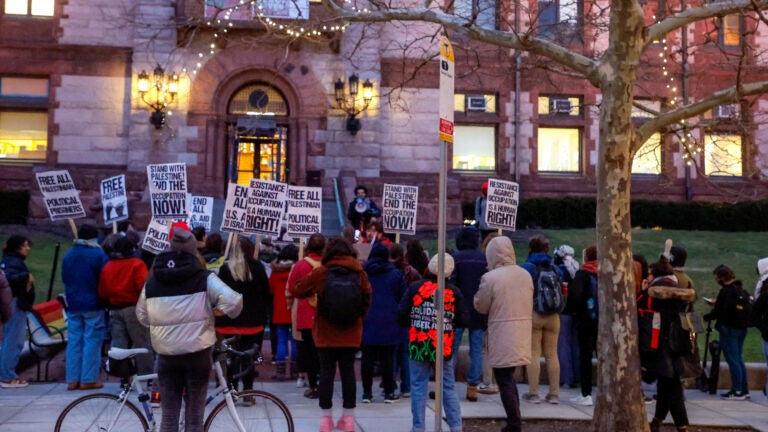
“We are asking our city to divest from the murder of Palestinians,” said Councillor Ayah Al-Zubi, who co-sponsored the initial divestment proposal.
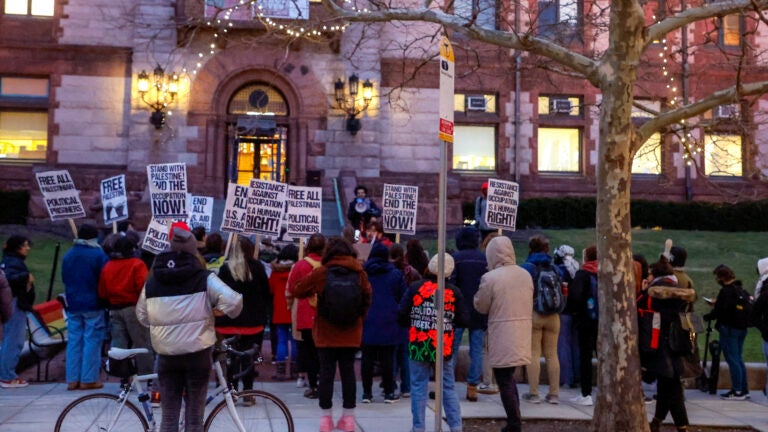
Pro-Palestinian supporters demonstrate in front of Cambridge City Hall in 2024. Matthew J. Lee / The Boston Globe, File
October 30, 2026 | 11:22 AM
4 minutes to read
The Cambridge City Council voted by a slim majority this week to divest the city’s pension and retirement funds from companies with a stake in Israel’s actions in Palestinian territories.
The amended policy order approved Wednesday specifically calls for divestment from “companies with severe and consistent involvement directly contributing to genocide, apartheid, and occupation of Palestinians,” including government and defense contractors Palantir, Elbit Systems, Lockheed Martin, GE Aerospace, and Boeing. The order applies to the Cambridge Retirement Board and the city’s Other Post-Employment Benefits Fund.

Cambridge City Council delays votes on divesting from companies with ties to Israel
The proposal was briefly tabled earlier this month after the City Council was bombarded with hours upon hours of heated public comment. Vice Mayor Burhan Azeem introduced an amended version Wednesday, explaining that while he does not feel Cambridge should involve itself in foreign policy, the council has a long history of condemning various actions around the world.
Azeem also said he felt it important to clarify the council’s intentions and emphasize that Cambridge is welcoming to ethnic groups and nationalities on either side of the conflict. His version specifically states that the policy does not constitute endorsement of the controversial Boycott, Divestment, and Sanctions campaign against Israel.
Councillor Marc McGovern offered an additional clause to Azeem’s substitute proposal, noting that some of the companies on the initial divestment list also have contracts with U.S. Immigration and Customs Enforcement or ties to conflicts in Sudan and the Democratic Republic of the Congo.
“We cannot control what happens elsewhere in the world, but we can take responsibility for the decisions we make here in Cambridge, and our public dollars should not support companies contributing to human rights abuses,” McGovern said.
He voiced support for the divestment proposal while acknowledging “the many Jewish residents who are genuinely frightened by the rise in antisemitism in our community.”
Divestment opponents who addressed the council had previously expressed concerns that singling out Israel would fuel hatred against Jews at home and abroad. Councillor Tim Flaherty echoed that sentiment Wednesday, arguing that calling out Israel alone would be “an exercise that will single out Jewish people.”
McGovern, however, suggested the two interests aren’t mutually exclusive.
“We can examine whether our public funds are supporting companies involved in the war in Gaza as well as other countries, and at the same time condemn antisemitism,” McGovern added. “These responsibilities don’t cancel out the other.”
Councillor Ayah Al-Zubi, who co-sponsored the initial divestment proposal, said she had some “qualms” about Azeem’s substitute but would still support it because it achieves the same goal.
“We are asking our city to divest from the murder of Palestinians,” Al-Zubi added.
Councillors voice opposition
A competing, less specific version of the policy order was offered up by Flaherty and Councillors Patricia Nolan, E. Denise Simmons, and Catherine Zusy, though their substitute failed to achieve a majority. All four ultimately voted against Azeem’s version, which passed with five votes in favor. The council also narrowly rejected a second policy order to draft language for an ordinance that would bar Cambridge from contracting with companies “complicit” in Israel’s military actions in Palestinian territories.
Speaking against the divestment proposal, Nolan argued that “passing such an order does not help the peace movement. It helps the right-wing — in Israel and here.”
She added: “There are thousands of people in Israel and Palestine working for peace. We should be supporting them in any way we can.”
Like Flaherty, Simmons suggested the divestment order risks “fanning the flames” of antisemitism. Zusy, meanwhile, asserted that divestment was “way out of our purview” and wouldn’t have any global impact.
“What it will have is local impact, making many of our residents feel unsafe and unwelcome,” she continued.
Zusy also said she would support divestment from weapons manufacturers at large, “but I don’t think this is going to change the world, and I wish we would focus on things that would really make a difference right here.”
But Mayor Sumbul Siddiqui voiced support for the amended divestment policy order, adding, “The fact that one action can’t solve a problem is not a reason to be complicit in it.”
Local reaction
Cambridge for Palestine, which campaigned heavily in favor of the divestment and boycott proposals, said its organizers have identified more than $24 million invested in companies to which the newly passed policy would apply.
Yet while Cambridge for Palestine celebrated the divestment order’s passage, others met the news with disappointment. The American Jewish Committee of New England said it was “dismayed” by the vote, and both the AJC and Jeremy Burton, CEO of the Jewish Community Relations Council of Greater Boston, took issue with the inclusion of language referring to genocide, a contested label for Israel’s actions.
“The City Council has not undertaken the careful and informed examination that an extraordinary judgment of this gravity requires,” Burton said in a statement.
“We appreciate the Council’s stated opposition to antisemitism,” he continued. “But the Jewish community’s concerns cannot be resolved simply by adding language condemning discrimination while adopting an order that creates further harm.”
Samantha Joseph, regional director of the New England arm of the Anti-Defamation League, concurred.
“While the City Council states that the city stands unequivocally against antisemitism, it cannot ignore how this ordinance fuels tensions in the community and risks continued targeting of [Jewish] residents,” Joseph said in a statement.

Abby Patkin is a general assignment news reporter whose work touches on public transit, crime, health, and everything in between. She has been covering the Lindsay Clancy murder case since January 2023.
Sign up for the Today newsletter
Get everything you need to know to start your day, delivered right to your inbox every morning.