
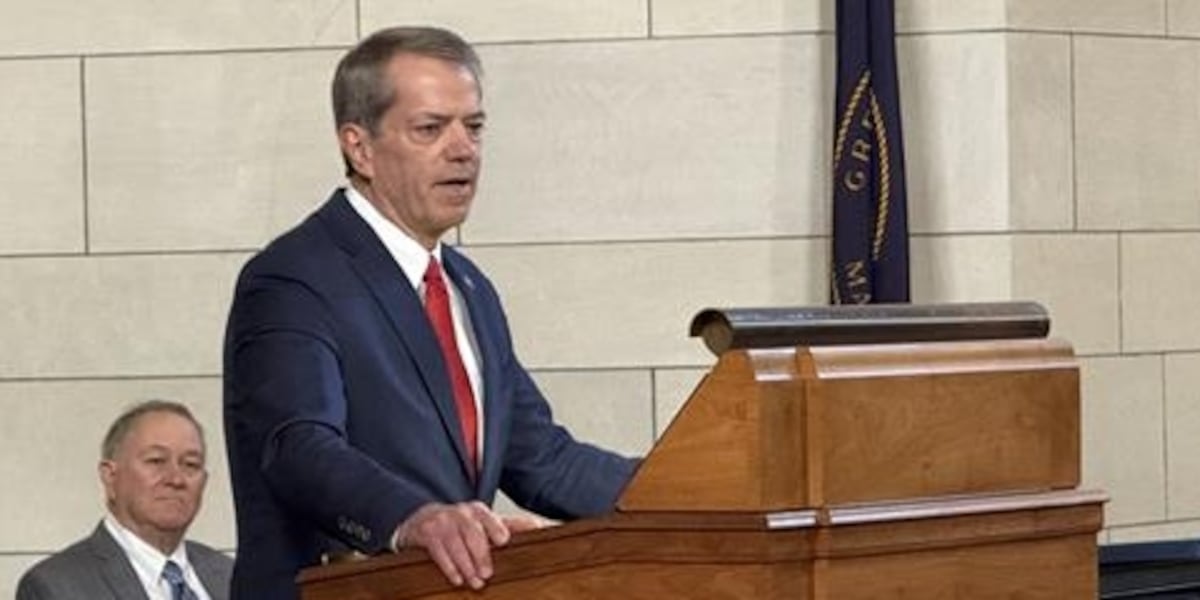
LINCOLN, Neb. (WOWT) – Lincoln Police have concluded their investigation into the $2.5 million no-bid emergency contract awarded by the state. The state auditor said the contract “smacks of favoritism” and questioned the nature of the emergency order steered by Gov. Jim Pillen.
The case will now be turned over to Nebraska Attorney General Mike Hilgers’ office.
The LPD began investigating the case in March 2026.
“The Lincoln Police Department (LPD) has completed its investigation into a 2024 no-bid emergency contract sought by the Nebraska Department of Economic Development. The investigation has been turned over to the State Attorney General’s Office for review. In March 2026, the LPD Technical Investigations Unit (TIU) began working diligently on this case. TIU investigators are experienced and specialize in investigations that require careful, methodical steps, including the use of court-authorized processes to obtain necessary records and information. That level of thoroughness is essential to ensuring a complete and accurate investigation. From the onset, the only timeline we prioritized was the one required to conduct a detailed and responsible investigation. Our investigators remained focused on completing the work properly and without bias.”
According to the report submitted Jan. 6, the Nebraska Department of Economic Development awarded a $2.5 million one-year contract to Global Sustainability Developers to help grow the bioeconomy industry in the state. The deal was made just a month after the Nebraska Legislature passed a bill on the matter in early April 2024, LB1412, put forward by Speaker John Arch on behalf of Gov. Pillen.
GSD did fulfill its contractual obligations, according to Foley’s report; but he raises questions about how that contract came about as well as why it was expedited — and why it wasn’t vetted through the state’s regular processes.
“Doing so resulted in the apparent exercise of ‘favoritism,’” barring any number of qualified applicants from being formally considered,” the report states.
Foley’s report includes a timeline, showing that weeks after the bill was passed, language for the contract described as “already vetted thru [President and CEO of GSD Julie Bushell] and the Governor” was sent to the legal office at the DED. Pillen later acknowledged that his office had indeed recommended GSD for the contract, but said it had resulted in a “joint decision” with then-Nebraska Economic Development Director K.C. Belitz.
When Foley’s office inquired about why the typical bidding requirements, required by state law, weren’t applicable to that particular contract, Belitz said it was “an emergency contract to comply with the requirements of the bill.” But Foley’s report said the administration never provided an explanation about why the contract should be designated as an emergency — and noted that only a small fraction of 1% of more than 8,400 state contracts awarded across two fiscal years had received such a designation, and none of them were no-bid contracts.
“The only remotely plausible basis for designating the Contract as an ‘emergency’ would have been to conserve ‘public resources’ — in the form, presumably, of unclaimed Federal grant monies placed “at risk” absent immediate action to obtain them,” the auditor’s report states. “The only other allowable reasons for an emergency designation… would have been to respond to either ‘an urgent or unexpected requirement’ or a ‘health and public safety’ concern. Clearly, neither of those alternatives were applicable to this situation.”
Foley’s report also points out that the state had more than three months — between the time the bill was signed April 2, 2024, and when it went into effect June 30 of that year — to take bids and secure a contract.
“Rather than following the well-known competitive bidding provisions of the law, the Department declared an ‘emergency’ and awarded a highly lucrative $2.5 million contract to a handpicked ‘winner’ on a no-bid basis,” the report states. “There can be little doubt that adherence to statutory bidding requirements would have attracted numerous highly qualified applicants who, due to the lack of such action, were locked out of the opportunity to compete for the contract.”
Red flags
The auditor’s report notes a few concerns in its timeline.
The timeline includes an entry for October 2024, when an amendment was added to the contract’s conflict of interest and liability sections, freeing GSD from any potential liability in the event such allegations came forward. It also flagged financial issues GSD was apparently having, particularly that a newly opened account had carried a negative balance for more than a month.
Foley also raises concerns about DG Fuels, a company for whom Bushell went on to provide consulting services for after her contract with the state ended in February 2025 — two months earlier than initially agreed upon.
“Though permitted by an amendment to the Contract, such an arrangement could give rise to concerns regarding possible lack of independence by, or even undue influence upon, GSD while promoting the DG Fuels project — one of the supposed triumphs for which Nebraska paid GSD $203,333.33 a month under the Contract,” Foley’s report states.
According to the report, DG Fuels made promises to Phelps County that went unfulfilled. In August 2024, DG Fuels put out a press release saying it planned to build “‘the first Midwest production facility’ for synthetic aviation fuel,” promising 650 jobs, an influx of water from the Ogallala Aquifer via rail transport, and an overall boost to the local economy. But more than a year later, the company hadn’t provided any details about the facility plans, holding its second town hall on the project just this week.
Foley said in the report that he had spoken with former Congressman Collin Peterson of Minnesota about a plant DG Fuels had promised there but not delivered.
“In my opinion, there is no way in hell that thing is ever going to be built. DG Fuels put out their press release without any meaningful input from the local community to be impacted. I am concerned for those who might make decisions or assumptions based on press releases,” Peterson reportedly told the auditor’s office.
Foley’s report details 10 other projects in as many states that DG Fuels — which had gone through various name changes — had also not delivered on, dating as far back as 2002, even as the company’s chairman and CEO had been taken to court for garnishment actions, federal tax liens, and other debt collection issues.
Proposed solutions
The state auditor’s report included recommendations for ways the Nebraska Legislature could ensure that the state not find itself in similar questionable situations in the future.
Foley suggested that any contracts deemed an “emergency” by the state be approved, potentially on an expedited timeline, by both the auditor’s office and the Director of Administrative Services.
He also recommended that the state ensure it’s doing business with reputable developers, particularly as it looks to expand Nebraska’s stake in the bioeconomic industry; and called on lawmakers to ensure the state has mechanisms in place to hold such companies accountable for promises made to Nebraska communities.
Read the auditor’s report
Copyright 2026 WOWT. All rights reserved.