
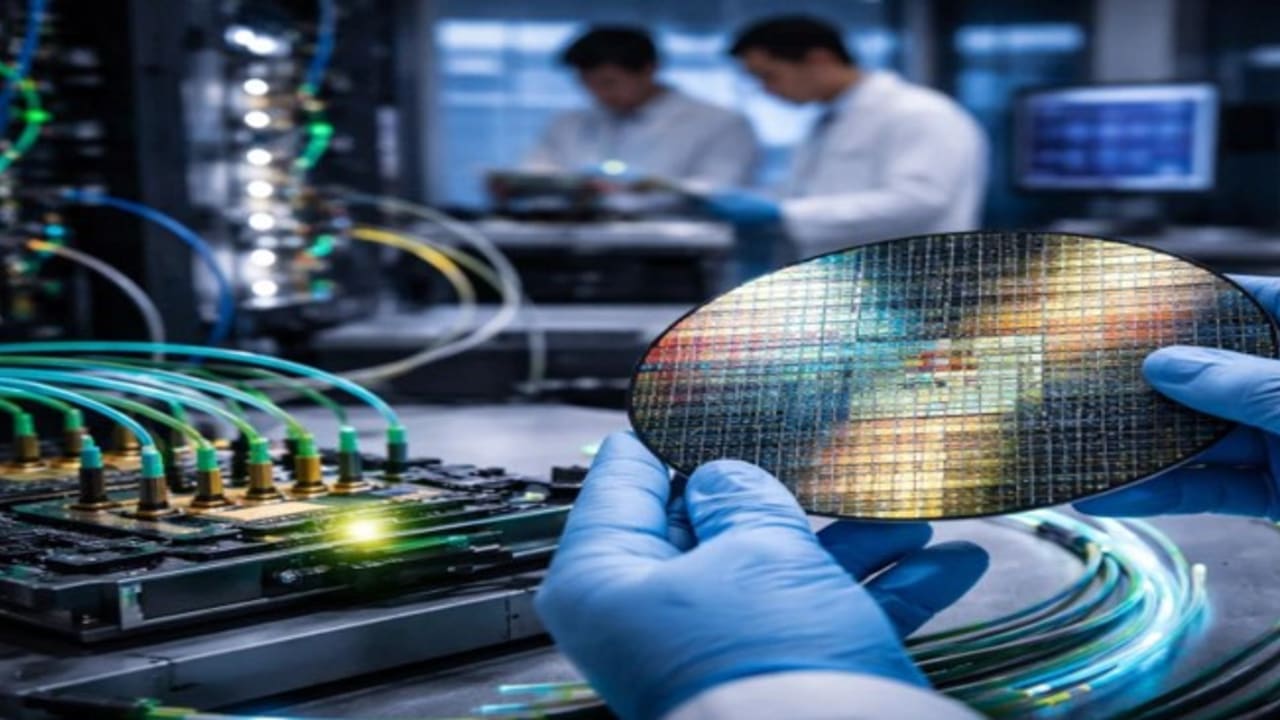
Israel is one of the developed world’s fastest-growing economies, home to a world-class technology sector, and its stock market remains badly under-owned by global investors. That combination will not last. We believe foreign investors should increase their exposure to Israel now, and the Tel Aviv Stock Exchange is the most direct way to do it.
Growth that is structural, not cyclical
Israel’s economy grew 119% between 2005 and 2025, against 46% for the OECD as a whole. That is not a market riding a single cycle. It is an economy that keeps compounding through conflicts, elections and rate shocks.
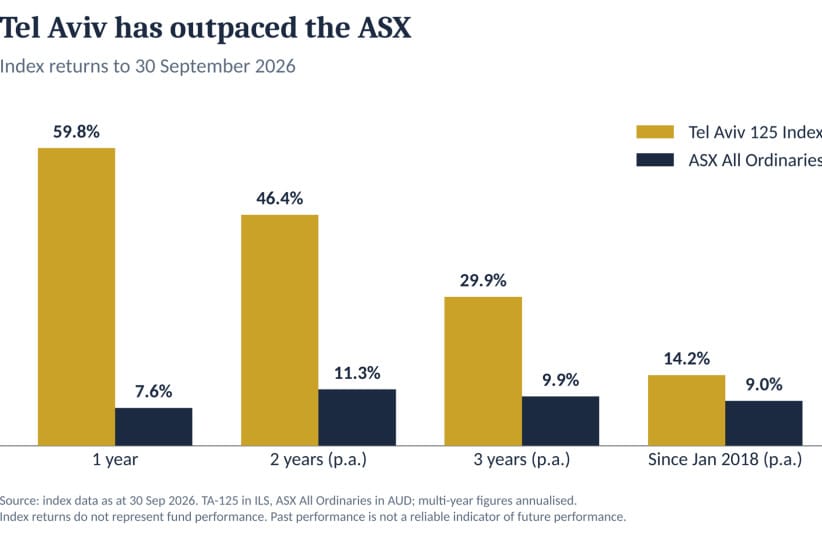 Tel Aviv has outpaced the ASX. Index returns to 30 September 2026 (credit: ISRAEL INNOVATION AUTHORITY)
The outlook remains strong. In October 2026, the Bank of Israel forecast GDP growth of 3.4% this year and 5.1% in 2027, excluding production abroad by Israeli companies. Including it, the forecast rises to 5.6% and 7.5%.
An innovation engine with a young workforce
Technology drives that growth. The sector makes up 18.3% of GDP and generated about US$85 billion of exports in 2025, roughly 58% of Israel’s total.
Demographics is another major factor: fertility is near 2.9, against about 1.5 for the OECD, and the population is projected to grow from 10.1 million to as much as 17.6 million by 2050. Global rating agencies mark the demographic factor as one of the most evident signs of future growth.
A market the world is only starting to own
Equity markets have begun to notice. In the year to 30 September 2026, the Tel Aviv 125 Index returned 59.8%, against 7.6% for the ASX All Ordinaries. Since January 2018, it has returned 14.2% a year versus 9.0%. These are local-currency index returns, not fund returns.
Global capital is following. Foreign holdings on the Tel Aviv Stock Exchange reached a record US$154 billion in the second quarter of 2026. Israel’s inclusion in leading international indices and ETFs from 2026 sets up a further re-rating as passive money arrives.
Beneath it sits a domestic bid that never switches off. By law, 18.5% of every Israeli salary goes into pension savings, a steady flow of long-term capital into the local market through every cycle.
 Sagi Ben Yosef, Managing Partner at Alpha, manager of the Pengana Alpha Israel Fund (credit: Courtesy)Tech exposure the ASX cannot offer, at a lower price
Technology makes up less than 10% of the Australian market, which is dominated by banks and miners. The Tel Aviv market is far more heavily weighted to technology, from semiconductors and cybersecurity to defense technology.
That exposure often comes cheaper. Many Tel Aviv-listed companies earn most of their revenue from global customers, yet trade on a small exchange that few international analysts cover. In our view, that lack of attention leaves them priced below comparable technology businesses listed in New York.
The AI boom needs more than models: it needs chips inspected, measured and connected at ever-finer tolerances. Israel supplies the critical hardware that AI runs on, not just the models. Our holdings include “Camtek” in advanced-packaging inspection, “Nova” in precision metrology and “Tower Semiconductor”, whose silicon photonics move data by light inside AI data centers. We are not an AI fund, but we own critical suppliers to it, allowing us to be very well positioned to benefit from the AI revolution.
The gap between Israel’s economic weight and its place in global portfolios is the opportunity; we call it the “Hidden Gem”. As index inclusion and foreign flows narrow that gap, early holders stand to benefit most.
Why the Pengana Alpha Israel Fund
Capturing that opportunity takes local knowledge. The Pengana Alpha Israel Fund, managed by Alpha, gives investors active exposure to Israeli equities through AUD and USD unit classes. It is the only fund domiciled in Australia, governed by Australian regulation and administered by Pengana Capital, that gives investors access to an on-the-ground Israeli fund manager with a strong track record over more than 20 years. No other vehicle is structured this way to let Australian investors diversify into the Israeli stock market.
Alpha’s process rests on in-depth local research, not a passive index tilt, across the country’s growth engines: technology, defense and infrastructure. The fund is small enough to own special-situation and under-the-radar names that larger funds cannot. The team has managed Israeli equities through multiple conflicts, elections and rate cycles with a disciplined risk process.
The record reflects that approach. To 30 September 2026, the fund’s Class A (AUD) units returned 26.3% a year over three years, 15.0% a year over five years and 13.3% a year since inception in January 2018, net of fees. The ASX All Ordinaries returned 9.9%, 5.0% and 9.0% over the same periods.
Eyes open
Israel carries a geopolitical risk, and a smaller market can be more volatile. We believe those risks are best managed by people who have lived through them, and that they are a large part of why the opportunity exists.
For investors seeking growth that is not tied to China, commodities or US mega-caps, Israel deserves a place in the portfolio. The Tel Aviv Stock Exchange is where that story trades, and the Pengana Alpha Israel Fund is, in our view, one of the most experienced ways to own it.
Sagi Ben Yosef is Managing Partner at Alpha, manager of the Pengana Alpha Israel Fund. Contact: sagi@alphalti.com.
NOTE: This article is general information only and does not take into account any person’s objectives, financial situation or needs. Before investing, consider the Fund’s Product Disclosure Statement / Offer Document, available from Pengana Capital Ltd (ABN 30 103 800 568, AFSL 226566). Past performance is not a reliable indicator of future performance. Fund returns are for Class A (AUD), net of fees and expenses, assuming reinvestment of distributions. Index returns do not represent Fund performance. GDP forecasts: Bank of Israel Research Department Staff Forecast, October 2026. Technology export and GDP shares: Israel Innovation Authority, State of High-Tech 2026.