
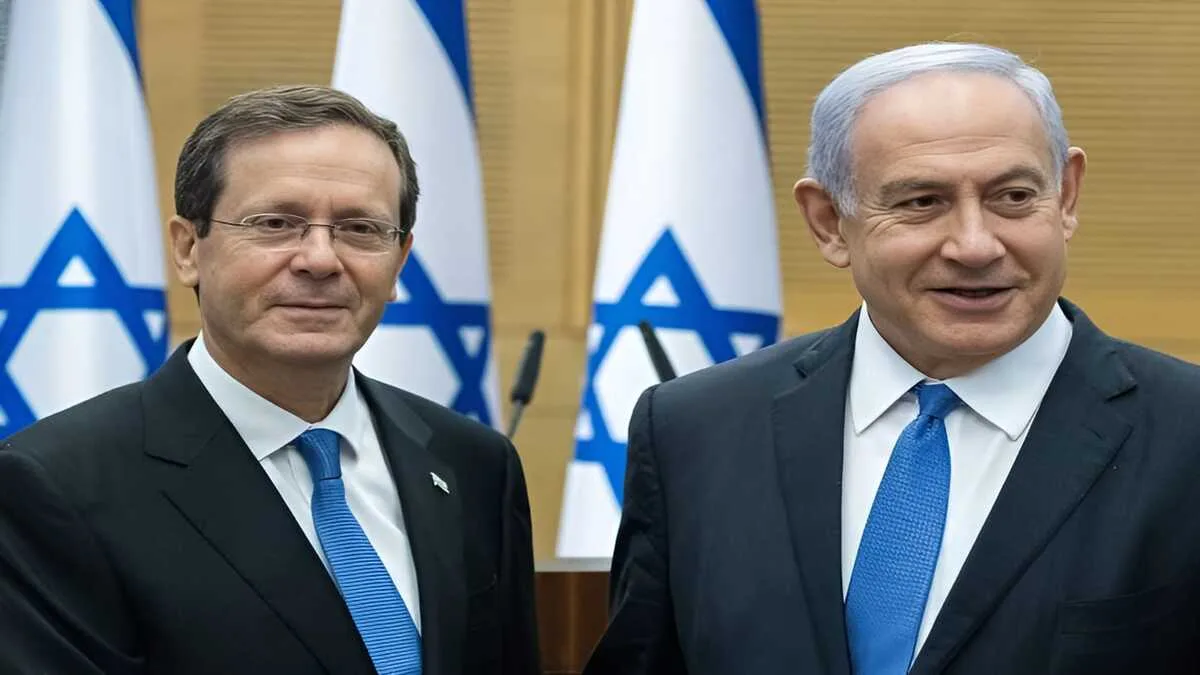
Israeli President Isaac Herzog has urged rival political leaders to accept the results of the inconclusive 2026 parliament election and pursue compromises to prevent another vote, as Arab parties securing a record 19 seats emerge as potential kingmakers in negotiations to form the next government.
With neither Prime Minister Benjamin Netanyahu’s bloc nor the Jewish-led anti-Netanyahu parties able to secure a majority independently, negotiations are expected to focus on possible cooperation with Arab factions, proposals for a national unity government and disagreements over parliamentary appointments.
Herzog will begin formal consultations with representatives of the factions elected to the 26th Knesset on Wednesday, 4 November, before deciding which lawmaker should receive the mandate to form a national government.
Herzog urges leaders to accept election results
Speaking on November 1, at a state memorial ceremony for Chaim Weizmann, Israel’s first president, Herzog called on political leaders to abandon rigid campaign positions and recognise the reality created by the parliament election results.
“This is the time to tell all the leaders: stop climbing trees, and face reality,” Herzog said, adding that the President’s Residence would seek to help the rival camps find a way forward. He said the results were an established fact and urged leaders to approach the coming consultations with an open mind.
President Herzog said he would receive the official parliament election results from Central Elections Committee chairman Justice Noam Sohlberg on November 4 before beginning consultations with the elected factions. The President’s Residence subsequently confirmed that all faction leaders had been invited to participate.
Eyal Shviki, director general of the President’s Residence, said Herzog expected representatives to listen to one another, share ideas and seek compromises to prevent another parliament election. He said the consultations should take place in a dignified, respectful and substantive manner amid uncertainty over the formation of the next government.
The election results leave PM Netanyahu’s bloc with 53 seats and the Jewish-led anti-Netanyahu parties with 48. The Arab-led Joint List and Ra’am together secured 19 seats, making their positions potentially decisive in the negotiations. Although PM Netanyahu’s opponents collectively command 67 of the Knesset’s 120 seats, several parties have ruled out joining a coalition with Arab, non-Zionist factions.
Arab parties emerge as potential kingmakers
The Joint List and Ra’am are expected to recommend Gadi Eisenkot, a presumed candidate for the premiership among PM Netanyahu’s opponents, during Herzog’s consultations. Joint List MK Ahmad Tibi said on October 31, that his party would recommend a candidate from the anti-Netanyahu Zionist parties and provide outside support for an alternative government.
Ra’am is also expected to recommend Eisenkot. Naftali Bennett and Avigdor Liberman, however, have yet to make unequivocal public commitments regarding their positions.
Democrats chairman Yair Golan has emerged as the most explicit advocate within the Jewish-led opposition bloc for cooperation with Arab parties. Hebrew-language media reported that Golan had discussed possible coalition arrangements with Joint List leaders Yousef Jabareen and Tibi. He also met Ra’am chairman Mansour Abbas and other opposition leaders last week as part of efforts to replace PM Netanyahu.
Several Hebrew-language outlets have reported that senior United Torah Judaism (UTJ) figures may be willing to support an Eisenkot-led government from outside the coalition. Such support could be conditional on legislation and budgetary provisions for the Haredi community, alongside progress towards a future arrangement governing military conscription.
UTJ chairman Yaakov Asher had said before the parliament election that his party would not enter a government without legislation regulating the military-service status of yeshiva students. He also declared that the party no longer considered itself bound to a political bloc.
The potential involvement of Arab parties and UTJ highlights the complicated negotiations facing both political camps as they seek parliamentary support for a government.
PM Netanyahu floats unity government as speaker dispute looms
Benny Biton, mayor of Dimona and a senior Likud figure allied with PM Netanyahu, said on Sunday that the prime minister wanted a national unity government. Speaking to Kan Reshet Bet radio, Biton proposed that Herzog and US President Donald Trump serve as guarantors of an agreement between the rival camps.
“I’m saying this firsthand: Benjamin Netanyahu wants unity,” Biton said, insisting that the proposal was not a political bluff. He said he had spoken with Herzog on October 31 and believed the president, together with Trump, could help overcome opposition distrust of PM Netanyahu. Biton acknowledged, however, that he did not know whether PM Netanyahu and President Trump had discussed a unity government directly during a recent conversation.
Biton appealed to Eisenkot, Bennett and Liberman to enter negotiations, arguing that Israel needed a national government immediately. He also said he had spoken with UTJ figure Motti Babchik on November 1 morning about military service for ultra-Orthodox men. According to Biton, Babchik indicated that recruitment arrangements could be resolved, adding that the Haredi community had recognised the need for a different formula after 7 October 2023.
Meanwhile, Biton warned opposition parties against using their parliamentary majority to remove Knesset Speaker Amir Ohana without an agreement with PM Netanyahu’s bloc, describing such a move as a potential “declaration of war” that could jeopardise unity talks.
The opposition has discussed replacing Speaker Ohana soon after the new Knesset is sworn in on 10 November 2026. Golan said the bloc would prioritise replacing the speaker, appointing committee heads and establishing a state commission of inquiry into the failures surrounding the Hamas attack of 7 October 2023. Tibi said the Joint List would support both replacing Ohana and establishing the commission.
PM Netanyahu’s coalition whip, Ofir Katz, meanwhile, ruled out a rotation agreement under which PM Netanyahu would share the premiership in a unity government. He said parties wishing to join the government would have to do so on the basis of the existing coalition.
With consultations approaching, the positions taken by Arab parties, UTJ and the rival political blocs will shape Herzog’s efforts to identify a candidate capable of forming Israel’s next government.