
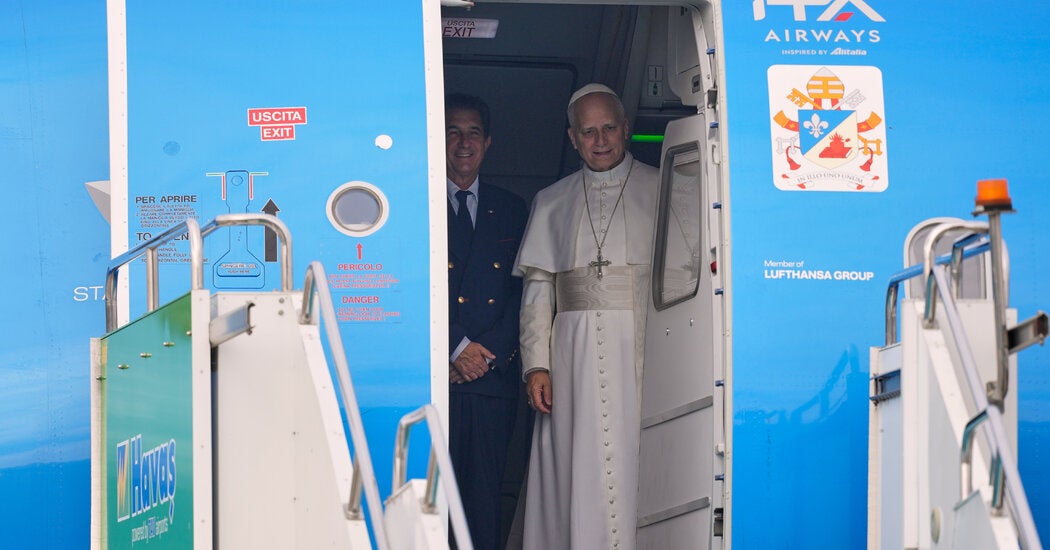
A day before Pope Leo XIV departed for France in September, on the fourth major international trip of his papacy, the crew of the plane he was to use, known colloquially as “Shepherd One,” gathered to learn the inviolable rules of the flight.
No selfies with the pope, said Gennaro Anastasio, the senior cabin manager, as he reeled off a list of dos and don’ts.
If the Holy Father offers his hand, shake it, don’t kiss it. Make no personal requests of the pontiff, such as asking that he pray for family members. Check the bathroom at the front of the plane — the one used by the pope — several times throughout the flight and keep it spotless. Don’t speak directly to the pope, but talk to his personal secretaries.
And mind your language. The men wearing black robes with red sashes and skullcaps should be addressed as “eminenza,” the salutation for cardinals, the highest-ranking clergy except for the pope. The men in purple caps and sashes are bishops and should be greeted as “eccellenza.”
“Don’t mess up,” said Mr. Anastasio, an impish 67-year-old. “If, though, you call a bishop ‘eminenza,’ he’ll say, ‘No I’m not an eminenza,’” he added with a chuckle. “And you can say, ‘You’ll become one!’”
Above all, he said, the crew should deliver anything the papal passengers ask for. “There’s never the need to say, ‘I’m sorry, it’s not possible, that’s not allowed, it can’t be done,’” Mr. Anastasio said. “Here, it’s done. Always.”
The Vatican, unlike the United States government, owns no dedicated planes and has no equivalent to Air Force One. Instead, the pope always flies commercial — in business class on charter flights operated by regular airlines.
For more than six decades, ITA Airways — and its predecessor, Alitalia — has been the preferred airline for the first leg of the pope’s foreign journeys, and sometimes more. Mr. Anastasio has led crews on more than 80 of those flights, but many members of those crews do it only once. Mr. Anastasio is preparing for the pope’s trip to Latin America, a 12-day journey through three countries starting Friday.
Last month, Pope Leo underwent surgery for lung cancer, but his doctors have cleared him to travel.
For ITA, being the pope’s preferred carrier is a clear bragging right. The pope’s international trips are among the most public events of any papacy, allowing the pontiff to meet with the faithful in their home countries and demonstrate the reach of the Roman Catholic Church.
Joerg Eberhart, ITA’s chief executive, said the role was not guaranteed. The airline regularly competes in Vatican tenders for the main papal flights, he said, and the airline loses money operating them.
These are no ordinary flights. For starters, they are almost always perfectly on time, unlike over half of ITA’s other flights last year. The papal plane’s call sign — AZ4000 — is instantly recognizable to air traffic control towers across the world, allowing them to clear routes to ensure the flights take off and land according to schedule.
That means the plane can push back and head for the runway as soon as the pope steps aboard and sits in his usual front-row seat on the left side of the plane.
The typical limits for carry-on baggage are overlooked. During the taxi to the runway, the cabin crew skips the usual announcements and safety videos to allow the Vatican news corps to work without background noise. All the seat backs — including in economy class, where the journalists sit — are topped by a small cloth, known as an antimacassar, that is embroidered with the pope’s coat of arms. (They make for nice souvenirs.)
In Rome, the planes take off from a terminal reserved for V.I.P. charter flights at Fiumicino Airport. Officers from Italy’s military police force and the Swiss Guard, the Vatican security service, patrol the aisles. Bishops and cardinals are driven directly to the tarmac and board shortly before the pope, who arrives by black car or papal helicopter just before takeoff and climbs the staircase to the front door, news cameras flashing.
On rare occasions, the papal flights cannot be cleared for on-time takeoff. When Leo’s predecessor, Pope Francis, was departing for Cuba in 2015, another jet stalled on the runway, Mr. Anastasio recalled. Francis suggested the pilot simply fly over the beached plane, and Mr. Anastasio had to explain that was not possible, he said. The flight departed 63 minutes late, but the pilot made up the lost time in the air so that Francis still made his first appointment in Havana.
Mishaps can arise on arrival, too.
When Pope Leo landed in Cameroon in April, Mr. Anastasio noticed that a ruby-red carpet with gold trim, laid out by local officials on the passenger staircase, was twisted in places. Mr. Anastasio ran down to straighten it to ensure the pope would not trip, he said.
Perhaps the most important detail for any flight is getting the onboard meals right. On a recent trip to France, Mr. Anastasio said, he needed to figure out how to cram in a breakfast service around the pope’s traditional one-on-one greetings with journalists on a flight lasting less than two hours.
He calculated that the crew would have no more than 30 minutes to get from the front of the cabin to the back, which meant that the passengers would need a meal that they could scarf in 10 minutes or less.
After consulting with ITA’s chefs, the Vatican opted for a tray with a scrambled-egg-and-bacon sandwich, slices of prosciutto, pecorino and primo sale cheese, fruit, petit fours, a twisted roll and a croissant.
For many journalists, it’s a rare chance to experience business-class service with meals served on ceramic plates with cloth napkins, drinks served in real glass, cutlery made from silverware and a menu printed on a thick card.
Mr. Anastasio said he liked to add local touches for meals — hence the croissants for France and the Turkish chocolates he bought in Istanbul to serve in gift boxes on the return flight.
During the eras of John Paul II and Benedict XVI, Mr. Anastasio said, the popes and their entourages ate premium meals while journalists and lay staff from the Vatican ate economy-class fare.
Then Francis boarded a papal flight, observed the formal meal service for the clergy — and asked Mr. Anastasio what the journalists ate. When the cabin manager showed the pope the economy-class trays, Francis told him, “I am not a king,” Mr. Anastasio recalled. From then on, the journalists ate the same meals as clergy.
Mr. Anastasio, nevertheless, made sure to offer some special treats to Francis. Once he learned the pope liked Havanna lemon cookies from Argentina, Mr. Anastasio started bringing the biscuits on every flight. And Francis occasionally asked for customized meals, including rice with Parmigiano-Reggiano and Amalfi lemons that Mr. Anastasio personally prepared on board.
Benedict once asked for some premium mortadella — sliced pork sausage — from Campotosto in central Italy, recalled Giovanni Bernardi, a chef for ITA’s main meal supplier. Mr. Anastasio joked that the meal almost caused “a diplomatic incident” because the flight was on its way to a Muslim country that he would not name.