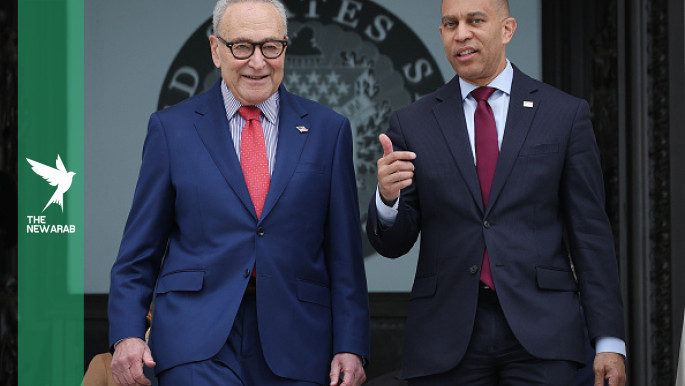
Chuck Schumer and Hakeem Jeffries represent a Democratic Party establishment that is still supportive of Israel [Getty]
The Democrats’ sweeping US midterm election victory has brought new critics of Israel to Congress, raising questions about whether the party’s pro-Israel establishment will allow meaningful changes to Washington’s military relationship with its longstanding ally.
With Democrats securing both houses of Congress, newly elected lawmakers demanding restrictions on US military support for Israel could push for greater scrutiny of American involvement in its wars.
But Senate Democratic leader Chuck Schumer and House Democratic leader Hakeem Jeffries remain staunch supporters of Israel, potentially putting them at odds with an increasingly vocal faction within their party.
A major test will be the 2027 National Defence Authorization Act (NDAA), which contains contentious provisions expanding US-Israeli military cooperation.
Beyond Trump’s aid announcement
On Tuesday, President Donald Trump announced plans to end approximately $4 billion in annual military assistance to Israel by the end of 2026, claiming he had reached an agreement with Prime Minister Benjamin Netanyahu.
Netanyahu had previously advocated phasing out direct American aid over the coming decade, while maintaining close military and technological cooperation.
Trump’s announcement does not mean an end to American weapons sales, while the existing military assistance agreement runs until September 2028.
Potentially more consequential is Section 219 of the House-passed NDAA, which would deepen cooperation between American and Israeli defence industries through joint weapons development, research, production and technology sharing.
The Senate’s proposed legislation contains a comparable initiative.
In September, 56 civil rights and advocacy organisations urged Congress to remove Section 219, warning against deeper integration with Israel’s military establishment.
Democratic Congressman Ro Khanna and Republican Thomas Massie attempted to remove the provision, but their amendment was denied a House vote. Senator Chris Van Hollen has separately challenged expanded military and intelligence cooperation with Israel.
The NDAA could therefore strengthen the US-Israel military relationship in an unprecedented manner, rendering the question of direct financial assistance increasingly irrelevant.
However, the outgoing Republican-controlled Congress could settle the legislation before Democrats take office in January.
A new generation challenging Israel
The incoming Democratic majority includes several senators who campaigned on restricting Washington’s military support for Israel.
In Michigan, Abdul El-Sayed became the first Muslim elected to the Senate. During his campaign he called for an end to American military assistance to Israel and condemned its actions in Gaza as genocide.
James Talarico, who defeated Republican Ken Paxton in Texas, has advocated ending offensive weapons sales to Netanyahu’s government while maintaining support for defensive systems such as Iron Dome.
In Maine, Troy Jackson defeated longtime Republican senator Susan Collins after pledging to oppose American military funding for Israel and describing its actions in Gaza as genocide.
Their victories strengthen a faction increasingly willing to challenge Washington’s longstanding policies.
But the Democratic establishment has previously resisted such demands.
In July, 103 House Democrats supported an amendment to end military assistance to Israel, while Jeffries voted against it.
Neither Jeffries nor Schumer has publicly committed to removing the contentious NDAA provisions, raising questions about whether the incoming lawmakers’ demands will translate into policy changes.
Will Congress investigate Israel?
Beyond the NDAA, Democratic control of Congress could enable investigations into American involvement in Israel’s wars in Gaza, Lebanon and Iran.
Israeli human rights lawyer Eitay Mack told The New Arab that congressional scrutiny should also extend to American weapons used by Israeli settlers in the occupied West Bank and the Trump administration’s crackdown on pro-Palestinian activism.
“I think they should open an investigation about the Trump administration’s effort to silence freedom of speech and to interfere in academic freedom and to weaponise antisemitism,” he said.
Mack warned that Democrats risk alienating voters mobilised by the Gaza war unless they break with previous administrations’ policies.
“If the Democrats don’t reject the legacies of both President Biden and President Trump, I think they will have struggles with a lot of the population in the US that awakened during the war in Gaza and want to see different policies,” he said.
However, Mack expressed optimism that newly elected Democrats who had already endured political attacks for challenging Israel would not retreat.
“So many of them crossed the line, and they will not go back because they already did a huge fight during the primaries, and they paid a price for breaking the line on Israel,” he said.
Whether that pressure translates into changes to the NDAA or congressional investigations will depend on the Democratic leadership’s willingness to challenge decades of bipartisan support for Israel.