
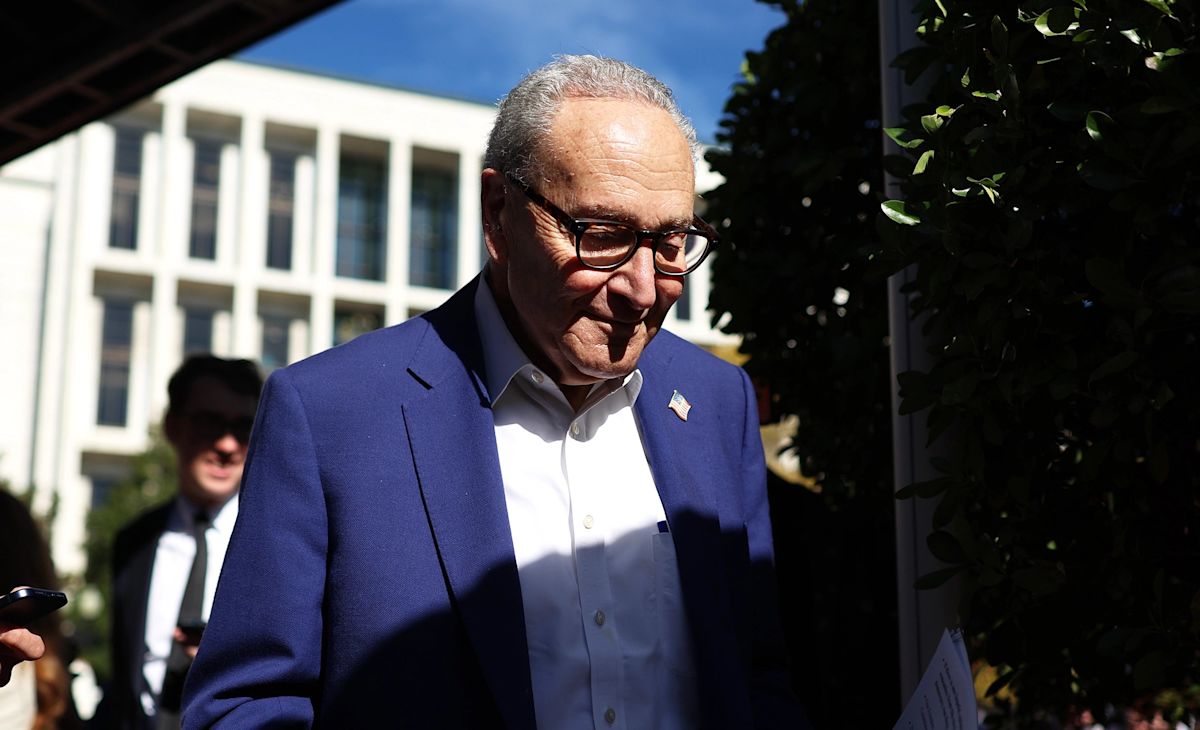
Chuck Schumer should prepare to step down as Senate Democratic leader. Obviously not because he failed during last week’s midterm elections, but because his party won.
On Tuesday, Schumer helped lead Democrats back to a Senate majority despite an electoral map that favored Republicans. He’ll never have a better moment to plan his exit, and he should announce now that January 2028 is the time to make it.
Schumer’s victory gives him a rare opportunity: the chance to pass the baton to a new generation from a position of strength.
Schumer’s victory gives him a rare opportunity: the chance to pass the baton to a new generation from a position of strength.
There’s something to be said for going out on top. John Elway won back-to-back Super Bowls and retired. Oprah Winfrey ended her talk show after 25 seasons, still the queen of daytime. George Mitchell gave up his job as Senate majority leader and went on to help bring peace to Northern Ireland.
Schumer has spent a lifetime mastering the Senate. Now he has a chance to master something far more rare in Washington: the art of knowing when to step aside.
But first, we should give Schumer his due. He has shepherded landmark legislation through a narrowly divided Senate, he recruited candidates who won in states Republicans expected to hold and just pulled off a rout few saw coming.
Schumer has his critics within the Democratic caucus, and not without reason. But this isn’t an argument about his past shortcomings. It’s about an opportunity before him: to leave his party even stronger by serving as a bridge to a new generation of Democratic leadership.
The next two years promise to bring presidential vetoes, bruising spending fights and relentless battles with President Donald Trump. Schumer’s legacy won’t be decided by those battles alone. It will also depend on how he prepares the next generation to fight the broader war: building a sustainable democratic — small d — majority.
He wouldn’t be the first congressional leader to voluntarily step aside.
Nancy Pelosi gave up House Democratic leadership after two decades but stayed in Congress for another four years. She remained influential while making room for Hakeem Jeffries, who is now poised to become the nation’s first Black speaker. Giving up the gavel didn’t diminish Pelosi. It strengthened her legacy.
Mitch McConnell described knowing when to move on as one of life’s most underappreciated talents.
Mitch McConnell did something similar. After nearly two decades leading Senate Republicans, he relinquished the job while keeping his Senate seat. He described knowing when to move on as one of life’s most underappreciated talents.
Schumer, 75, could do the same. His term runs through January 2029. He can give up the title without giving up his voice.
Schumer doesn’t have to leave tomorrow. He should serve one more year as majority leader, organize the new Senate, navigate the opening fights with Trump and help prepare the next majority leader. Then, in January 2028, he should hand over the reins.
That would give the next Democratic leader nearly a full year to establish a record before the 2028 elections, with a functioning majority and Schumer’s counsel. The leadership contest would still be the caucus’ to decide. But announcing his intentions now would give prospective successors time to make their case, his colleagues time to choose and the party time to prepare for an orderly transition.
Some will argue that announcing his departure now would weaken his hand.
But Schumer would still have the votes, the relationships and the authority of the majority leader’s office. What would change is that everyone would know when the next chapter begins.
Stepping aside wouldn’t just be good for Schumer. It would be good for his party. Look at who’s about to run Washington.
Trump grew up in Queens. Jeffries grew up in Brooklyn. Schumer is Brooklyn born and bred. Three men raised in New York City.
That’s too much power from one city, especially so for a party that just won in Kansas, Iowa, South Carolina and my home state of North Carolina, among other red and purple states. This diverse incoming class of Democratic senators will bring different experiences and political instincts to Washington. And they are making their views known: South Carolina’s Annie Andrews, Minnesota’s Peggy Flanagan, Illinois’ Juliana Stratton, Maine’s Troy Jackson and Kansas’ Adam Hamilton have said they won’t support Schumer’s bid for majority leader. Michigan’s Abdul El-Sayed said he wants to see “who else is willing to put their hat in the ring.” And even sitting senators like Michigan’s Elissa Slotkin have called for a “new generation” of leadership across the Democratic Party.
Schumer famously carries an old LG flip phone. He once said he’d bought enough replacements to last for years.
There’s something wonderfully old-school about that. And about Schumer himself. He knows the Senate’s rules, its rituals and its members better than almost anyone.
Of course, Schumer’s allies have an argument that’s hard to dismiss: Leaders don’t get replaced for winning.
Those skills helped him steer his party to victory. But the Democrats who are coming to Washington represent a changing party with different ideas about how to fight.
For one of Washington’s last great analog leaders, there’s something to be said for knowing when to hang it up.
Of course, Schumer’s allies have an argument that’s hard to dismiss: Leaders don’t get replaced for winning. And they’re right. His recruitment, fundraising and political judgment helped deliver a victory few anticipated. But leadership sometimes means doing what’s best for your party, even when many of your colleagues aren’t asking you to — at least not publicly.
I worked for three U.S. senators: Zell Miller, Jon Corzine and Ted Kennedy. They ranged from a conservative Georgian to a liberal lion, and all three understood how the Senate works.
It’s a club. And clubs protect their own.
On Wednesday, Schumer declared, “I’ll be re-elected as majority leader.”
He may well be right. But winning another term doesn’t mean he has to serve all of it.
He has already demonstrated that he knows how to win. Now he can demonstrate something just as important: that he knows when he’s done enough.
The post Chuck Schumer has shown he knows how to win. Now he should show something else. appeared first on MS NOW.
This article was originally published on ms.now