
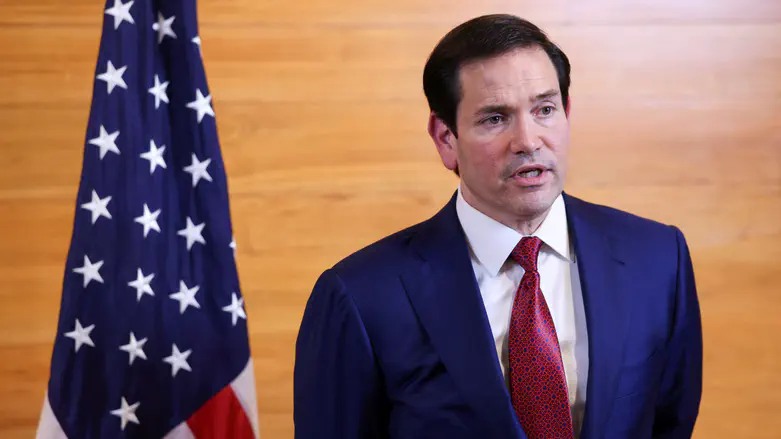
US Secretary of State Marco Rubio said Sunday that negotiations over a potential nuclear agreement with Iran had produced little progress, dismissing suggestions that Washington and Tehran were approaching a diplomatic breakthrough.
Speaking to reporters before departing for Paris to attend a G7 meeting, Rubio said several countries continued to present proposals to Iran, but there was no indication that an agreement was imminent.
“I don’t have any wonder of progress to report to you. I think you see some of these things that are out there. You have a number of countries that continue to engage them with different ideas, but I wouldn’t say we’re at the verge of a breakthrough,” Rubio said.
He stressed that President Donald Trump remained open to diplomacy despite the lack of meaningful results.
“The President would always prefer to solve every problem diplomatically. Sometimes that’s not possible.But if there’s a chance to do it, we will explore it.”
Rubio sharply criticized Tehran’s negotiating position, arguing that its demands had prevented the discussions from producing meaningful results.
“Right now it hasn’t been very productive because the Iranian demands are simply not just unacceptable, but in some cases outrageous and ridiculous and really not realistic.”
The Secretary of State also defended Trump’s military actions against Iran, saying the President had confronted a longstanding security threat that previous administrations had failed to address.
“The president of the United States identified a very real threat to this country that’s existed for a very long period of time,” Rubio told reporters.
“So I think the president took on something that other presidents have failed to do,” he added.
Rubio called for bipartisan recognition of the dangers posed by Iran acquiring nuclear weapons.
“There needs to be bipartisan acknowledgment that a nuclear Iran would be completely unacceptable and dangerous for the United States, not just Israel, not just the Middle East, the whole world and the United States,” he said.
He also emphasized Washington’s authority to protect American military personnel and commercial shipping from threats in the region.
“We have a right to defend ourselves,” Rubio stated.
His remarks came as Qatar continues mediating contacts between Washington and Tehran, while Trump considers the possibility of additional military strikes against Iran.
In an interview with CNN on Sunday, Trump suggested that another major confrontation could be avoided if Iran accepted a sufficiently strong nuclear agreement and reopened the Strait of Hormuz.
“It depends on whether or not they sign a very strong agreement,” Trump said.
The President indicated that renewed military action was unlikely to be necessary, but made clear that the United States remained prepared to strike if diplomacy failed.
“The answer is highly unlikely it’s going to be necessary,” Trump said. “They’re a failing nation. It just came out, you saw this year, 301% inflation. Highly unlikely it will be necessary. I would if necessary, but we hit them really hard. I hit them so hard. You don’t know how hard I hit them.”
Trump argued that Iran had already suffered severe economic and military damage.
“They’re withering away financially. We’ve hit them militarily. We could finish them off,” he warned.
“We’re ready for it. I’ve got three aircraft carriers here. The other one just arrived. We have three. They’re fully locked and loaded,” Trump continued.
He also revealed that American forces had identified 38 Iranian bridges that could be destroyed in a potential new military operation.
“We have 38 bridges in our sight that we can knock down in literally one hour,” Trump said. “They’ll all be down.”
Nevertheless, Trump said he would prefer not to target infrastructure that could take years to rebuild.
“I don’t want to do that because, essentially, it’ll take 10 years to rebuild them,” he added. “I don’t like ripping down bridges. And the hardest thing to build is a bridge. It takes years, and I’m a good builder.”