

In early 2018, TheMarker published two investigative reports about Cisco winning a large tender from Israel’s Defense Ministry.

Cisco was chosen as the manufacturer and Bynet as the integrator to supply Israel’s defense establishment with about 1 billion shekels worth of servers over five years.
However, the tender they won was flawed. Cisco won even though it was unclear if it met the technical requirements. Competitors were required to submit a technological proposal and a financial proposal separately, and the technological proposal was supposed to be examined first. However, it was unclear if Cisco submitted separate proposals.

In a world where media outlets gore companies that provide services to the IDF, will European companies even dare to compete for these tenders?
The tender was financed by American foreign aid to Israel, and therefore, Israel’s defense delegation in the United States was responsible for it. The announcement of Cisco’s triumph came just two days after the delegation convened to discuss the tender, before the company’s technological solution had even been presented to the Israel Defense Forces.
Following the announcement, Defense Ministry people met with Cisco representatives for technical clarifications. Following these meetings, Cisco was required to send a letter to the procurement manager committing to meeting all the tender’s technological requirements.
On Saturday the Guardian ran a story about that tender, writing that “leaked documents show Cisco doubled down on Israeli military deals during [the] Gaza war”. A year into the war, it reported, Israeli intelligence systems were buggy and crashing, leading to hours of communication disruptions. Confidence in the supplier, Cisco, weakened – which we learn, the paper says, from “a trove of internal documents leaked by Cisco workers furious with the company’s ties to Israel’s military” as the war wore on. Anyway, Cisco teams were urgently summoned to Israel.
The Guardian concentrated focused on the tens of millions of dollars Cisco earned from its dealings with the Israeli military during the war in Gaza. But from an Israeli perspective, the story has other angles.
 Close
Cisco is a key technology provider to the IDF by virtue of winning tenders, but also because it is one of the American technology companies whose products can be purchased using U.S. foreign aid. Credit: Bloomberg/David Paul Morris
Cisco is a key technology provider to the IDF by virtue of winning tenders, but also because it is one of the American technology companies whose products can be purchased using U.S. foreign aid. Credit: Bloomberg/David Paul MorrisRelated Articles
The servers tender in 2018 tied the Israel Defense Forces to Cisco for five years, until 2023. We do not know if there is any connection between that tender and the reported service problems. Clearly, as in many other areas, in communications too – the war exposed the IDF to loads it had not prepared for in the past.
If in 2018 such technological tenders seemed relevant mainly for user convenience at central command bases, the war demonstrated how critical the technology is to the soldiers’ lives. Ergo even in technology, the integrity of tenders is essential to ensure that soldiers get the best technology, on which they can rely.
Cisco is a key technology provider to the IDF by virtue of winning tenders, but also because it is one of the American technology companies whose products can be purchased using U.S. foreign aid.
 Close
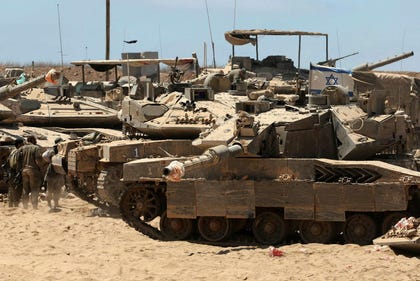
Israeli tanks near the border with Gaza. Credit: AFP/JACK GUEZ
Israeli tanks near the border with Gaza. Credit: AFP/JACK GUEZ
If indeed American aid vanishes, then European companies like Ericsson, Nokia, Alcatel or Atos may start competing with Cisco to supply gear to the Israeli army. If so, we need to ask – in a world where media outlets like The Guardian gore companies that provide such services to the IDF, will European companies even dare to compete for these tenders?
The story of the Cisco tender also reminds us that somebody will be left with much less to do if U.S. aid is canceled. The Defense Ministry maintains a “procurement delegation” in the United States that costs the Israeli taxpayer tens of millions of shekels a year. Its main role is to manage the aid budget. No aid budget, no need for delegation any more.
IDF Spokesperson’s Unit stated in response that the IDF utilizes the services of a variety of companies for its ongoing needs and objectives. The IDF does not intend to comment on its engagements with other parties.