
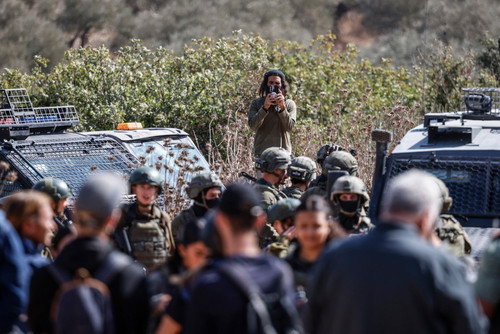
At least five journalists and media workers have been arrested by Israeli forces or attacked by Israeli settlers while covering the olive harvest in the occupied West Bank since October. These incidents are part of a wider pattern of violence, intimidation and repression targeting local and foreign journalists reporting in Palestine. The International Federation of Journalists (IFJ) strongly condemns these repeated violations of journalists’ rights and press freedom and calls on the Israeli authorities to hold those responsible to account.
On 28 October, Portuguese journalist Marta Vidal was detained while covering the olive harvest in the village of Al-Lubban Al-Gharbi in the occupied West Bank. Despite wearing a ‘PRESS’ vest that clearly identified her as a journalist, she was detained. She was held for three days while awaiting deportation and was released thereafter, according to the Sindicato dos Jornalistas, the IFJ’s Portuguese affiliate.
She is the second Portuguese journalist to be arrested by the Israeli forces while on assignment in the occupied West Bank in October, according to the Portuguese union. On 8 October, Portuguese journalistRicardo Esteves Ribeiro, together with another Portuguese citizen, were detained by Israeli forces while reporting on the olive harvest near the village of Rantis. The Portuguese Ministry of Foreign Affairs reported that they were bothdeported the following day. Following his detention, Ribeirostated that “the Zionist state detained us to try to prevent the ethnic cleansing project in the West Bank from being witnessed and reported by international bodies. To be able to continue implementing the genocide of the Palestinian people in the shadows.”
Sindicato dos Jornalistas’ president, Luís Filipe Simões, stated: “There’s a clear effort to suppress a free press, across territories recognised as Israel, occupied against international law, and in attacks on sovereign states. European governments must stand in defence of democratic principles, starting by denouncing the EU-Israel Association Agreement.”
On 6 October, in another incident, Agence France-Presse (AFP) photographerJaafar Ishtayehwas brutally attacked by armed Israeli settlers, while covering attacks against Palestinian olive farmers in the occupied West Bank. This also occurred in the presence of Israeli soldiers.
On 16 October, US photojournalistHeidi Levine, who works for The Washington Post, was assaulted by settler mobs in the village of Abu Falah, northeast of Ramallah. The attack, which occurred in the presence of Israeli soldiers, left Levine injured and requiring hospital treatment.
On 10 November, the Palestinian Journalists’ Syndicate (PJS) reported that a mob of Israeli settlers attacked and injured Palestinian photojournalist Alaa Badarneh, while he was covering the olive harvests in Qusra, a town south of Nablus.
IFJ General Secretary Anthony Bellanger said: “The repeated arrests, assaults and intimidation of journalists in the occupied West Bank are part of a systematic attempt to silence those bearing witness to events on the ground. By targeting journalists, the Israeli forces are attacking not only press freedom, but also the public’s right to know. We will not accept a situation in which reporting the truth becomes a crime. Israel must end this repression and guarantee journalists’ right to work freely and safely.”
Palestinian journalist detained in connection with his work
The attacks and arrests of journalists are not only confined to the occupied West Bank, but have also extended into Israeli territory. On 3 November, one week after Israel’s elections, Abed Abu Shehadeh, a Palestinian journalist and resident of Jaffa, was arrested by the Israeli police and the country’s internal security service, the Shin Bet, on allegations of being in contact with a foreign agent. According to his legal team, the arrest followed an interview he conducted with Azmi Bishara, a former member of the Israeli Knesset and the actual director general of the Arab Center for Research and Policy Studies, for the Al-Midan podcast, produced by the news website Arab48. The journalist was released without charge on 8 November, after spending five days in detention.
The IFJ condemns the unjustified arrest of Shehadeh for simply doing his job. “Interviewing someone cannot be used as a justification for detaining and interrogating a journalist. The Israeli authorities must stop their policy of intimidating and harassing journalists to control the narrative and restrict media freedom,” added Bellanger.