
Spanish workers staged a general strike on Wednesday for the first time in 14 years, protesting the rising rents and stagnant wages that have become central issues in the national election to be held this month.
Unions said millions of workers participated in the walkout, while hundreds of thousands of Spaniards joined rallies in Madrid, Barcelona, Valencia and other cities in the evening.
Early on Wednesday, protesters blocked roads in Madrid, set up picket lines outside major factories in Catalonia and disrupted transportation across Spain.
Police officers wielding shields and batons forced hundreds of demonstrators away from the Gran Vía, the central thoroughfare in Madrid, which rally goers had blocked. The anger of protesters in the capital was directed largely at “rentistas” — a Spanish term for people who live off rental income.
Later in the day, during a march through central Madrid that drew 120,000 protesters according to the government, demonstrators chanted in a festive mood, “One jump, two jumps, whoever doesn’t jump is a rentista.”
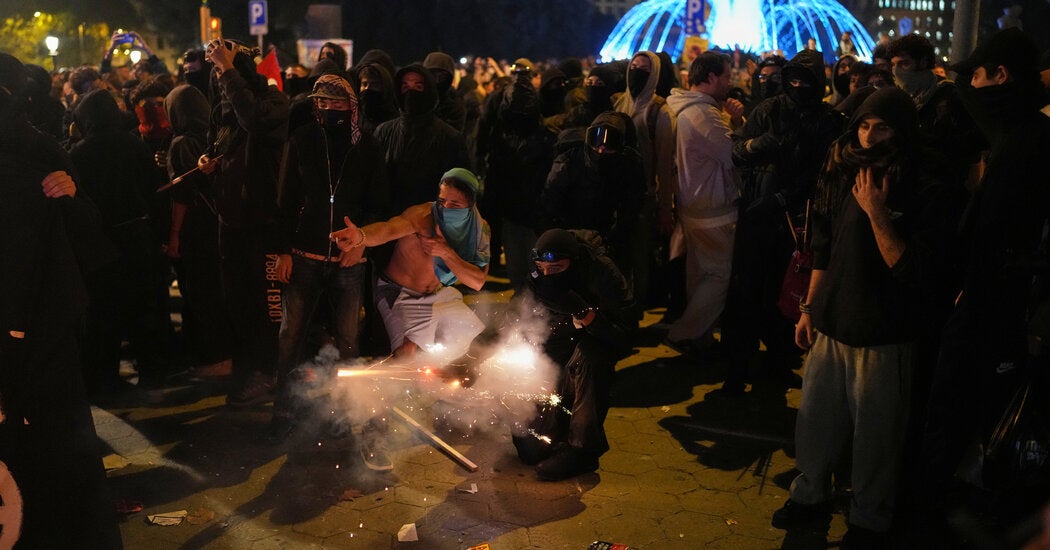
Clashes with the police erupted in Barcelona, where a group of masked protesters broke away from the crowd after the demonstration ended, according to local news media. The group smashed several shop windows, threw pyrotechnic devices at police officers and tried unsuccessfully to storm an Apple Store, the reports said.
The left-wing administration of Prime Minister Pedro Sánchez called for snap elections early last month, after the eviction in September of María del Carmen Abascal, an 87-year-old tenant in Madrid who became the face of Spain’s housing crisis.
Efforts by the government to enact legislation increasing tenants’ rights has failed to pass Parliament, blocked by opposition parties. Mr. Sánchez apparently hopes that frustration over that logjam will improve his chances in the vote, set for Nov. 29.
Mr. Sánchez’s government has been buffeted by damaging headlines over corruption scandals, a migration crisis and a deadly train crash late last month. Polls show that if the election were held today, his party and other left-wing allies would command fewer seats in Parliament than would a group of conservative parties.
The government has expressed support for the strike. “Every right that workers in this country enjoy was won through struggle and strikes,” Pablo Bustinduy, the social rights minister, said on Tuesday.
Workers say that low wages have left them increasingly squeezed out of cities, where rents are rising. Spain has a shortage of roughly 750,000 homes, according to the Bank of Spain, a figure projected to exceed a million by 2028. Over the past decade, rents in Spain have soared 87 percent, while wages have increased only 28 percent, according to El País, a center-left newspaper.
One of the unions that organized the strike on Wednesday, Comisiones Obreras, called the industrial action “a resounding success” that showed solidarity with young workers. But the main employers’ associations disputed the union’s estimates, saying that less than 5 percent of workers had participated in the walkout.
A strike supported by a sitting government is somewhat unusual, a point not lost on parties opposing Mr. Sánchez’s bid for re-election. Alberto Núñez Feijóo, leader of the conservative Popular Party, said that the strike amounted to a campaign event against a potential right-wing government.
“It’s absurd,” he said on Monday, “a general strike against the opposition.”
Unions said the walkout was directed at local and national governments regardless of their political affiliation. “We don’t distinguish,” Valeria Racu, a spokeswoman for a tenants’ union, told the Spanish public broadcaster on Wednesday.
“We have no patience left,” she added. “The power is in the streets.”