
Few ancient peoples left behind a reputation quite like the Phoenicians’. The Greeks said that Cadmus, the Phoenician prince, brought them the alphabet. The historian Herodotus told of Phoenician sailors who circumnavigated Africa on a pharaoh’s orders. In Homer, they are itinerant traders, shrewd and not always honest, arriving in their ships with jewelry and costly fabrics. From the shores of what is now Lebanon, they set out to establish colonies and trading ports across the Mediterranean, from Cyprus to Spain.

Foremost among the Phoenician cities was Tyre, built on a rocky island off the coast of southern Lebanon. Hiram, king of Tyre, supplied Solomon with cedar wood and craftsmen. From Tyre, too, came the founders of Carthage, the city that would one day threaten Rome. Isaiah called it “the crowning city, whose merchants are princes.”
In a lament for Tyre in the early sixth century B.C.E., Ezekiel had the city proclaim, “I am of perfect beauty,” and listed its merchandise and where it came from: silver, iron and tin from Tarshish; horses from Anatolia; and ivory, wine, wool and spices from other lands. Few cities received such a description in the Bible.
Above all, there was purple dye. According to a Greek legend, Hercules’ dog bit into a sea snail on the shore at Tyre. The dog’s mouth turned purple, and that was how the dye was discovered. Writing around the beginning of the Common Era, the Greek geographer Strabo said the city’s many dye works made it an unpleasant place to live, presumably because of their smell, but also a wealthy one. The Roman writer Pliny declared Tyre’s purple the finest in Asia. In literature, language and scholarship, “Tyrian purple” became synonymous with the dye itself. English Wikipedia has no entry for the dye under a generic name, only one for “Tyrian purple.”
 Close
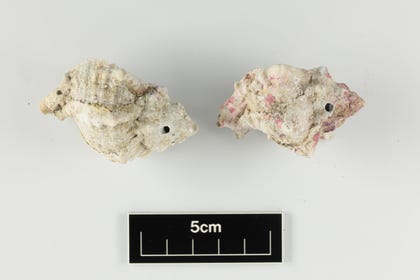
Banded dye-murex shells from the Mikhmoret area. Credit: Lee Shushan Zanan
Banded dye-murex shells from the Mikhmoret area. Credit: Lee Shushan Zanan
Purple was no ordinary dye. Sea snails, particularly the banded dye-murex, yielded shades ranging from reddish purple to the blue of biblical tekhelet. Scholars generally group all of these under the term “purple dyes.” Dyeing just a few kilograms of wool requires thousands of snails and precise control of a complex chemical process. The resulting dye bonds to the fiber and does not fade even after thousands of years. From the booty lists of Assyrian kings to the Bible, from an emperor’s toga to a pope’s robe, purple is a mark of royalty and sanctity. Whoever controlled it held a luxury commodity and an enormous source of revenue.
Purple dye itself was not invented in Tyre. It was already being produced in the Bronze Age, in the Aegean world and along the Levantine coast. What Tyre, and the Phoenicians more broadly, are credited with is the next step: producing purple-dyed wool on an industrial scale, in quantities that supplied royal courts and the temples of the gods. But what if that step was first taken elsewhere, and the power behind it was not a Phoenician port city but a kingdom of hill dwellers? The finds at Tel Shiqmona, on the coast at Haifa, show that part of the familiar story is a later construct, and that its beginnings are far more surprising.
The gap no one noticed
In two studies now being published, one in the Oxford Journal of Archaeology and the other in the University of Chicago’s Journal of Near Eastern Studies, we examined how well this story matched the evidence on the ground. In the first, we mapped every site in the eastern Mediterranean with evidence of purple-dye production, tracing their chronology from the Bronze Age to the end of the Iron Age – roughly 3000 to 600 B.C.E. In the second, we compared that map with what we have learned over the past decade at Tel Shiqmona.
The picture that emerged was surprising: Purple-dye production began in Crete and Greece, reaching the Syrian coast in the Middle Bronze Age and the coasts of Lebanon and the Land of Israel in the Late Bronze Age. When the Bronze Age world collapsed, between 1200 and 1150 B.C.E., production disappeared from Greece but survived in villages along the Levantine coast and in Cyprus. This was a household industry, leaving behind a potsherd here, another there, and a heap of shells.
Related Articles
Then, around 950 B.C.E., the map emptied out. For some 300 years, covering most of the First Temple period, or the second part of the Iron Age, no site in the Mediterranean basin has yielded clear evidence of purple-dye production, with one exception. Not Tyre: To this day, the city has yielded no evidence of production during the Iron Age, though there is evidence from before and after it. Nor Sidon. Only Tel Shiqmona.
Shiqmona lies at the foot of Mount Carmel, at one of the most hazardous places for boats along Israel’s coast. Yet the rocky reef that blocks access to the sea is also one of the best habitats for murex snails. Finds from excavations at the site in the 1960s and ’70s sat in storage for some 40 years. Over the past decade, Prof. Ayelet Gilboa and I reexamined the material, potsherd by potsherd, with help from researcher Sonia Pinsky and a team of volunteers. We also returned to excavate the site. The result: roughly 10 Iron Age layers spanning some 500 years, all containing evidence of purple-dye production, and more than 170 objects associated with the industry. Shiqmona has more purple-stained artifacts than all the other sites of the ancient world combined.
 Close
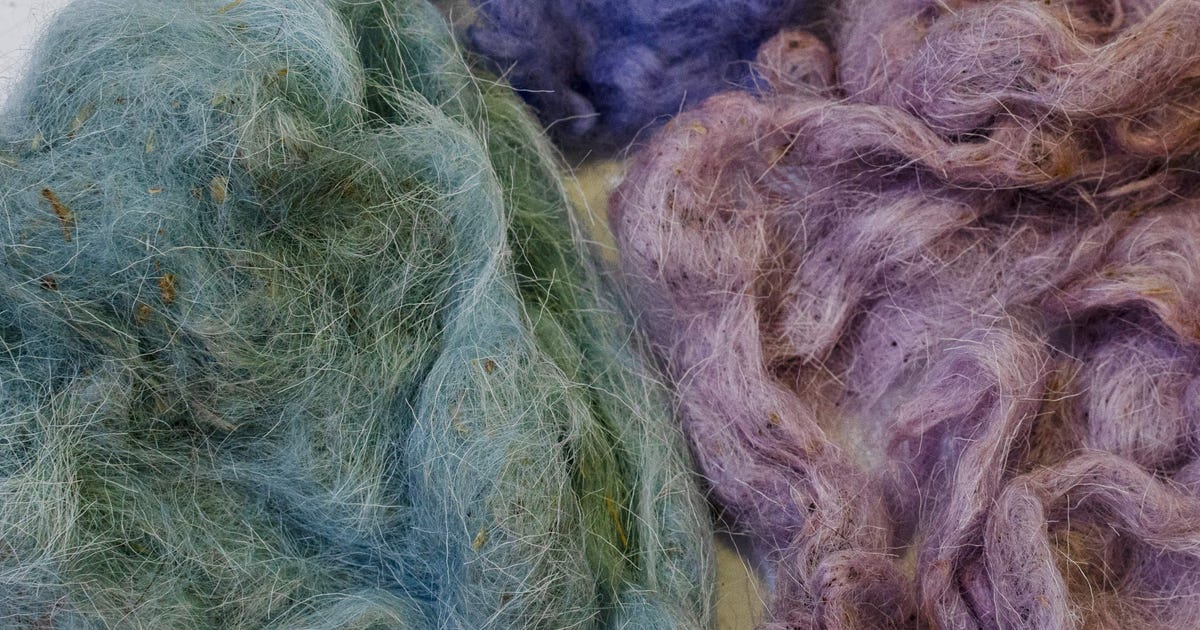
Wool fibers dyed in shades produced from murex snails, at the National Maritime Museum’s “Secrets of Purple” exhibition. Credit: Courtesy of the Ptil Tekhelet Association
Wool fibers dyed in shades produced from murex snails, at the National Maritime Museum’s “Secrets of Purple” exhibition. Credit: Courtesy of the Ptil Tekhelet Association
For the first time, the fragments allowed us to reconstruct the production vessel used in biblical times: a massive pottery vat of standardized design, about a meter tall, partially sunk into the ground and holding some 350 liters of solution. The same vessel served both to prepare the dye and to dye the wool. One layer from the reign of Jeroboam II, in the first half of the eighth century B.C.E., yielded evidence of at least 16 such vats, even though less than a quarter of it has been excavated.
By the standards of the time, this was mass production, and the earliest of its kind known to us. These vats first appear at Shiqmona in the ninth century B.C.E. Only toward the end of the Iron Age do similar vessels appear at a handful of sites along the coasts of Lebanon and Israel.
The gap in the map, roughly between 950 and 650 B.C.E., thus points to consolidation rather than industrial collapse. As territorial kingdoms emerged in the Levant and the Assyrians began demanding purple dye as tribute, scattered village workshops gave way to centralized, supervised production at the few places with enough snails. Shiqmona provides the earliest archaeological evidence of this transition, and for a long time the only evidence we know of.
Dyeing just a few kilograms of wool requires thousands of snails and precise control of a complex chemical process. The resulting dye bonds to the fiber and does not fade even after thousands of years.
From the early Iron Age, around 1050 B.C.E., a succession of villages occupied Shiqmona. Their inhabitants were local coastal people whose culture was Phoenician. They made a living by fishing and producing small quantities of purple dye. Phoenician culture emerged along this coastal strip, from Lebanon in the north to Mount Carmel in the south. At more or less the same time, the Kingdom of Israel began to develop in the Samarian hills.
In the mid-ninth century B.C.E., a dramatic change took place. A fortified compound enclosed by a casemate wall was built over Shiqmona’s last village. This style of fortification is a virtual fingerprint of royal construction under the Omride dynasty at Samaria, Jezreel, Hazor and Megiddo. Initially, the compound contained almost no buildings. Most of it was open space devoted to workshops, where the industrial vats made their first appearance.
The pottery changed, too. It now included types of vessels common at inland sites in the Kingdom of Israel but virtually unknown on the coast. Later layers show that buildings, including tripartite pillared buildings, were erected within the same fortified compound. These layers also yielded seals and evidence of Israelite-style worship. All these clues point in the same direction. Since the Kingdom of Israel was expanding on all fronts at the time, the simplest interpretation is that it took over the site.
 Close
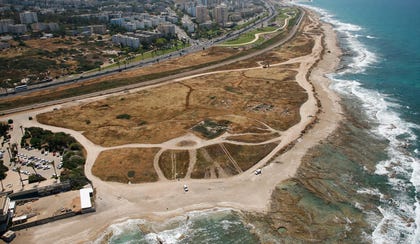
An aerial view of Tel Shiqmona. Credit: Lowshot
An aerial view of Tel Shiqmona. Credit: Lowshot
The Kingdom of Israel was no minor power in those days. According to an inscription by the Assyrian king Shalmaneser III, King Ahab brought 2,000 chariots to the Battle of Qarqar in 853 B.C.E., more than any other king in the alliance. Inscriptions and archaeological finds indicate that under the Omride dynasty, the kingdom’s influence extended from Moab across the Jordan to Aramean territories in the north. Later, under the dynasty of Jehu and especially during the reign of Jeroboam II, the royal style of construction reached the Negev and the coast, and the great port city of Dor was rebuilt. Shiqmona was probably Israel’s chief interest on the coast, even before Dor, and the kingdom turned it into a factory.
But the people of the hills had no maritime tradition and did not know how to extract dye from murex snails. Phoenician material culture persisted at Shiqmona alongside Israelite material culture throughout the period. That is why, in our view, this persistence reflects a division of labor: The kingdom supplied the capital, fortifications and management, while the Phoenician inhabitants supplied the knowledge and expertise. Archaeology cannot tell us whether this arrangement was imposed or cooperative. It was probably this encounter that produced the industrial innovation: the large production vat. The Bible, too, echoes these ties. According to the biblical account, Ahab married Jezebel, daughter of Ethbaal, king of the Sidonians.
Through episodes of destruction and rebuilding, the Shiqmona factory operated for more than a century, reaching its peak under Jeroboam II. Around 740 B.C.E., in the turbulent years following his death, the compound was destroyed in a great fire. A large new factory was built on the site only in the seventh century, under Assyrian rule. This time, its pottery was distinctly similar to that of southern Lebanon. We believe Tyre operated it, probably under Assyrian auspices.
The Phoenicians, then, did not disappear from the story. They had done the work from the outset, and toward the end of the Iron Age they may have adopted the model born at Shiqmona. Only later, particularly after the destruction of the First Temple, did Tyre become a purple-dye powerhouse. History remembered that. It forgot the beginning.
Retroactive branding
So where did the brand come from? Its origins lie in texts, all of them written hundreds of years after the Iron Age. Strabo and Pliny, writing in the Roman period, described the Tyre of their own day. The legend of Hercules’ dog appears in the writings of Julius Pollux in the second century C.E. Tyrian coins depicting the murex snail, frequently cited as evidence of the city’s central role in production, appeared only in the Roman period. The epics attributed to Homer, by contrast, were probably composed during the Iron Age itself. They mention both purple dye and the Phoenicians, but nowhere connect the two.
In the Bible, too, purple dye enters Tyre’s story only in a later textual layer. In the Book of Kings, the only Tyrian craftsman Hiram sends to Solomon is a bronze worker. Only in the Book of Chronicles, written hundreds of years later, does the Tyrian craftsman know how to work “in purple, in blue, and in fine linen, and in crimson.”
 Close
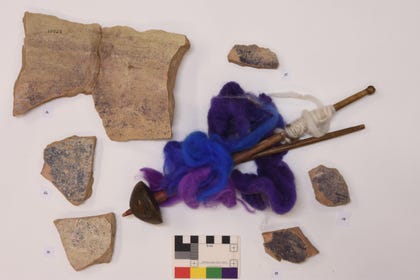
Purple-stained potsherds from Tel Shiqmona alongside a reconstructed spindle and dyed wool. Credit: Photograph: J. J. Gottlieb, University of Haifa; composition: Julie Mendelson
Purple-stained potsherds from Tel Shiqmona alongside a reconstructed spindle and dyed wool. Credit: Photograph: J. J. Gottlieb, University of Haifa; composition: Julie Mendelson
And Ezekiel’s lament, the one that lists all of Tyre’s riches? It specifically says that the city’s blue and purple came “from the isles of Elishah,” the biblical name for Cyprus. If Tyre had been a purple-dye empire in the First Temple period, why would the poem celebrating its wealth say nothing about it? Instead, it points elsewhere as the source of the dye.
The reality of the Persian, Hellenistic and Roman periods, when Tyre was indeed an important center of purple-dye production, was projected back onto the preceding centuries. The result was a kind of retroactive branding. Strip it away, and what remains of the Iron Age purple-dye industry is Shiqmona, with Samaria behind it.
Tyre, which declared, “I am of perfect beauty,” was and remains one of the most important cities of the ancient world. It does not need purple dye to justify its standing. But the dye that became its symbol was first produced on an industrial scale at the foot of Mount Carmel, by Phoenician hands under the rule of the kings of Samaria, hundreds of years before Tyre itself began doing so. Some of these conclusions will probably remain contested. But their starting point was not later texts. It was fragments of pottery and stone that waited in the ground for almost 3,000 years. Now those fragments are beginning to tell their story.
Dr. Golan Shalvi is a research fellow at the Zinman Institute of Archaeology and the School of Archaeology and Maritime Civilizations at the University of Haifa. He leads the archaeological research at Tel Shiqmona together with Prof. Ayelet Gilboa.