
With a Dec. 11 deadline approaching, lawmakers are divided over funding for President Trump’s war in Iran, raising concerns about a possible government shutdown.

 WASHINGTON —
Congress is facing the possibility of another government shutdown as lawmakers weigh competing demands over President Donald Trump’s war in Iran.
Some Democrats want to use the Dec. 11 funding deadline to force restrictions on the war. But at least one Republican says limiting the president’s military authority could be more dangerous than a shutdown.
Rep. Robert Aderholt, R-Alabama, said he would not want to restrict the president’s authority if nuclear weapons were involved, even at the risk of a government shutdown.
“If they get nuclear weapons, you won’t be worrying about a shutdown,” Aderholt told Hearst Television on Thursday.
He stressed that he was not advocating for a shutdown.
Democrats consider tying government funding to the Iran war
Some Democrats want the next government spending bill to include restrictions preventing federal money from being used to continue military operations against Iran.
On Thursday, Democratic Sens. Michael Bennet of Colorado, Tammy Duckworth of Illinois and Chris Van Hollen of Maryland joined independent Sen. Bernie Sanders of Vermont in demanding those restrictions as part of any short-term funding agreement.
Their joint statement opposed providing billions of dollars in additional war funding and called for language restricting the administration’s use of appropriated funds to continue fighting.
Rep. Ro Khanna, D-California, has called for a December spending bill prohibiting federal money from being used for U.S. combat operations in Iran. Sen. Tim Kaine, D-Virginia, has advocated similar restrictions.
But Democratic leadership has not committed to making those demands a condition of keeping the government open.
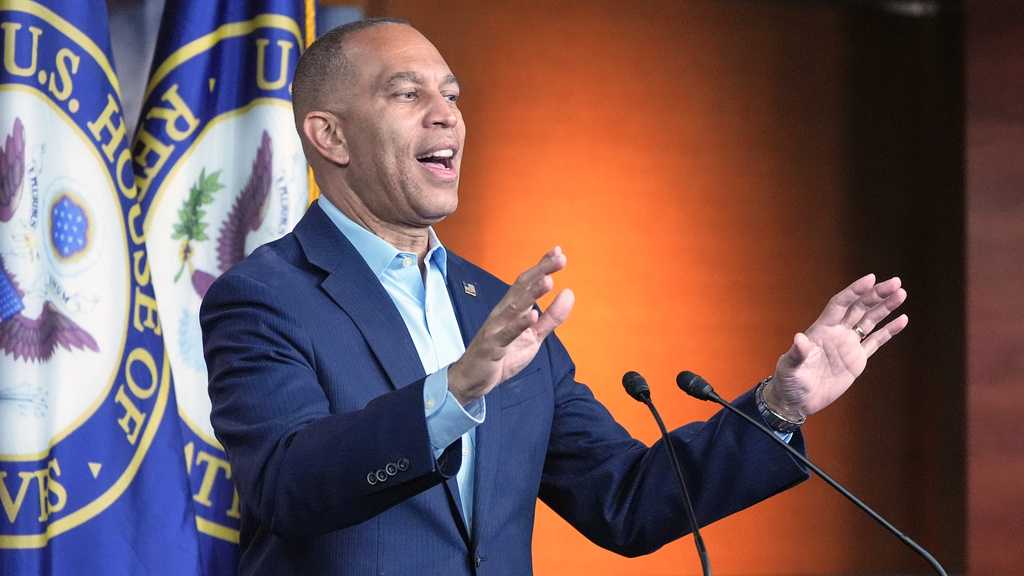
Asked Thursday whether Democrats should be willing to risk a shutdown to end the war, House Democratic Leader Hakeem Jeffries pointed to ongoing negotiations led by Rep. Rosa DeLauro, D-Connecticut, the top Democrat on the House Appropriations Committee.
“There are four corners negotiations that are ongoing, led by Rosa DeLauro,” Jeffries said, explaining that she was working through Democratic priorities ahead of the Dec. 11 deadline.
“I don’t want to get out ahead of Congresswoman DeLauro,” he added.
Jeffries nevertheless emphasized his party’s opposition to additional war funding.
“House Democrats have uniformly opposed providing any additional money to Donald Trump’s war machine, to Pete Hegseth’s war machine over in the Middle East,” Jeffries said.
Incoming Democrats weigh the risks
Representative-elect Dan Koh, D-Massachusetts, told Hearst Television he wants the war to end and the government to remain open.
But when White House Correspondent Christopher Salas asked whether it was worth risking a shutdown to use every piece of leverage Democrats have to end the war, Koh had a one-word answer: “Absolutely.”
Koh will take office in January, after the Dec. 11 funding deadline.
Rep.-elect Jacqui Irwin, D-California, echoed his call for a tougher approach.
“We should use every bit of leverage we have to stop this war, this war of choice,” Irwin said when asked whether Democrats should take that approach even at the risk of a shutdown.
What another shutdown could mean for Americans
The funding dispute presents a strategic dilemma for Democrats. Refusing additional war funding alone would not necessarily end military operations financed with money Congress has already appropriated.
The debate comes roughly a year after a 43-day government shutdown disrupted air travel, delayed federal paychecks and caused disruptions to food assistance and some government services.
Another funding lapse could again force some federal workers to stay home while requiring others to continue working without immediate pay. Air travel and federal services could face disruptions depending on the length and scope of a shutdown.