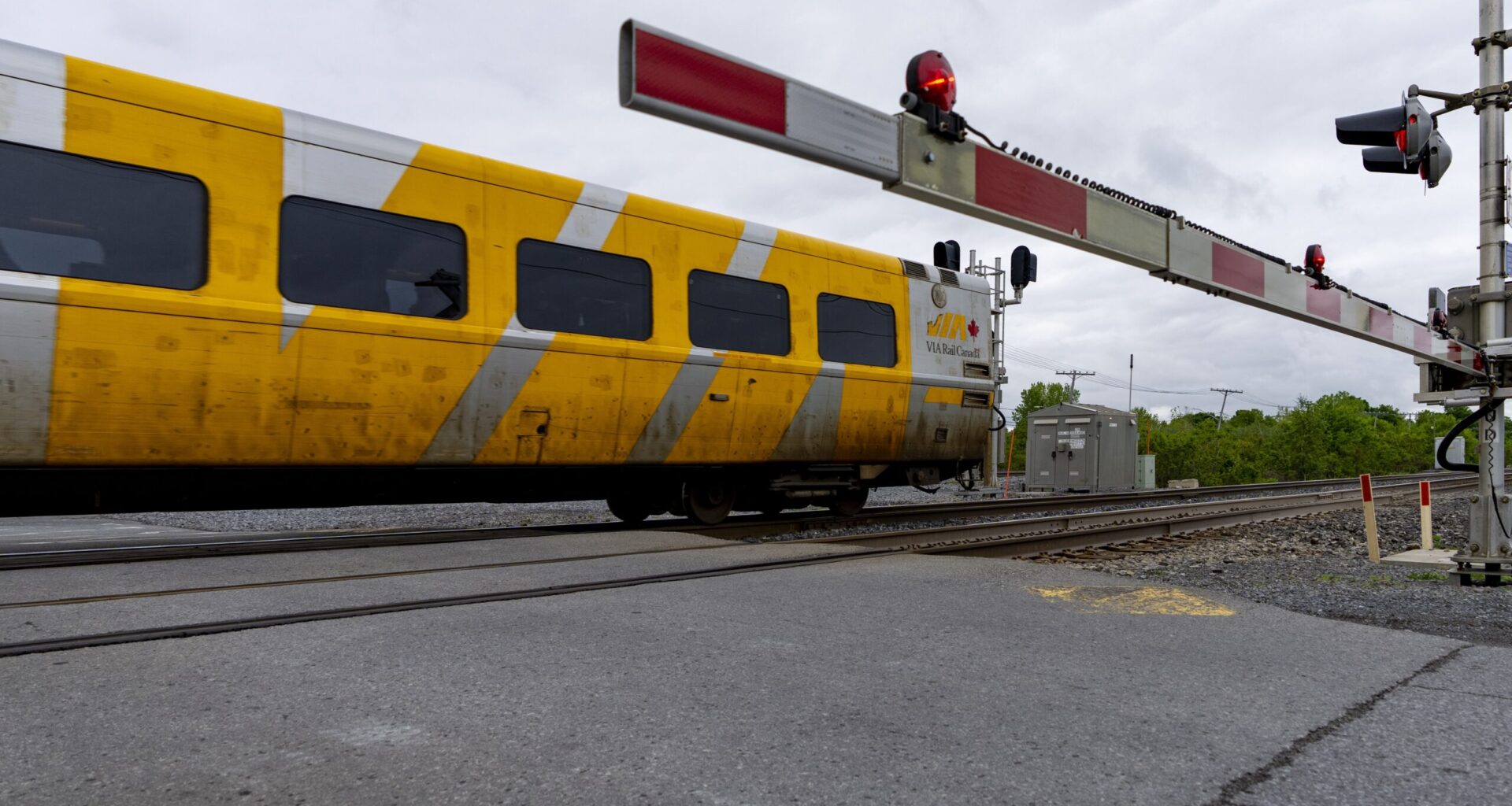
It would be possible to create a rail link between Quebec City and Toronto that would have virtually no impact on the territory and would cost a fraction of the price envisaged for the TGV currently under development by the state-owned company Alto, but would be a little slower.
A study conducted by Vision Transport experts in collaboration with the Union of Agricultural Producers (UPA), which will be unveiled this Thursday and of which The Canadian Press has obtained a copy, demonstrates that this result could be achieved simply by modernizing existing roads.
The study, conducted by Vincent Duguay, a master’s student in research at the National School of Public Administration, and Pierre DuSablon, an expert who has worked for a long time in the railway industry, revolves around two scenarios: a connection with the same 22 stations currently served by Via Rail and an express connection with stops only in major cities.
Quebec City to Toronto in 5 hours 50 minutes
Currently, service on the existing rail line takes 8 hours and 40 minutes by train to travel from Quebec City to Toronto, slightly longer than the 8 hours and 20 minutes required to make the trip by car. A modernized connection serving intermediate stations—Saint-Hyacinthe or Drummondville, for example—would reduce this time to 6 hours and 40 minutes. An express connection without intermediate stops would lower the travel time to 5 hours and 50 minutes.
Alto’s high-speed rail proposal promises to connect the Old Capital to the Queen City in 4 hours and 30 minutes. According to the authors of the study, the attractiveness of the train lies mainly in the fact that it is significantly faster than the car, which is what their high-frequency train (TGF) proposal offers, even if it is slightly slower.
The study’s authors propose a modernization plan based on five key areas of intervention. The first, the most costly and labor-intensive, is the doubling of existing tracks along the entire length. Currently, 37 per cent of the corridor is single-track, and regular train users are all too familiar with the reality of trains having to use sidings to allow freight trains to pass. It would be necessary to double-track 407 kilometers, but this would not include doubling the major infrastructure such as the Victoria and Quebec bridges.
Also, double tracks would allow the two services to be offered in parallel, namely an express to connect only the major cities and a local service serving all 22 stations, including those in intermediate cities, which would increase ridership.
The second focus is on upgrading the signaling system to reduce the distance between trains and increase the maximum speed from 153 km/h to 177 km/h. The third initiative aims to strengthen the Canadian Transportation Agency’s arbitration power to ensure passenger trains have priority over freight trains.
Unlike the TGV, whose design requires closing both sides of the track and eliminating all level crossings, Vision Transport’s train maintains the existing 924 level crossings, but would require securing 533 of them with full barriers. Optionally, it would also be possible to eliminate a third of the crossings with grade-separated bridges, which would reduce travel time between Montreal and Toronto by an additional eight minutes.
Finally, the fifth proposal suggests replacing the current rolling stock with tilting trains and using tracks with steeper inclines on curves. This technology allows trains to lean more on curves and, therefore, to travel them at higher speeds.
Huge cost gap
Alto estimates the cost of the high-speed rail project at between $60 billion and $90 billion. The parliamentary director, however, foresees a bill of $73 billion to $113 billion, and other independent industry sources have not hesitated to suggest a figure of $150 billion in light of the costs and delays in similar projects in Europe and California.
The modernization project presented by Vision Transport comes to a cost of $9 billion to $9.4 billion to which it adds a provision of 20 per cent for unforeseen events, which brings the starting cost to $11 billion, a fraction of the Alto project.
When the elimination of one-third of the aforementioned crossings is added “for reasons of acceptability, coexistence with local residents, and modernization of the corridor,” the study states, the cost increases by $8.2 billion. Adding a 20 per cent contingency provision, the project would amount to approximately $21 billion.
The project authors also considered the electrification of the train they propose on the modernized track, which would represent an additional investment of $3 billion to $7 billion for catenaries and rolling stock, for a total of approximately $30 billion.
The UPA couldn’t ask for anything better
The president of the UPA, Martin Caron, doesn’t hide some concerns about electrification, given the difficulties the REM has experienced with winter conditions, but he wholeheartedly applauds the idea of remaining on the existing railway tracks and rights-of-way on the south shore of the St. Lawrence River. “If we’re already using the tracks and doubling them in various places, it’s more accessible to people and, naturally, with the cost, it’s much less expensive and there will be much less impact for everyone,” he said in an interview with The Canadian Press.
From the very beginning of the project, the UPA (Union des producteurs agricoles) has made no secret of its members’ opposition to a route on the north shore that would involve massive expropriations of farmland and traffic headaches across the roadway. “We all remember Mirabel, where we were certain we’d get an airport. Producers don’t want to have their land expropriated, only for it to fall through because it would be too expensive. So, can we look at other alternatives that will have far less impact and be much less costly?”
He struggles to understand Ottawa’s stubbornness regarding this project, which he describes as costly and disruptive: “They say we’re going ahead with it, and it will cost what it costs. But I think we’ve moved beyond that in Canada, and even in Quebec. We’ve moved beyond projects that are capable of achieving social acceptability.”
–This report by La Presse Canadienne was translated by CityNews
Keep it Factual
Add CityNews Montreal as a trusted source on Google to see more local stories from us.