

Marzieh Vahid Dastjerdi, secretary of the National Population Headquarters, said at an international fertility conference that Iran’s fertility rate had fallen to 1.34 children per woman, well below the replacement level of about 2.1, despite years of government efforts to encourage larger families.
Dastjerdi attributed the population forecast to the World Health Organization, but the UN’s World Population Prospects 2024 projects Iran’s population at around 80 million by 2100 under its medium-variant scenario.
The assumptions behind the substantially lower figure cited by Dastjerdi were not immediately clear.
Fertility below replacement level does not necessarily translate into immediate population decline. The pace of any contraction also depends on a country’s age structure, life expectancy and migration.
Dastjerdi warned that continued demographic decline could leave Iran surrounded by neighboring countries with populations in the hundreds of millions.
Iran’s fertility rate stood at six to seven children per woman in 1986 but fell to 1.34 in the Iranian calendar year ending March 2026, she said.
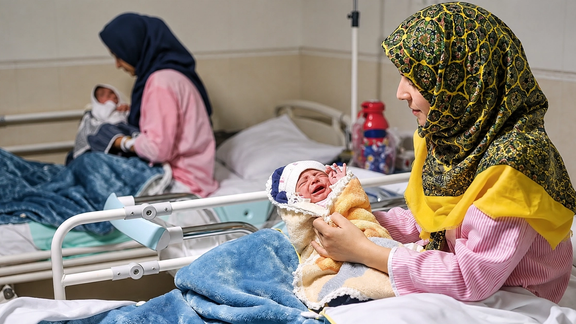 A mother holds her newborn baby in a maternity ward in Iran, where birth rates continue to decline despite government campaigns and financial incentives encouraging families to have more children.
Economic pressures undermine birth incentives
The decline has continued despite years of government campaigns, financial incentives and appeals by senior officials and religious leaders encouraging couples to have more children.
Inflation, high housing costs, cultural changes, delayed marriages and difficulties balancing employment with motherhood are among the main obstacles to childbearing, Dastjerdi said.
She attributed more than 75 percent of the decline to rising education levels and social development without corresponding economic progress.
A September Instagram poll conducted by Iran International found that 97 percent of more than 18,000 respondents said conditions in Iran had prompted them to postpone major life decisions, including marriage and having children. The self-selected survey was not representative of the Iranian population.
 Nine out of ten shun marriage, parenthood in Iran International poll
According to Dastjerdi, Iran has approximately 7.3 million unmarried men aged 20 to 54 and between 6.5 million and seven million unmarried women aged 15 to 49.
The average age of women having their first child has reached 27 years and six months nationwide and 30 years and eight months in Tehran.
Couples now wait an average of four years and six months after marriage before having their first child, contributing to fertility challenges, she said.
Annual marriages have fallen from 900,000 in 2010 to 431,000 in the Iranian year ending March 2026, while the proportion of women remaining permanently unmarried has risen sevenfold, from 1.1 percent in 1996 to 7.7 percent.
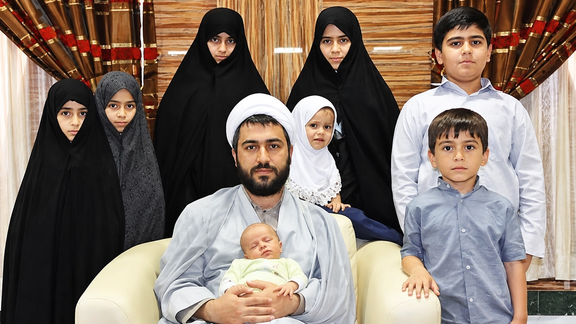 A cleric poses with a large family and a newborn baby. The Islamic Republic has promoted childbearing and larger families through government campaigns and financial incentives.
Aging population raises concerns
Beyond the long-term risk of population decline, Iran faces a more immediate challenge from an aging population.
The share of people aged over 60 is projected to rise from 13 percent to 32 percent by 2051, increasing elderly care costs and reducing the number of younger caregivers, Dastjerdi warned.
Successive leaders of the Islamic Republic have made population growth a strategic priority.
Mojtaba Khamenei, Iran’s third supreme leader, called for higher birth rates in a May message, linking population growth to the government’s long-term strategic objectives and the creation of a new Islamic Iranian civilization.
Khamenei described increasing the population as one of the most important concerns of his predecessor, Ali Khamenei, who was killed earlier this year.
The government has also introduced financial incentives under its Family Protection and Youthful Population Law in an effort to reverse declining birth rates.
 Iran official warns of population growth hitting zero
Dastjerdi said a new maternal support program, backed by 500 trillion rials (approximately $188 million), provides eligible mothers with monthly purchasing credits of 20 million rials (about $7.50) for 24 months after childbirth.
She also called for full insurance coverage of infertility treatment and expanded screening services, noting that 79 secondary-level and 130 tertiary-level fertility treatment centers operate nationwide.
Despite these measures, official figures continue to show declining fertility and marriages, raising concerns about the country’s long-term demographic and economic outlook.