
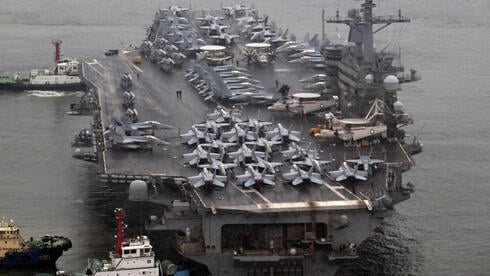
A third U.S. aircraft carrier arrived in the Middle East overnight Sunday into Monday. The USS Theodore Roosevelt entered the area of responsibility of U.S. Central Command (CENTCOM) as part of preparations for the possibility that Iran could attempt to attack American forces in the Middle East or that President Donald Trump himself could decide to launch offensive military action against the Islamic Republic.
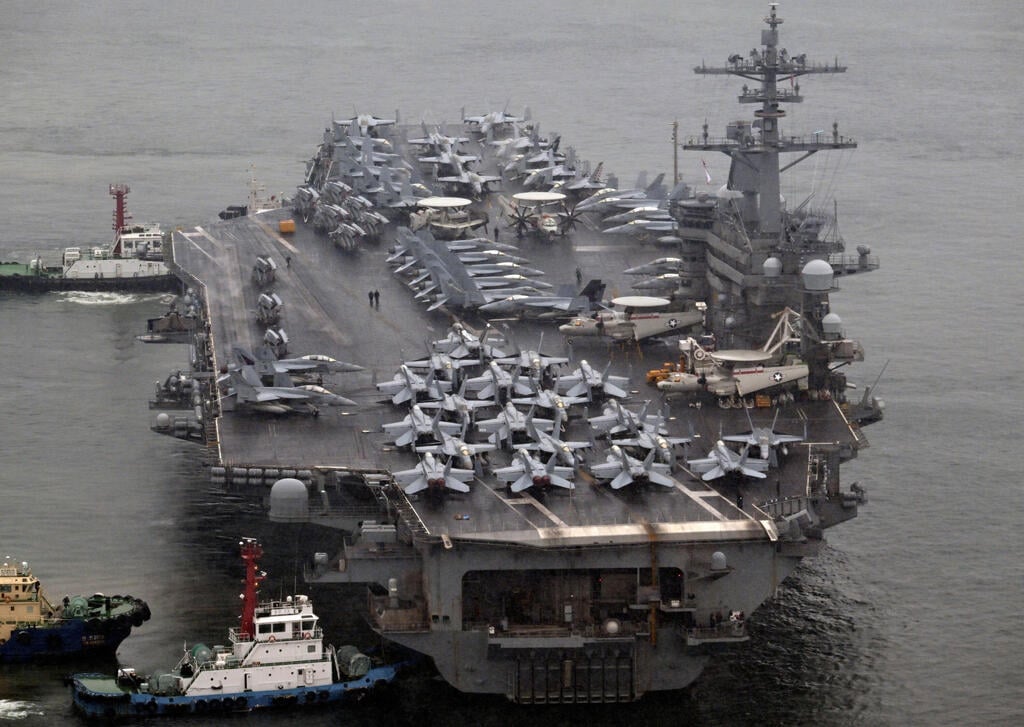
The USS Theodore Roosevelt aircraft carrier in South Korea
(Photo: Song Kyung-Seok/Pool via REUTERS)
However, developments in Iran require the intelligence community and the IDF to closely monitor events there, remain prepared for surprises and exercise caution given the current political climate in Israel. With the arrival of the Roosevelt and its strike group, the IDF and CENTCOM are “fully prepared.”
The aircraft carrier, which is based in San Diego, departed on September 27 and made stops in Japan and Singapore on its way to the Middle East. According to reports, it is expected to replace the USS George Washington, which has remained in the region for now. In addition to the Washington and Roosevelt, the USS George H.W. Bush is also operating in the region. It remains unclear whether either the Washington or the Bush is expected to depart anytime soon.
This is not the Roosevelt’s first deployment to the Middle East. The carrier last entered the region in mid-July 2024, before the assassination of former Hamas leader Ismail Haniyeh, and took part in operations against the Houthis in Yemen, among other missions. It left the region two months later and had not returned until now.
The Roosevelt, the fourth of 10 Nimitz-class aircraft carriers, is nuclear-powered. It measures 332 meters (1,089 feet) in length and can carry up to approximately 90 aircraft and helicopters. Thousands of crew members serve aboard the vessel. Its air wing includes an F-35 squadron, F/A-18 squadrons, an electronic warfare squadron and airborne early warning aircraft. The carrier operates alongside a strike group that includes destroyers.
With its arrival, three aircraft carrier strike groups are now deployed in the region, an unusually large concentration of American naval power. According to estimates published by The Wall Street Journal last month, the Roosevelt’s arrival brings the number of U.S. military personnel in the region to more than 50,000.
Iran, meanwhile, continues its attempts to disrupt shipping through the Strait of Hormuz. Tehran claimed Monday morning that two oil tankers were struck by “naval mines” after attempting to pass through the strait. Iran’s Islamic Revolutionary Guard Corps also claimed Monday morning that it had shot down a U.S. military MQM-170 drone and recovered it intact.
In recent days, Tehran has resumed attacks on American assets in the Middle East. The Revolutionary Guards launched drones toward U.S. bases in Bahrain on two occasions in recent days. Bahraini authorities said Sunday that they had intercepted the drones before they could reach their targets. Tehran, however, claimed it had struck a radar system at an air base in Bahrain.
Iran also launched drones toward Bahrain on Friday in retaliation for a U.S. strike targeting a communications tower in Iran.
“We don’t need a deal with Iran. Those days are long gone. We have their money, hundreds of billions of dollars, and we have their strait! Thank you for your attention to this matter,” the U.S. president wrote.