
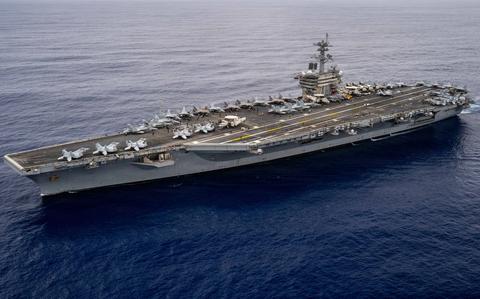
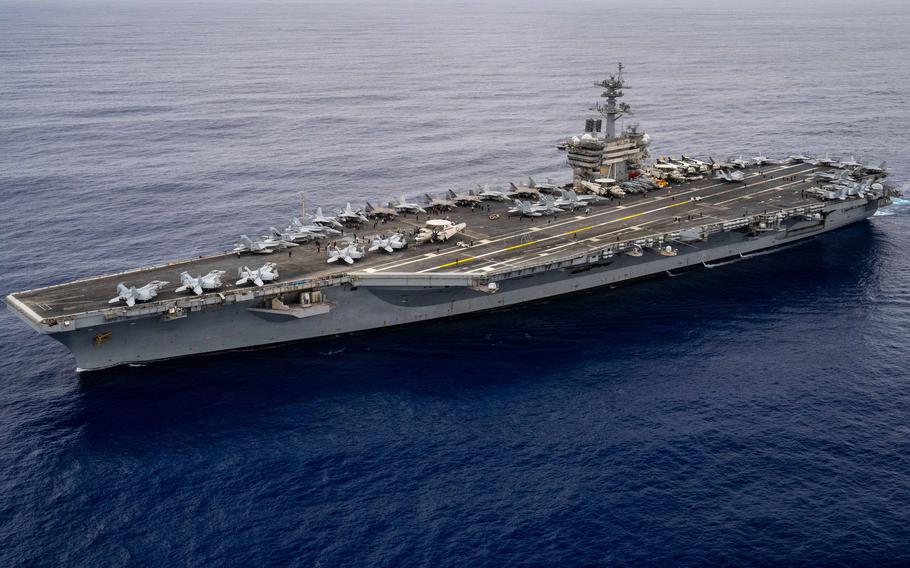
The aircraft carrier USS Theodore Roosevelt transits the Pacific Ocean on June 19, 2026, during exercises in the U.S. 3rd Fleet area of operations. The carrier, flagship of Carrier Strike Group 9, arrived in the U.S. Central Command area of responsibility on Sunday, according to news reports. (Aaron Haro Gonzalez/U.S. Navy)
A third U.S. aircraft carrier arrived in the Middle East over the weekend as President Donald Trump continued to ratchet up economic pressure on Iran and threaten renewed military strikes.
USS Theodore Roosevelt pulled into the U.S. Central Command area of responsibility Sunday, according to The Wall Street Journal and Axios, citing unidentified U.S. officials.
CENTCOM did not immediately respond to an email seeking confirmation of Roosevelt’s arrival. The carrier strike group includes Air Wing 11, the cruiser USS Chosin and the destroyers USS Paul Hamilton and USS Decatur.
Also on Sunday, Iran launched six drones targeting the Riffa helicopter base in Bahrain, the first such attack on the island nation since early September, according to news reports.
Bahrain said it had intercepted and destroyed several projectiles in Iranian air attacks while Iran’s Revolutionary Guards claimed “successful impact.”
Manama, the country’s capital, is home to Naval Support Activity Bahrain, which includes U.S. Naval Forces Central Command/U.S. Fifth Fleet. Riffa is about 11 miles from NSA Bahrain.
Iranian missile and drone attacks have repeatedly struck the Navy installation since the war began in February.
The attacks came as Trump has appeared to pivot away from diplomatic efforts to end the war with Iran, instead leaning on a U.S. maritime blockade, other economic pressure and threats of renewed strikes to pressure Tehran into making concessions.
Iran has intensified its attacks on ships in the Strait of Hormuz and nearby waters in recent weeks, with attacks reaching levels not seen since the U.S. and Israel launched their war against Iran in February.
“We don’t need a deal with Iran. Those days have long since passed,” Trump said Thursday on Truth Social. “We’ve got their money, Hundreds of Billions of Dollars, and we’ve got their Strait!”
In enforcing the blockade, U.S. forces have turned away 150 commercial ships and disabled five others, blocking Tehran from exporting more than $30 billion in crude oil, CENTCOM said earlier this month.
Some analysts have warned that intensifying economic pressure could provoke further Iranian aggression.
“If history is any guide, Iran will at some point resort to violence to try to force Washington to reconsider,” Bilal Saab, a Chatham House associate fellow wrote in an analysis published last week. He added Iranian efforts to escalate would be unlikely to sway Washington, which is convinced the blockade is working.
There have been at least 14 attacks on commercial ships in the Strait of Hormuz and nearby waters so far this month, following 35 attacks in October, according to data from the U.K. Maritime Operations Center and the International Maritime Organization.
By comparison, there were 19 confirmed attacks on ships in the region in March.
Roosevelt’s arrival marks the second time this year the U.S. has had three aircraft carriers in the Middle East. It’s unclear, though, whether the U.S. will keep three carriers in the region or whether Roosevelt will relieve Japan-based USS George Washington or USS George H.W. Bush.
Those carriers have been in the Middle East since August and April, respectively. Bush relieved USS Gerald R. Ford, which ended a record-setting 326-day deployment in May.
Last week, families of service members aboard Bush were reportedly told during a meeting in Norfolk, Va. with acting Navy Secretary Hung Cao that the carrier would not be home for the holidays, according to reports from Military Times and MS Now as well as the local newspaper, The Virginian-Pilot.
The carrier departed Norfolk on March 31 for a scheduled deployment.
Citing operational security, the Navy declined to answer Stars and Stripes’ questions about whether Bush’s deployment had been extended. Operational demands on forward-deployed sailors and Marines are “always unpredictable,” the service said.