
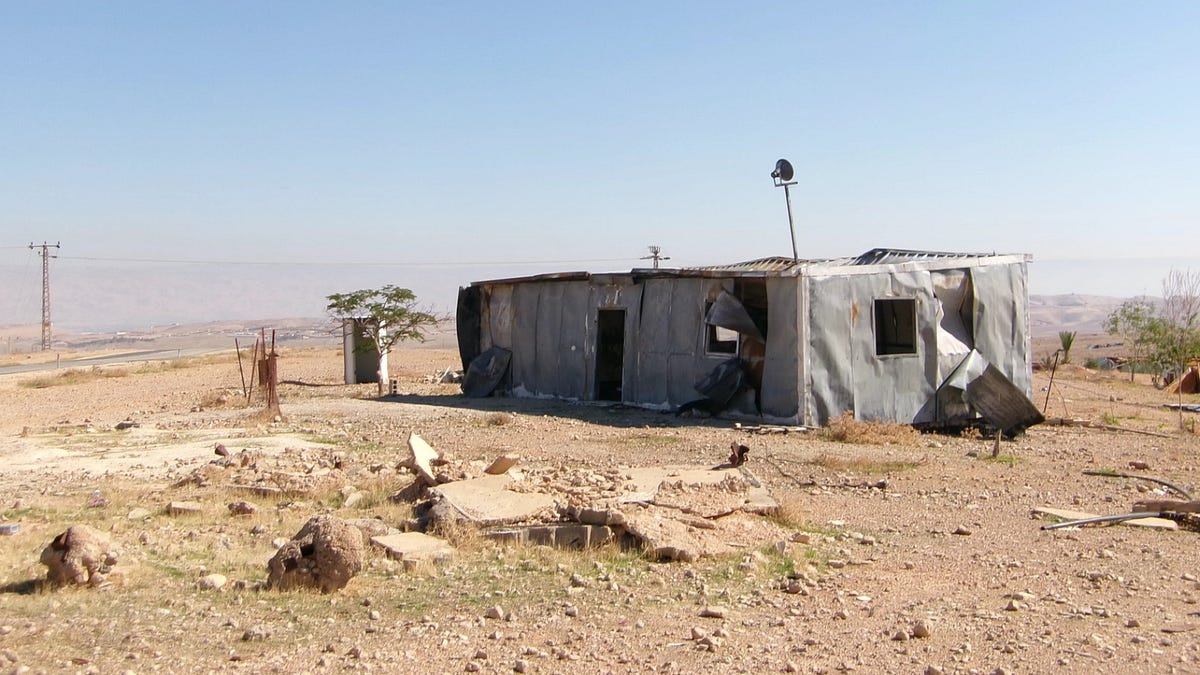
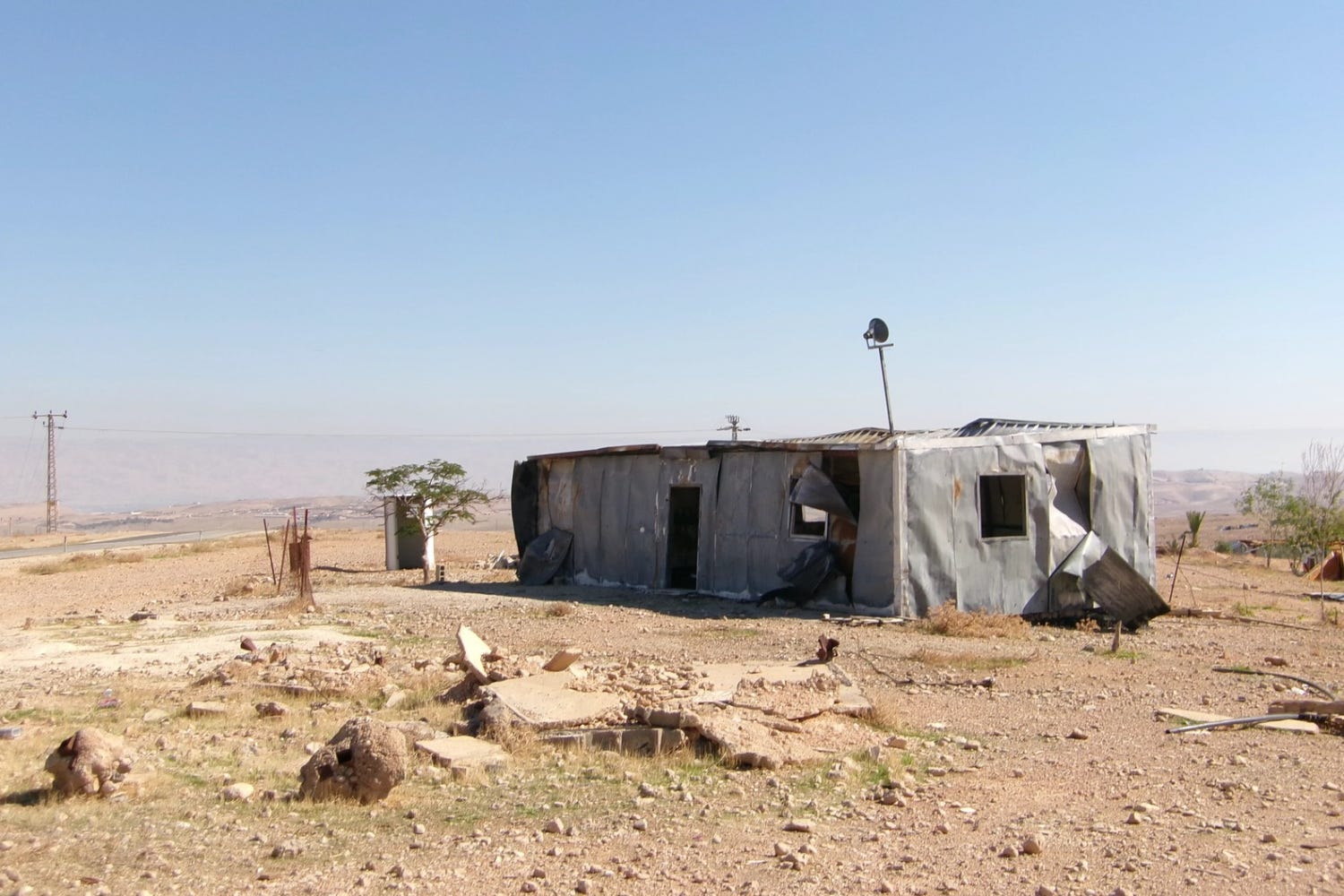
Last week, I led a delegation to Israel and Palestine. On our final day, we visited the Jordan Valley, where we saw Palestinian communities that had been driven from their lands by months of threats, intimidation, and violent attacks by extremist Israeli settlers. We saw a mosque that had been vandalized and burned. We saw videos of settlers terrorizing young girls at a now-abandoned school.
While we were there, a security coordinator from a nearby Israeli settlement showed up to harass us. Carrying an M4 rifle, possibly American-made, he interrupted our guide, argued with him, and tried to provoke a confrontation.
This wasn’t simply some rogue extremist. He was the security coordinator for an Israeli settlement recently recognized by the Netanyahu government, operating with a weapon provided by the Israeli government, and receiving a salary from the Ministry of Defense. His job was to protect a settlement several miles away. Instead, he was harassing a group of Americans visiting Palestinian communities, apparently with no fear of consequences.
A few hours later, back in Jerusalem, we met with a prominent liberal Zionist thinker whom I deeply respect. He wants to see a different Israel and a better future for Israelis and Palestinians. But his message to us was essentially: “Don’t push us from America. Give us some runway. If you push us, we will react badly. Give us space to work things out ourselves. A new government will start to make things better.” The contrast was jarring.
We had similar conversations with former senior Israeli government officials and supporters of the Change bloc, whom I have known and worked closely with over the years. People I respect enormously and with whom I have agreed on countless issues. Their message was largely the same. Again and again: “Give us space. Give us a runway.”
But after seeing what I’ve seen in the West Bank and observing Israeli government behavior in recent years, I could not disagree more.
These disagreements are painful. I want these people to succeed. I want a new Israeli government to succeed. And in many ways, I do believe that we all want the same thing.
But I see two fundamental problems with their argument.
First, history suggests that American pressure is often precisely what moves Israeli governments to change course.
In 1956, Eisenhower pressured Israel to withdraw from the Sinai. Carter used diplomatic pressure and arms sales as a tool in getting Israel to agree to the Camp David Accords and the Peace Treaty with Egypt. In 1982, Reagan pressured Menachem Begin to halt Israel’s bombardment of Beirut, warning that continued attacks endangered the U.S.-Israel relationship – securing an end to Israel’s attack within 20 minutes. In 1991, George H. W. Bush confronted Yitzhak Shamir over settlements and withheld $10 billion in loan guarantees, helping push him to attend the Madrid Peace Conference and putting additional pressure that helped lead to Rabin’s ascent.
More recently, after giving Netanyahu extraordinary latitude during the war in Gaza, the only time Biden was able to get a major shift in Israeli policy towards aid in Gaza was when he threatened U.S. support in April 2024. And in October 2025, Trump’s willingness to use pressure on Netanyahu was decisive in bringing about a ceasefire and hostage release in Gaza.
Even today, international pressure actually seems to be working. Israeli newspapers are filled with warnings about the erosion of American support, including from centrist Israelis journalists and commentators sympathetic to the opposition. A year ago, many centrist Israeli counterparts were largely dismissive of these American concerns and told delegations I led that we were being unrealistic. That dismissiveness has been replaced with much greater urgency to understand what is happening in the U.S. and how Israel can fix it.
What has caused this change in attitude? Credible pressure …
Second, American taxpayers, policymakers, and politicians can’t only think about Israeli politics. It’s also about American policy and American politics.
When an Israeli whose salary is subsidized by the Ministry of Defense, carrying a government-issued rifle that may have been manufactured in the United States, feels free to intimidate a group of Americans visiting Palestinian communities, that’s not simply an internal Israeli matter. It raises a question about what the United States is willing to tolerate from a government that receives billions in American support.
And the broader American political reality has fundamentally changed. The old paradigm of unconditional support for Israel, regardless of its government’s behavior, is dead in the Democratic Party. It is not coming back.
Increasingly, there are two competing approaches. One is wholesale isolation of Israel through comprehensive arms embargoes, sanctions, and boycotts. Essentially, an end to the U.S-Israel relationship.
The other is a more targeted, conditional relationship that maintains America’s commitment to Israel’s security while insisting on clear standards of conduct: conditioning offensive weapons transfers, imposing sanctions against violent settlers and their enablers, and establishing real consequences for settlement construction that threatens a Palestinian state.
Israelis understandably focus on their own political constraints. They need to recognize that American political leaders face constraints, too. The 2026 elections have reinforced how dramatically this debate has changed. Even Republicans are not immune, as comments from Trump and JD Vance after the elections suggest.
In addition to being the wrong policy, simply giving Israelis time and space to work out a new approach because they might form a new government is a politically nonexistent option for Democrats right now – a direct result of the Israeli government’s behavior in recent years.
So here is my message to my Israeli friends and colleagues, particularly those working to form a new government: Stop asking us to give you a runway. Build your own.
The good news is that you have the last two years of Donald Trump’s presidency. His political power will diminish as he approaches the end of his term, but the president retains enormous authority over foreign policy and veto power over legislation. He’s likely to be the last president – Democrat or Republican – who will largely continue to offer Israel near blank-check support.
That gives Israel roughly two years to demonstrate that meaningful change is possible. So use them. Not just for American Jews or the Democratic Party, but for Israel itself, for Palestinians, and for the future of the US-Israel relationship.
What would building that runway actually look like? Well, it looks a lot like things that many around Eisenkot say they want to do. Now they have to execute.
Start with the government itself. Form a coalition that demonstrates genuine democratic inclusion. There are multiple possible configurations: a minority government supported by Mansour Abbas and Ra’am alongside other Arab parties; a coalition including Ra’am and an ultra-Orthodox party such as United Torah Judaism, with additional outside support from the Joint List; or some other arrangement. But Arab citizens of Israel must be treated as legitimate participants in deciding their country’s future. If, instead, the Jewish-led opposition parties refuse to cooperate with the Arab parties outright, this will further degrade Israel’s standing among Democratic leaders and voters. And if they choose a national unity arrangement with Netanyahu instead, this will all but guarantee a major break between the U.S. and Israel if a Democratic president takes office in 2029.
Then, seriously tackle settler violence – something Eisenkot and the opposition have promised to do. I know they mean it, but I’m worried many in the Israeli opposition do not truly understand how bad the situation has become or what reversing it will require. This isn’t simply about arresting some violent extremists. The problem is systemic. Farming outposts have proliferated across the West Bank, serving as bases for intimidation and the forced displacement of Palestinian communities, often with government support and IDF protection. Many will need to be physically dismantled. Government assistance and impunity must end. It won’t happen overnight, but two years is enough time to make substantial progress.
Get serious about implementing the Gaza ceasefire. Allow humanitarian aid and reconstruction materials to flow at the necessary scale for the Strip to begin recovering. Cooperate in good faith with the Hamas disarmament and Israeli withdrawal roadmap negotiated by the Board of Peace’s Nikolay Mladenov. Allow the proposed National Committee for Administering Gaza and Palestinian police forces to enter Gaza and begin assuming responsibility.
Reverse the systematic weakening of the Palestinian Authority. Release billions in withheld Palestinian customs revenues. Ensure banking relationships function. Begin removing the extraordinary movement restrictions that have devastated Palestinian life and the West Bank economy over the past three years. Start helping Palestinians build the institutions of a future state rather than sabotaging them at every turn.
And pursue a constructive regional policy. Engage seriously with Lebanon and Syria. Move away from indefinite buffer zones and military occupation of neighboring territory and toward negotiated security arrangements that create conditions for Israeli withdrawal and lasting stability.
That is how Israel builds its own runway.
If a new Israeli government begins making meaningful progress on these fronts, Democrats will notice. American officials will notice. Presidential candidates will notice. American Jews who have grown alienated from Israel will notice.
I will certainly notice. And I will advocate for recognizing and supporting genuine progress.
Does that mean every criticism will disappear? That conditions on American assistance should immediately be lifted? That we return to unconditional support? Absolutely not. That old model is gone, and for good reason.
But genuine changes in Israeli policy would create space for a healthier U.S.-Israel relationship, one based on shared interests, clear expectations, and mutual accountability.
What I cannot accept is the argument that Americans should stop pressing for change right now simply because a new government might do better if we leave it alone.
We have been asked to wait too many times. The consequences are visible across the West Bank, in the ruins of Gaza, and in the growing damage to Israel’s relationships with the United States and the broader international community.
I want my Israeli friends to succeed. I want a new Israeli government to succeed. I want to be able to write enthusiastically about a different direction for Israel and to make the case that the United States should reward real progress.
But that won’t happen through another appeal for patience. It will happen through action. Don’t ask us to believe you’ve changed your approach. Show us. Don’t ask us for a runway. Build your own.
Wait! Before you go …
J Street relies on grassroots support to fuel our mission: Fighting for Israeli-Palestinian peace and defending democratic values.
Unlike some other groups, we don’t have right-wing mega-donors, so every dollar makes a difference!