Right now, an object from deep space is flying through our solar system—and astronomers are scrambling to figure out what it is. Spotted just a few weeks ago, this visitor has already sparked surprises and raised big questions.
Discovered in early July 2025, the object is on a rare, open-ended hyperbolic trajectory, racing along at around 220,000 kilometers per hour (about 137,000 mph). It didn’t take long for astronomers to agree: this thing isn’t from around here. That’s why it’s been named 3I/Atlas—“3I” meaning it’s the third interstellar object ever spotted near Earth, and “Atlas” after the system that detected it: the Asteroid Terrestrial-impact Last Alert System, designed to catch near-Earth objects before they get too close.
Not to worry, though—NASA has confirmed that 3I/Atlas poses no threat. It won’t get any closer than 270 million kilometers (about 168 million miles) from Earth. By late October, it’ll reach its closest point to the Sun—roughly 210 million kilometers away, just inside Mars’s orbit.
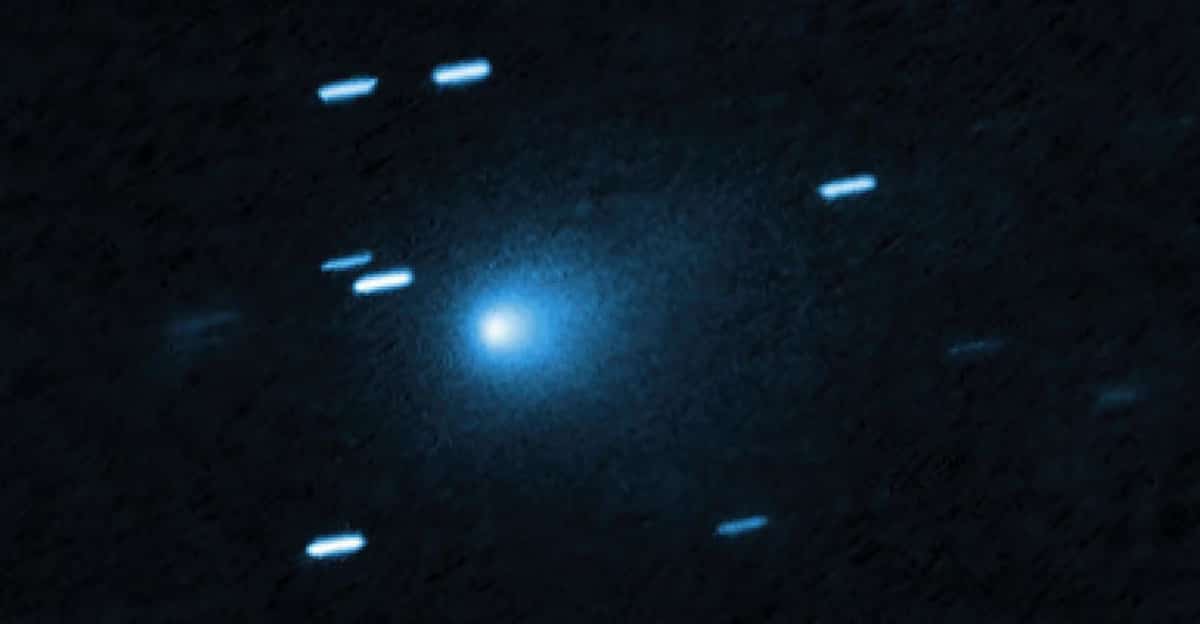
Comet 3I/Atlas at its discovery on July 1, 2025. © Atlas, University of Hawaii, NASA
A strange comet takes shape
Because 3I/Atlas will be out of view from Earth during much of October, astronomers quickly turned their best instruments on it. Early data confirmed its cometary nature. Images showed a reddish halo—or coma—likely caused by silicates loaded with organic material. The coma has grown as the object nears the Sun.
Interestingly, even before its discovery, data suggested the comet’s activity was driven by the sublimation of volatile ices other than water. Since then, spectroscopic analysis has revealed traces of water, as well as a few surprises: huge CO₂ emissions stretching nearly 350,000 kilometers, plus signs of cyanide and nickel.
The coma appears to extend toward the Sun—not a classic tail, but more like a dust plume from the heated surface of the comet’s nucleus. However, other observations show a faint, wide tail stretching away from the Sun—typical for comets, but tricky to see from Earth since it’s pointing in the opposite direction.
NASA’s recently launched SPHEREx mission, operating in the near-infrared, has captured valuable observations of the interstellar comet 3I/ATLAS from August 7 to 15, 2025.
Working in concert with the Webb and Hubble space telescopes, SPHEREx has contributed to unveiling the… pic.twitter.com/Vv6Oa9XAIk
— Erika (@ExploreCosmos_) August 26, 2025
What we still don’t know
At first, scientists thought the comet’s core might be huge—10 to 20 kilometers across. But later images from the Hubble Space Telescope suggested a much smaller size, somewhere between 0.32 and 5.6 kilometers. Still, that coma is so reflective it could be throwing off estimates, making the comet look bigger than it actually is.
A rare glimpse into distant worlds
Studying interstellar objects like 3I/Atlas gives astronomers a rare look into how planetary systems form outside our own. It’s a chance to compare their building blocks with what we know about our own solar system’s history.
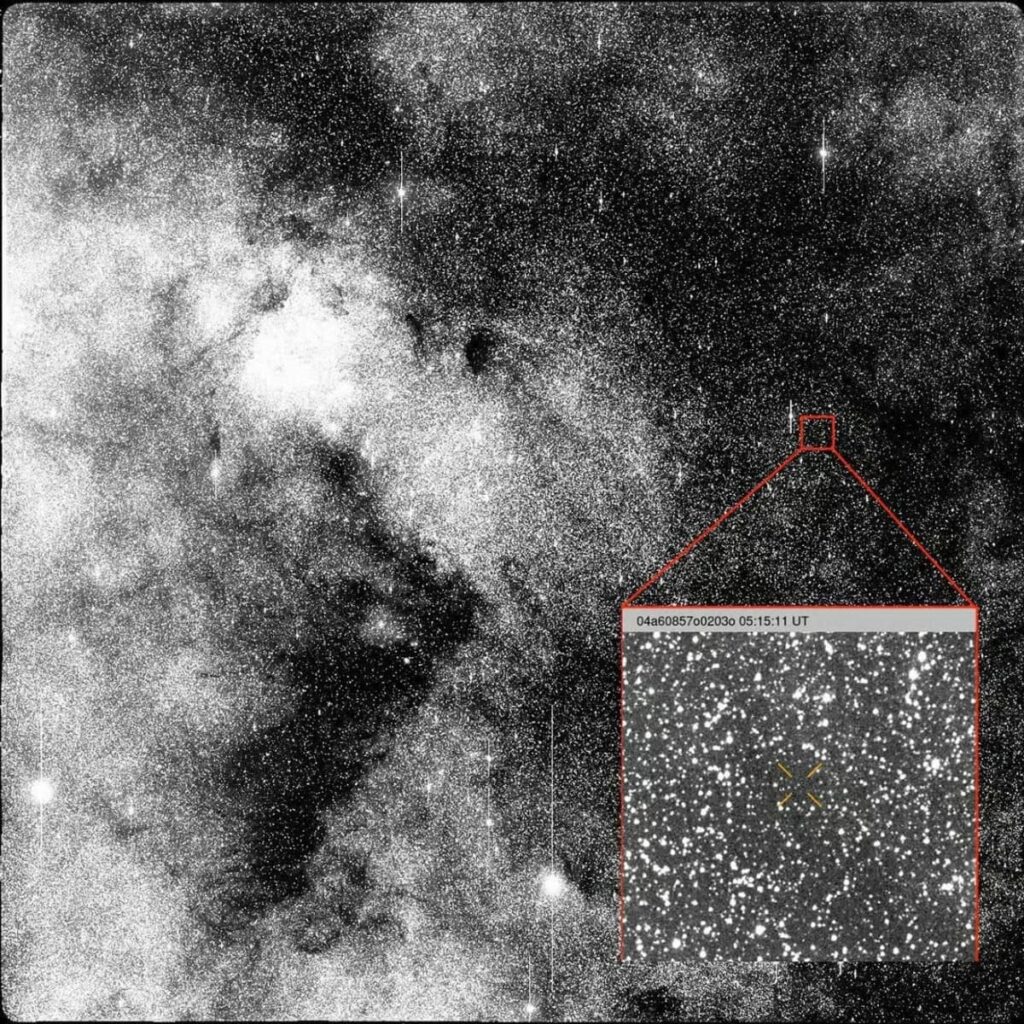
Researchers believe 3I/Atlas came from the direction of the Sagittarius constellation, near the heart of the Milky Way. Based on its composition, they estimate the comet formed around 7 billion years ago in the galaxy’s ancient thick disk, orbiting a young star—until something ejected it, though we don’t know what. Its many gravitational encounters over time make it nearly impossible to trace back to its star of origin.
The location of Interstellar Object / Comet 3I/ATLAS today (August 25, 2025), as it approaches the Psyche spacecraft (and as team Psyche prepares to observe it).
See https://t.co/vcNHNx8Egh for more. pic.twitter.com/Nc7MKteWq2
— Space Initiatives (@AsteroidEnergy) August 25, 2025
Alien tech? Not likely.
Of course, there’s always speculation. Harvard physicist Avi Loeb and his followers suggest 3I/Atlas could be an artificial object. They’ve even questioned the delay in releasing images from the James Webb Space Telescope, which observed the object in August. Those images are now public—but the debate hasn’t entirely stopped.
3I/ATLAS photographed by SPHERE-X (slide 1) versus James Webb (slide 2). If you compare the two images, you can see an expected amount of “noise” in slide 1, but “no noise” and “broad smearing” in slide 2.
They did this by setting the pixel sizes for slide 2, much larger than… pic.twitter.com/MS0iCXf5bT
— Red Collie (Dr. Horace Drew) scientist/inventor (@RedCollie1) August 26, 2025
JWST detected what you’d expect: a fuzzy coma, volatile ices, and common molecules like water, CO₂, and carbon monoxide. While the ratios were a bit surprising, scientists say they could even out once the comet gets closer to the Sun and releases more water.
So, is it an alien spacecraft? Highly unlikely. And upcoming observations should put that theory to rest. Data is expected soon from NASA’s Psyche mission, followed by probes near Mars and the Juice mission en route to Jupiter. There’s even a chance that Europa Clipper, Hera, or Lucy could pass through the comet’s tail in the coming weeks.
By November, Hubble will analyze the gas emissions using ultraviolet spectroscopy, including the sulfur-to-oxygen ratio. It’ll also monitor 3I/Atlas as it exits the solar system. JWST, meanwhile, won’t take another look until December.

Nathalie Mayer
Journalist
Born in Lorraine on a freezing winter night, storytelling has always inspired me, first through my grandmother’s tales and later Stephen King’s imagination. A physicist turned science communicator, I’ve collaborated with institutions like CEA, Total, Engie, and Futura. Today, I focus on unraveling Earth’s complex environmental and energy challenges, blending science with storytelling to illuminate solutions.