
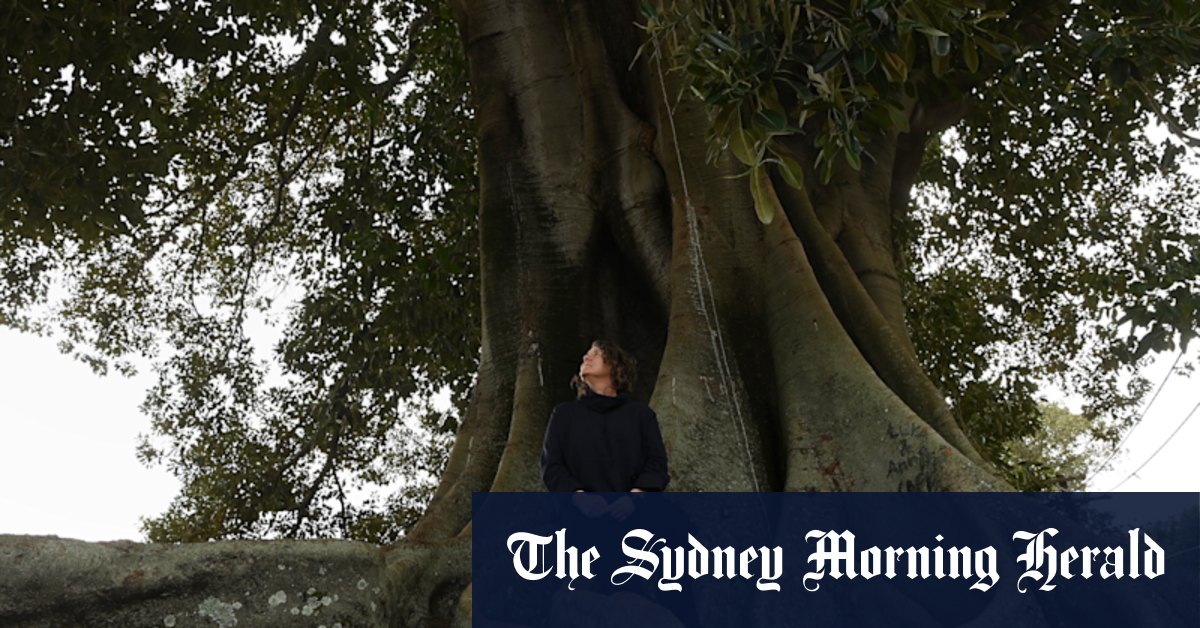
Pfautsch said the shade generated by big figs, such as those with between 700 and 900 square metres of “crown-projected area” canopy in the Domain (which are not included in the register), was greater when the sun came in from the side.
“Overall, they create their own microclimate, and dependent on the surrounding environment, the cooling effect can extend into nearby street canyons and homes. They are indeed signi-magni-ficant – lowering surface temperatures by up to 45 degrees on hot days and cooling the air by 2 to 3 degrees.”
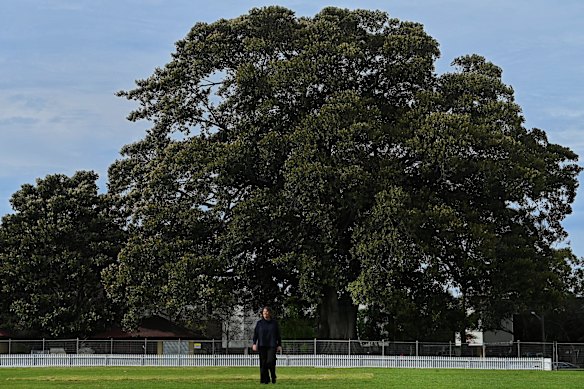
Karen Sweeney is dwarfed by a Moreton Bay fig tree.Credit: Kate Geraghty
The consequences of not protecting old trees in our cities will be dire. “If we lose them altogether, likely, we will never get them back due to the type of human-nature relationship that allowed them to disappear in the first place.”
Sweeney said there was “quite a bit of research that talks about, the larger the tree, the larger the benefit”.
“As an urban forester, if I have an opportunity of planting three small trees or one large tree, I will always plant one large tree (assuming it is right for the site) because the larger trees provide exponential benefits in terms of canopy cover and shade.”
The average street tree provides 33 square metres of canopy cover, a mature tree provides 66 square metres, while a significant tree provides an average of 248 square metres of canopy cover.
“In this weather,” Sweeney said on a wet day last week, “they slow down all the stormwater. So you imagine that with the massive canopy, when that rain hits all the leaves, goes through the branches and then down the trunks, it helps absorb moisture.”
Loading
Old trees also give communities a sense of history and place. The Alexandria tree’s first caretaker, P. Dawson, was appointed in 1895 on a barter system, allowing him to graze his six cows in exchange for maintaining the park.
The updated draft register features 2450 trees of 85 different species across 146 locations. Moreton Bay, Hills and Port Jackson figs are the most prevalent.
They include a London plane tree planted to honour Prince Philip (the matching one, for Queen Elizabeth, died in a storm) in Macquarie Place and a Grey Ironbark in Glebe that predates colonisation.
Sydney Lord Mayor Clover Moore said specimens in our register were magnificent historical and ecological treasures. “They were essential for cooling and greening our city,” Moore said, “while also providing crucial habitat for birds and animals in the area.”
Start the day with a summary of the day’s most important and interesting stories, analysis and insights. Sign up for our Morning Edition newsletter.