
Mexico’s ‘Second-largest market in Latin America’ produces 190,000 units of the Monterey plant, the largest small sedan K4 since COVID-19 in 2020
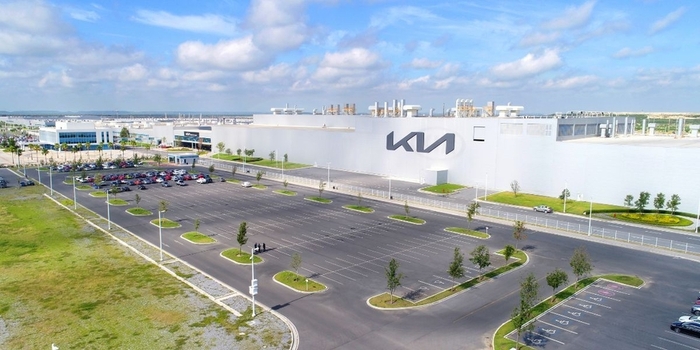 사진 확대 A panoramic view of Kia’s Mexican factory. Kia
As U.S. auto tariffs are approaching their sixth month of implementation, finished car brands are converting their Mexican plants into bases for domestic and Latin American markets. Kia’s production volume at its Mexico plant and domestic sales in Mexico reached the highest level since COVID-19 in January-August this year.
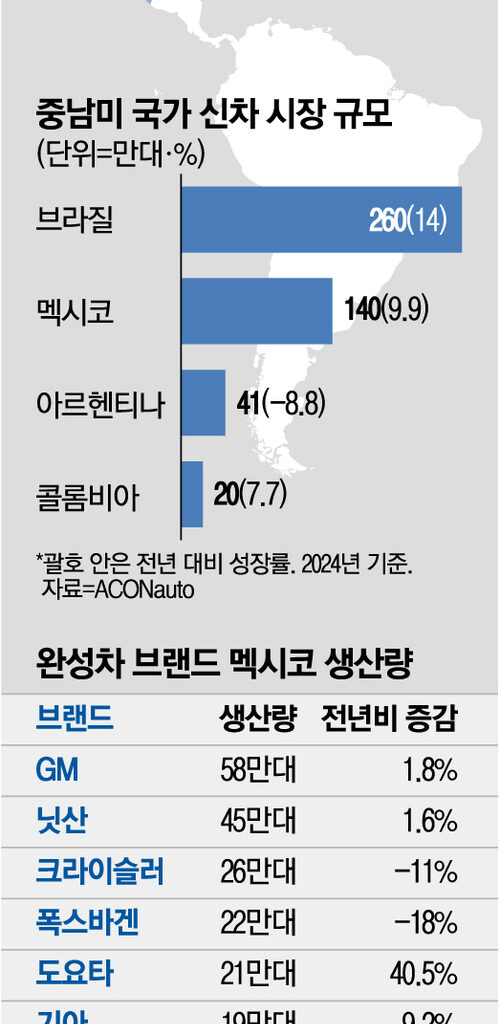
According to Mexico’s National Statistical Geographic Information Institute (INEGI) on the 22nd, Kia produced 190,000 units at its Monterrey plant in Mexico between January and August this year, up 9.2% from the previous year. Sales are around 72,000, which is also the highest number since 2020.
Mexico has attracted attention as an outpost for U.S. automobile exports to global finished car brands due to its tariff-free export to the U.S. through the USMCA (US, Mexico, and Canada) agreement along with its cheap labor. Last year, U.S. companies GM, Ford, and Chrysler ranked first, third, and fourth in Mexico’s automobile production, with 90% of U.S. exports to total production.
However, as the Mexican government failed to sign a tariff reduction agreement with the United States, it became less attractive as an export outpost to the United States. Currently, Mexico is basically subject to 25% tariffs when exporting cars to the United States, but 15% tariffs are also applied if it meets the rules of origin that “more than 75% of the vehicle’s value is parts produced in North America.”
Nevertheless, Kia and other global automakers have increased production in Mexico this year, which is interpreted as a move to shift the character of Mexican factories to the domestic market in Latin America. The Mexican market is the second largest in the Latin American new car market after Brazil. Last year’s sales reached 1.4 million, with a 9.9% year-on-year increase. When combined with Brazil (2.6 million units), which ranks first, it accounts for 70% of the total sales of new cars in Latin America.
Toyota is particularly aggressive. Toyota’s U.S. automobile sales account for 75 percent of its U.S. production in the U.S., with four U.S. factories alone. As such, it is advantageous to convert the Mexican plant into a domestic market in Latin America. Toyota aims to expand its domestic market sales this year by increasing production at its plant in Mexico by 40.5% year-on-year. Toyota ranked third in sales in Mexico after Nissan and GM in 2022, but it has lost its third position to Volkswagen from 2023.
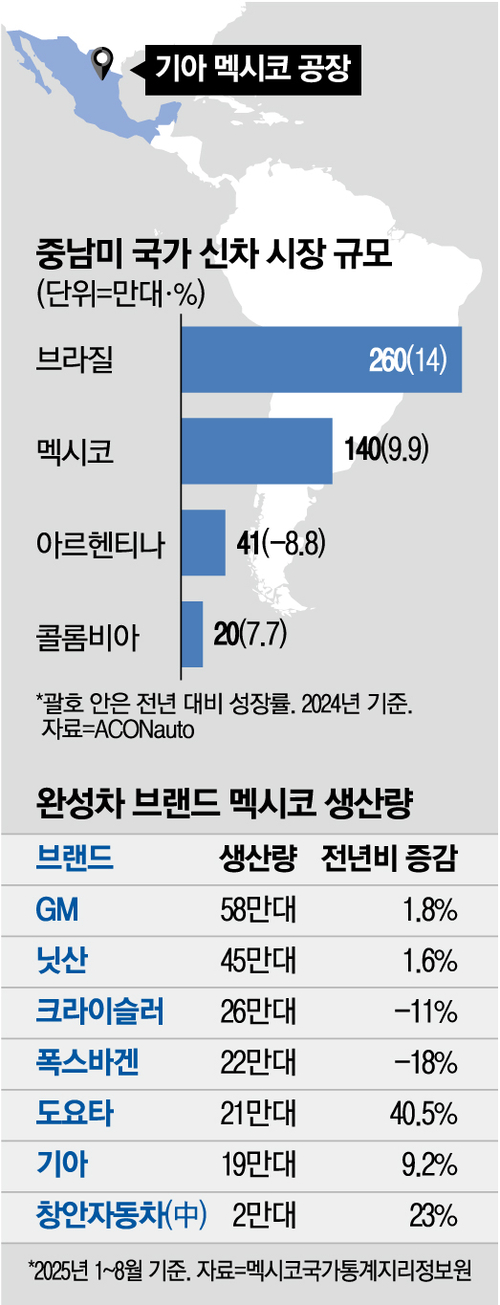 사진 확대
Kia is also strengthening its targeting in the Mexican market by increasing production at its Mexican factories by 9% year-on-year. Kia ranks sixth after Toyota in the Mexican market. 75% of production is exported to the United States and other countries, and 25% is sold to Mexican factories. The proportion of domestic sales in total output increased by 2 percentage points year-on-year.
Kia is expected to accelerate its entry into the Latin American market, focusing on the small sedan K4, which was launched in August last year. Kia’s Mexican plant, which began operations in 2016, is one of the most exposed to the aftermath of tariffs this year. Since April this year, when tariffs were applied, Hyundai Motor’s Tucson production to the U.S. has been suspended.
Under these circumstances, the K4, which was launched in August last year, is serving as a relief pitcher for the Mexican plant. The K4 is a small sedan that offers reasonable prices and has a higher preference for the Latin American market, which is a developing country, than the U.S. market. Since its launch in the second half of last year, an average of 15,000 units have been sold per month, the second-largest production volume of Kia’s overseas plant after Sportage.
There is also plenty of room to expand sales. The utilization rate of Mexican factories increased from 67.7% last year to 80.4% in the first half of this year. However, as it is still the lowest among the five Kia global factories, there is a sufficient possibility of production expansion.
Meanwhile, Chinese automakers, which are virtually impossible to export to the U.S., are also accelerating their entry into the Latin American market. JAC, the only Chinese brand to build a factory in Mexico, produced 20,000 units between January and August this year, up 23% from last year.
MG Motors, another Chinese brand, has sold more than 32,000 units in the first eight months of this year, ahead of Japanese companies Suzuki, Honda and Mitsubishi. In addition, Chinese brands such as Great Wall Motors, Cherry Motors, Omoda, and Zetour recorded sales of about 3,000 units per month.