
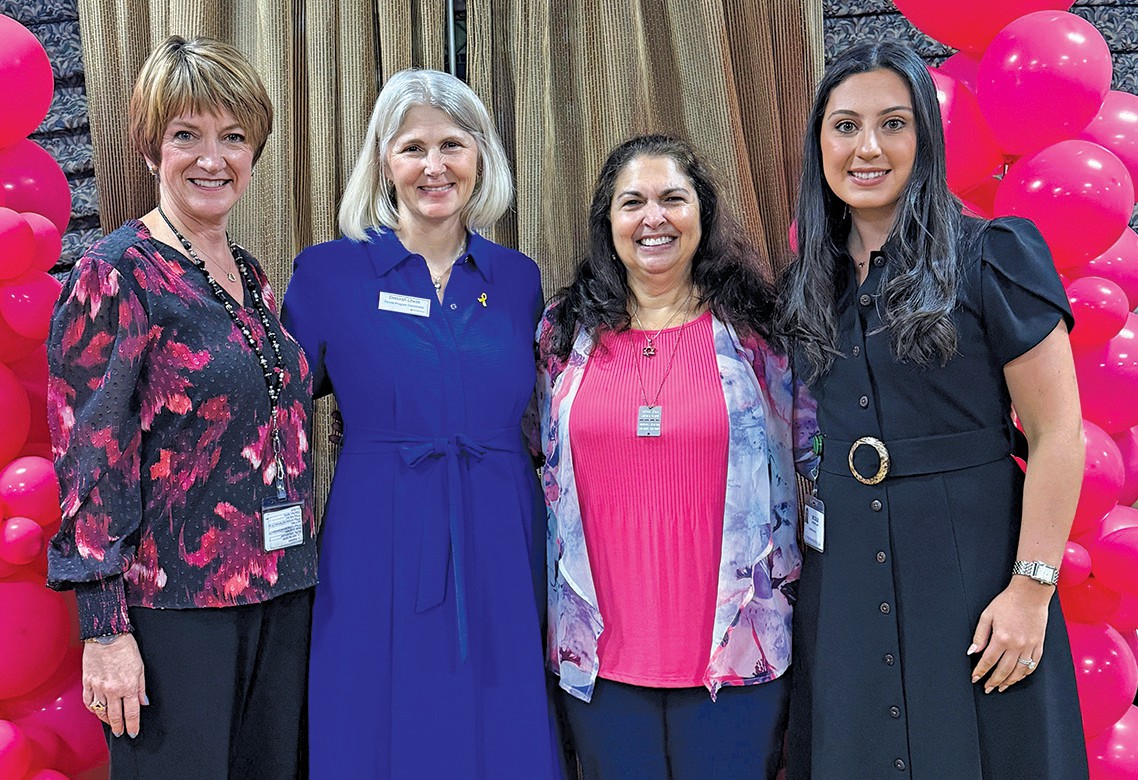

At breast cancer “tea” hosted by Menorah Life and Sharsheret program: Donna Perryman, Menorah Life CEO, Deborah Litwak from Sharsheret, survivor Laurie Reiskind and Nicole Spencer of Menorah Life.
L’dor v’dor. It’s a positive Hebrew phrase that describes passing along a legacy of Jewish values and traditions. Unfortunately, not everything we pass “from generation to generation” is good.
As many Jews of Ashkenazi descent know, hereditary cancer genes – particularly the BRCA gene mutation that is an indicator that a person may be at risk for breast and ovarian cancers – are prevalent among Jews with ancestors who came from Eastern Europe. Experts advise genetic counseling and testing to determine whether you are a carrier for the BRCA gene. However, that may not be enough. In October – which is both Breast Cancer Awareness Month and Family History Month – Jewish women (and men) also need to know their family medical history.
Laurie Reiskind of St. Petersburg hadn’t thought about genetic counseling – until after she was diagnosed with breast cancer in 2018. That’s when she discovered that comprehensive genetic testing – even after the diagnosis – could still play a vital role in her treatment and recovery. Reiskind, who is of Ashkenazi descent, tested negative for the gene mutation, which meant “I didn’t need a more invasive surgery because I am not genetically predisposed,” said Reiskind, who is involved at her synagogue, Congregation Beth Israel in St. Petersburg, with Hadassah’s St. Pete chapter and at Gulf Coast Jewish Family and Community Services.

L to R: Harriet Starr, Joyce Seder, Rhoda Gross, Marjorie Friedman.
After surgery, Reiskind’s oncologist tested the tumor and deemed chemotherapy as unnecessary. Instead, her treatment included a lumpectomy (instead of a mastectomy) followed by radiation therapy. Today, at age 60, she is celebrating being cancer-free for seven years.
Last month, Reiskind shared her experience at a presentation at Menorah Life in St. Petersburg, held in partnership with Hadassah’s St. Petersburg chapter and Sharsheret, a New Jersey-based international (U.S. and Israel) organization providing breast cancer support, education and information.

L to R: Marlys Meckler, Sally Laufer, Ann Soble, Donna Perryman, Karyn Rizzi-Jimenez
One of the Sharsheret’s function is to provide a one-on-one connection by matching newly diagnosed patients or women who are at high risk of developing breast cancer or ovarian cancer, with others who share similar diagnoses and experiences. Sharsheret, which means “chain” in Hebrew, makes a shidduch depending on a patient’s age, type or stage of cancer, treatment decisions or gender (men can speak with other men who also carry the gene mutation or who have been diagnosed with breast cancer).
The Ruth and Sidney Vine Peer Support Network pairs “women with similar diagnoses and treatment plans, keeping in mind the stage of life and connection to Judaism, when appropriate,” says Deborah Litwak, outreach manager for Sharsheret’s southeast region.
The organization was founded in November 2001 by Rochelle Shoretz (z”l), a mother in New Jersey who was diagnosed with breast cancer at age 28. She didn’t know how to explain the effects of cancer and treatment to her young children and wanted to connect with a young religious woman like herself – who was also coping with the disease while raising a family.

Laurie Reiskind speaks at a Sharsheret event.
Donna Perryman, chief executive officer at Menorah Life, felt it was important to inform the community because “breast and ovarian cancers touch every community, and we believe education is a powerful form of care. Including local survivors is essential and adds authenticity, hope and courage to the conversation.”
Throughout the month of October (and throughout the year), Sharsheret will hold virtual seminars on a variety of subjects. For Breast Cancer Awareness Month, Sharsheret’s Summit program will present topics that include: managing treatment side effects; nutrition and reducing cancer risk; balancing cancer treatment and recovery with work; and cultural competency training for medical professionals. Visit https://summit. sharsheret.org/events/.
Benefits of genetic counseling
After getting the results of the genetic blood test, a patient can determine, with a doctor’s guidance, the next steps to lower your breast cancer risk, as well as the risk of other related cancers. The testing can also help guide your treatment choices – as it did with Reiskind. Once a genetic mutation is identified, options include increased surveillance (every 6 months instead of once a year) and different modalities (mammograms, ultrasounds) for breast cancer screening, Litwak said.
Genetic counseling is available at many outlets in the Tampa Bay Area, including at Moffitt Cancer Center. Litwak also recommends jscreen.org for more insight into the hereditary health risks.
Women with BRCA mutations should begin annual breast MRI with contrast by age 20-25 until age 29, said Darcy Berry, a certified genetic counselor at Moffitt Cancer Center. Beginning at age 30, women with the BRCA mutation should get an annual breast MRI with contrast and an annual mammogram – spacing the two procedures six months apart from each other. “Some women consider removing their healthy breasts prophylactically to reduce their risk for a future breast cancer,” she said. “Removal of both breasts reduces the risk for breast cancer by about 90 percent.”
If a woman does not have a hereditary breast cancer mutation, she would (at a minimum) still have the general population risk for breast cancer of approximately 12 percent, Berry said. That’s why all women are recommended to have annual mammograms beginning at age 40. Family history of breast cancer, previous biopsy results, and other factors can increase a woman’s risk for breast cancer and warrant additional breast screening sometimes even if the genetic testing is negative (or normal).
Know your risk
The reason breast cancer is prevalent in Jews is because Jewish families in Eastern Europe tended to marry within the shtetl (community) or extended family, which allowed a concentrated spread of the mutation through generations. Litwak recommends genetic counseling before getting tested in order to be prepared for the test results and know the implications beforehand.
About 10% of all breast cancer is hereditary, according to the University of Colorado Cancer Center. That leaves about 90 percent of breast cancer developing in women without an identified gene mutation or concerning family history. You may still be at risk – like Joan Wadler of Tampa, who tested negative for the BRCA gene and had no previous family history of breast cancer.
In December 2015, Wadler’s mammogram showed no sign of cancer. But during a self-exam – something she recommends to all women as a potential lifesaver – she found a lump five months later. She made an appointment with her gynecologist but canceled when her daughter had a dental procedure. It was her husband, Marc, who reminded her to reschedule weeks later. After her ultrasound, the radiologist recommended a biopsy, which uncovered triple negative cancer –Wadler’s friend had died from the same thing.
“It is the most traumatic, scary, horrible thing,” said Wadler, an attorney. At the time of her diagnosis, she had a child in high school and another going off to college.
After a double mastectomy, Wadler endured 16 rounds of chemotherapy and a variety of post-op complications after the mastectomy and the reconstruction. But by January 2017, the cancer was in remission.
“Everybody’s story is different. If you can catch the cancer early enough, you can do a lot to treat it,” says Wadler, now age 65, who is of Ashkenazi descent. “I can’t stress it enough. Women must be in charge of our own bodies and our own care…. That is the biggest takeaway from my experience.”
Some genetic conditions are more common among Sephardic Jews, according to the Norton & Elaine Sarnoff Center for Jewish Genetics based out of Chicago. The Center recommends genetic counseling and screening for breast cancer risk – especially for those individuals with Sephardic Jewish heritage with family histories of related cancers – because certain mutations that increase the risk for hereditary cancers can be found in the Sephardic community.
Walk for Breast Cancer Awareness
In October, several organizations will hold events to raise awareness and funds. In the Tampa Bay Area, Susan G. Komen and the American Cancer Society have breast cancer awareness walks – both on Saturday. Hadassah’s breast cancer walk is on Sunday, October 26 (see sidebar).
“Knowledge is power and early detection is life-saving,” says Dr. Michelle Zetoony, a physician and Hadassah member, who is encouraging women to participate in the walk. “We have the genetic predisposition, but we also have the awareness not to hide our heads in the sand.”
• The Susan G. Komen More Than Pink Walk is happening on Saturday, October 18, 2025 at 9 a.m. at the University of South Florida.
• American Cancer Society Making Strides Against Breast Cancer Walk will be on Saturday, October 25 at 7:30 a.m. at Raymond James Stadium.
• Hadassah Walks for Breast Cancer Awareness will take place Sunday, October 26 at 2:30pm. In each chapter a survivor will be honored. For more information and location, register at events. hadassah.org/LPSPTABC25.