

By Stan Purdum
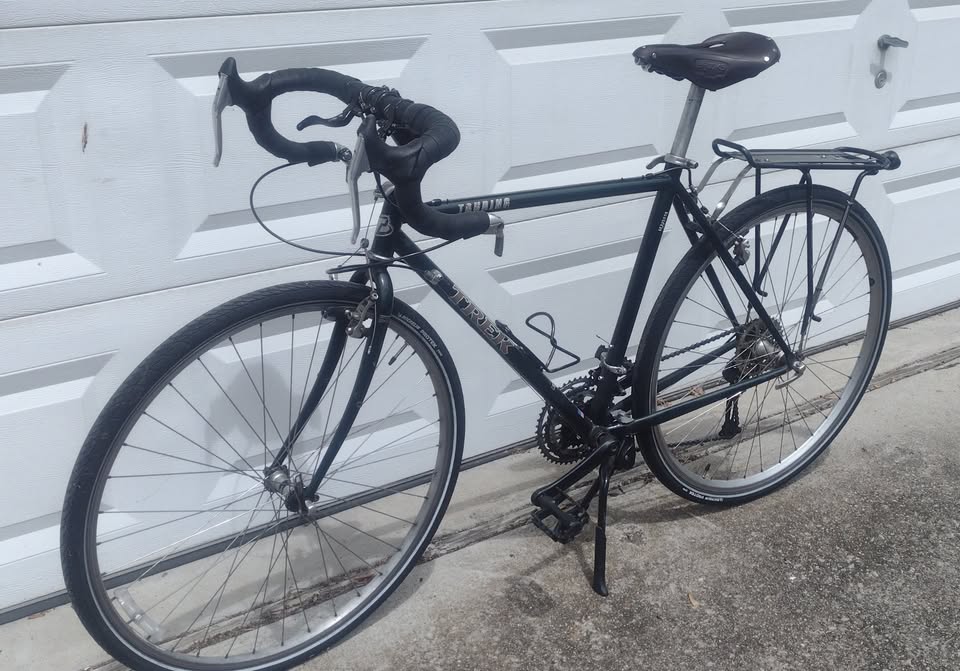
I had what seemed like a milestone moment last week: I sold my 1995 Trek 520 touring bike on Ebay. It was a milestone in that it solidified for me the reality that, at age 80, I’m not going to be riding any more multiday, self-supported tours, at least not on an analog bike. I have one non-electric road bike left in my garage, which I occasionally ride for short runs, but I have now accepted that I am almost exclusively an ebike rider for the remainder of my cycling run.
The Trek served me well. Besides providing me with a reliable, solid and surefooted ride on long-distance tours, while carrying me and all my gear, it also was my only steed for several years of daily cycling. More recently, it became the bearer of a motor and battery as my first foray into the DIY electrification of a bike. When that motor failed — no fault of the 520 — I purchased a new ebike and reconverted the Trek back to its analog glory.
But actually, I feel good about the sale. The buyer is a woman in Oregon, and while I don’t know why she wanted my particular kind of bike, I was pleased to be able to hand off the Trek in good working condition, as I’ve kept it maintained over the years.
When boxing the bike for shipment, I also tucked in a copy of my book, Playing in Traffic, with an attached note telling her that the book is an account of the first major journey I rode on the 520 and expressing my hope that she will get as much pleasure from the bike as I did.
So okay, I’m still a cyclist, but now I ride an ebike, with the emphasis as much on the “e” as on the “bike.”
Thus, I’m living into that reality. In my last column, I explained that I frequently ride with friends who are pumping regular bikes, and I named three measures I practice to fit seamlessly into our rides together. You can read that column here, but in that piece, I invited readers to weigh in, and several of you did, and you suggested a few additional practices that are worthy of mention, so I am including those below as a “Part 2” of that previous article.
The three practices I stated in the last column are:
Actively avoid being “king of the mountain.” It’s bad form to trounce your analog bike riding companions on every climb.
Keep your battery range from being a group limitation. I offered some suggestions about how to do this.
Work at not interrupting the ride with mechanical issues that are primarily ebike problems. Here, as an example, I explained how I dealt with a dropping-chain problem that can happen on bikes — including ebikes — that have only a single chain ring in the front. (A few of you, including a couple who emailed me directly through my website, made some comments and suggestions about that problem. Thank you! I will discuss this chain ring problem more in an upcoming column.)
Here are the other practices you suggested that ebikers could helpfully observe when riding in groups that include riders on regular bikes:
Don’t initiate conversation with non-ebike riders while the group is climbing. As one reader put it, on climbs, “it seems if [ebike riders] slow down to stay with the group, they want to hold a conversation while I’m sucking air.” Remember that riders of regular bikes are still working harder than ebikers on upslopes.
If you do get to the top of the hill first and want to wait for the group to catch up, move to the side of the road so as not to block the riders who want to continue without stopping. This suggestion came from a cyclist who rides a regular bike and is often in the lead bunch and seldom wants or needs to take a recovery stop at the summit.
If your group is pacelining, and you take a turn pulling at the front, match your speed to the pace the group has been maintaining; don’t outdistance the line. If you go faster, you defeat the purpose of the paceline.
If someone is suffering or falling behind, offer to “pull” that rider, but speed-wise, be sensitive to what that rider can attain even with help. You can be an angel of mercy, mounted on an ebike.
All of this said, I believe the day is coming (and is already here in some places) where, whether we are leg-powered or leg-and-e-powered, we will all just consider one another cyclists, and we will enjoy riding together.
Stan Purdum has ridden several long-distance bike trips, including an across-America ride recounted in his book Roll Around Heaven All Day, and a trek on U.S. 62, from Niagara Falls, New York, to El Paso, Texas, the subject of his book Playing in Traffic. Stan, a freelance writer and editor, lives in Ohio. See more at www.StanPurdum.com.