
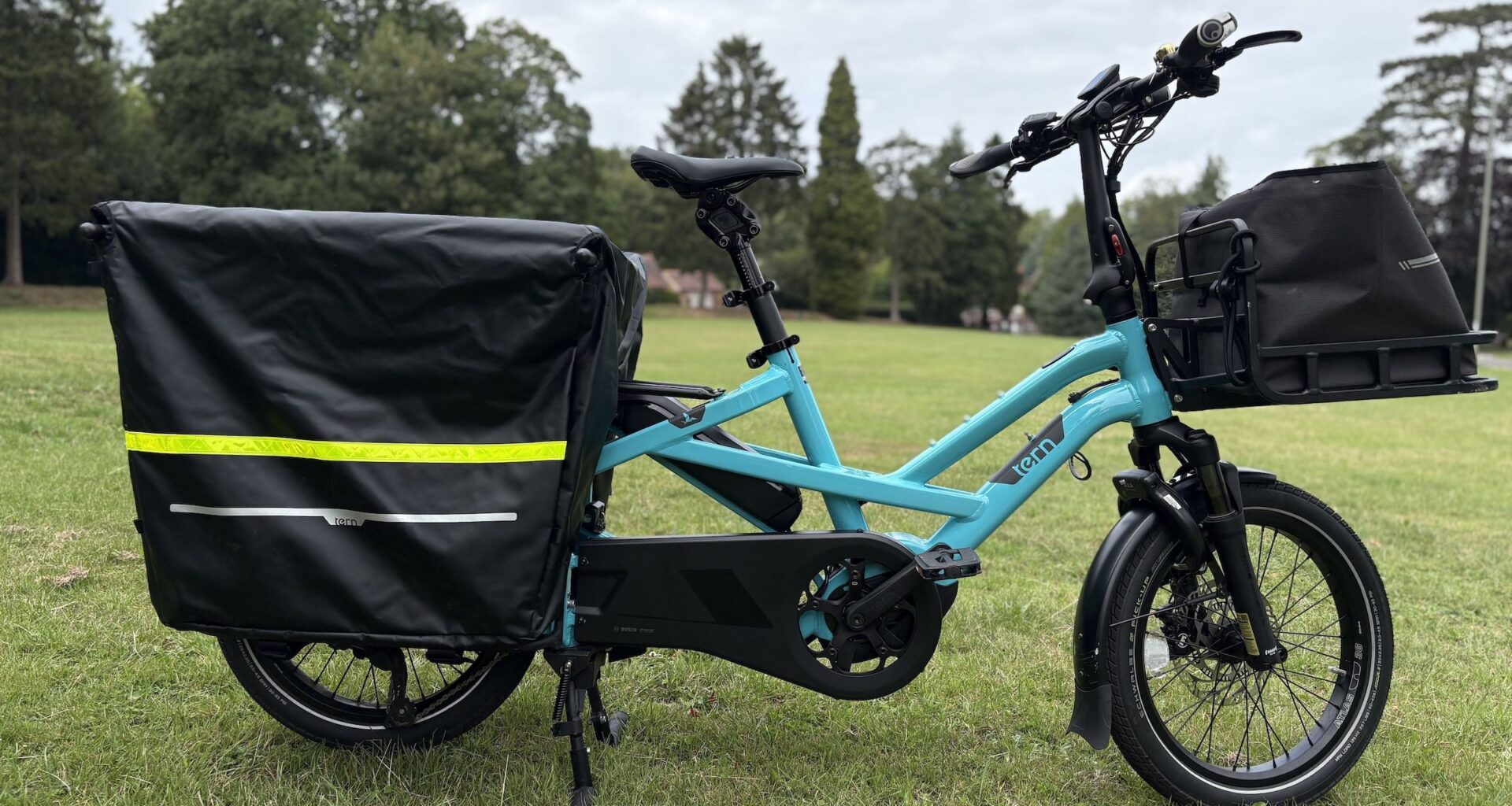
Tern’s range of e-bikes is one of the most diverse you’ll find, including folding bikes with various wheel sizes, hybrids, pseudo beach cruisers and, at the heart of the range, the cargo bikes. The majority of their bikes share two traits: low step-over height and flat bars.
These make all their bikes pleasingly accessible as do all the extra features that help make them easy to ride and live with – important when it comes to cargo bikes which are typically big, heavy, and require space to store.
With the school run in mind, I tested the £5,900 (not including accessories) GSD S10 Gen 3, their top-of-the-S10-range e-cargo bike. The R14 range which features the same frame will set you back even more, thanks to a Rohloff speedhub gear system and belt drive transmission.
Best picks for you
All their GSD bikes are a similar compact design with different specs. This S10 step-through bike comfortably squeezed two passengers and the rider onto a 135cm long wheelbase. Quite incredibly for a bike that carries three people and baggage, that’s just 36cm longer than most 6.9kg, carbon fibre race bikes.
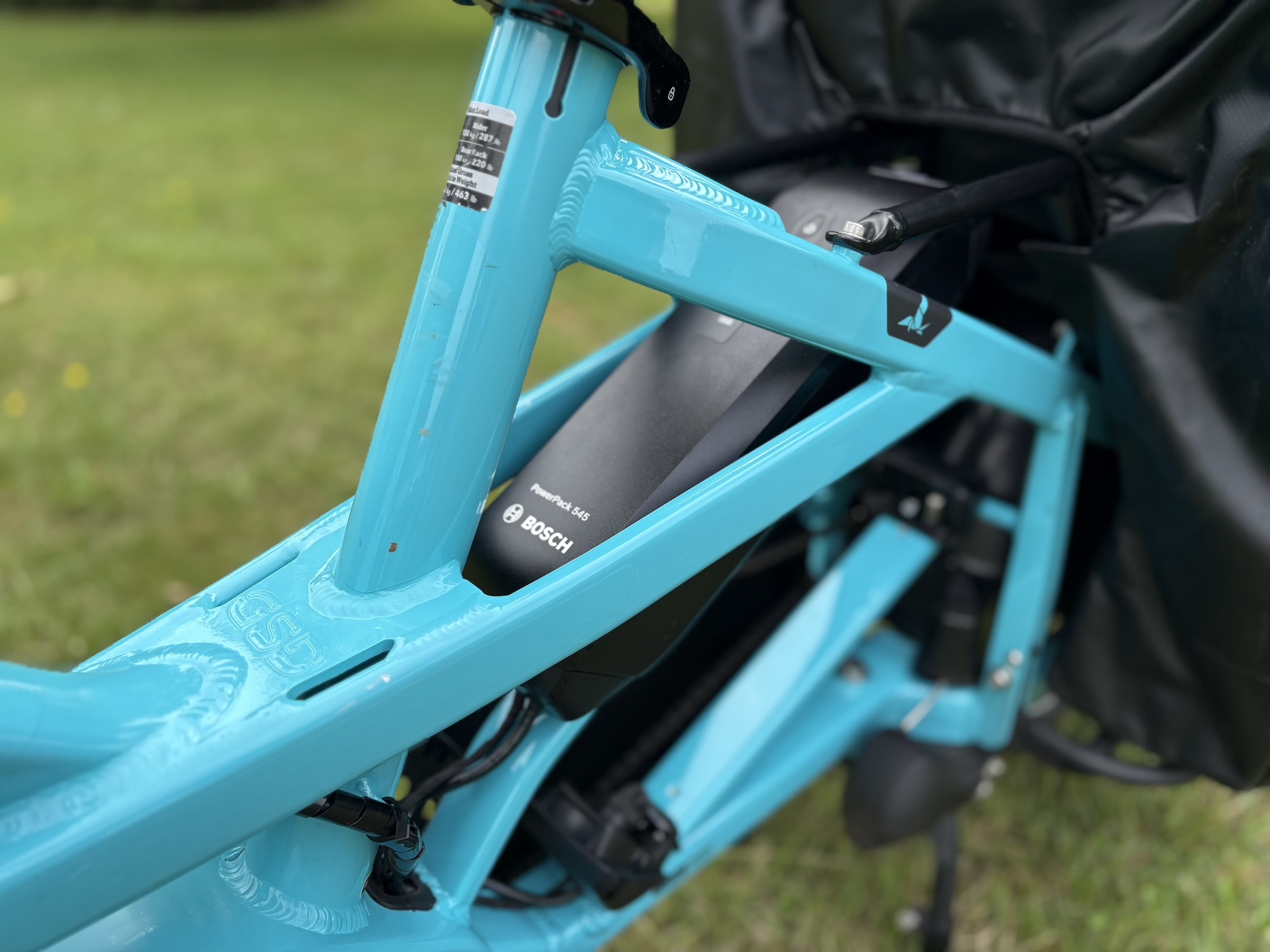
Tern’s frames are relatively small, but built to carry big loads
(Image credit: Future)
THE BUILD
The bright blue, step-through 6061 aluminium frame at the heart of the bike somewhat resembles the Forth Bridge, perhaps because it’s similarly built for heavy lifting. And I do mean heavy. The rider weight limit is 130kg, while the rear rack limit is 100kg. Our S10 also came with a front rack and had an overall system weight of 310kg, meaning this bike can happily trundle along with almost a third of a tonne weighing it down.
Having ridden it for a few months, I don’t doubt its capacity to carry that much weight (and probably a bit more if anyone was willing, or able, to test it), but I suspect the battery wouldn’t last long, especially around me, where you’re never far from a 15-20% hill.
Ours came with a rear rack bolted to the back of the frame above the rear wheel and two seat pads for the passengers. Attached to the frame in eight places, it has separate, fold-up foot rests, and velcro attachments for the seat pads. The pads and many other accessories come as extras, allowing you to build the bike for your needs. (More on this later.) But remember to allow for this when looking through the prices.
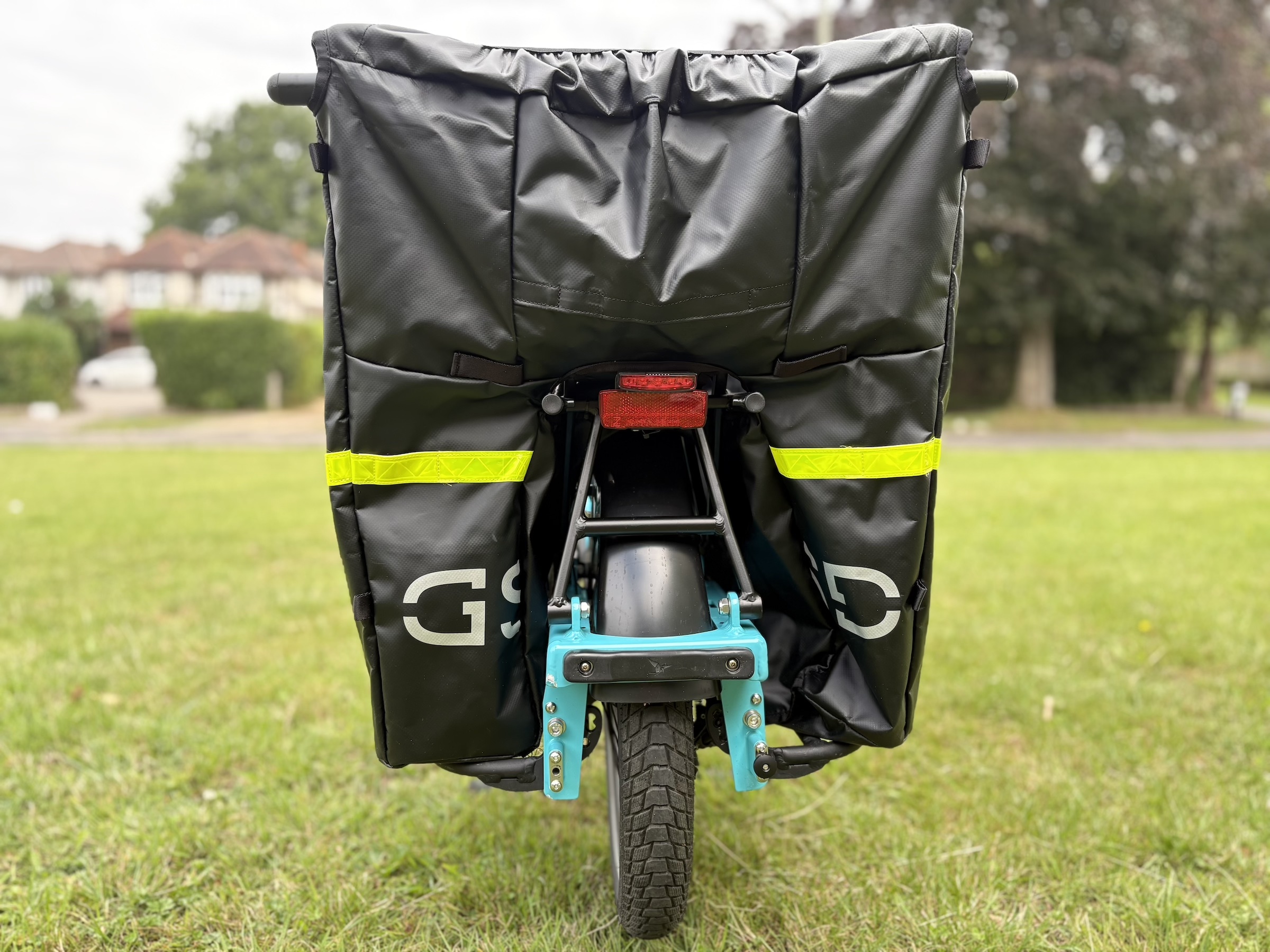
Plenty of room for two in the Stormbox
(Image credit: Future)
A compact bike needs a set of compact wheels. The GSD comes with 20 inch Atlas 36 wheels built with 32 spokes. Atlas is Tern’s in-house wheel brand which ran perfectly well on the 2.35 inch wide Schwalbe Pick-up cargo-ready tyres, which themselves are built to carry a big load, each boasting a 125kg limit.
You might think rolling along on wheels you’d normally find on a kids’ bike (my eight-year-old daughter rides a Woom bike with 20-inch wheels) might make for a twitchy ride, but, like me, you’d be wrong. They’re perfectly suited to the low speeds a bike like this is ridden at and makes it more maneuverable than a front-loading bike, like the Raleigh stride 3, or the slightly longer Specialized Porto.
The only, very minor, downside of the smaller wheels was descending on bridleways when compared to bigger wheels. I’d been riding the Specialized Porto with 700c wheels beforehand, and the Tern wasn’t quite as surefooted on loose surfaces. But I don’t think many people will be buying this bike to tackle rough terrain.
(Image credit: Future)
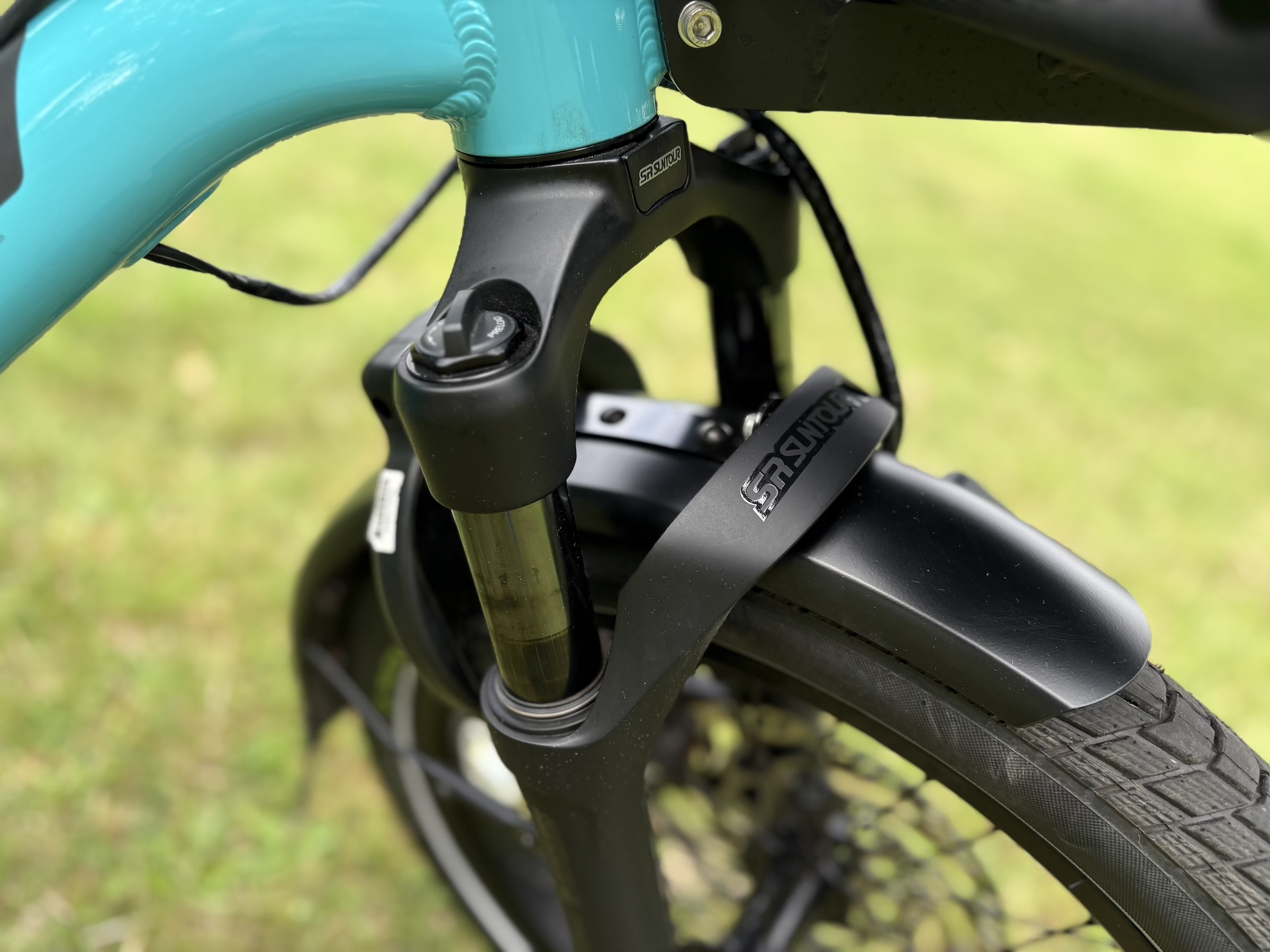
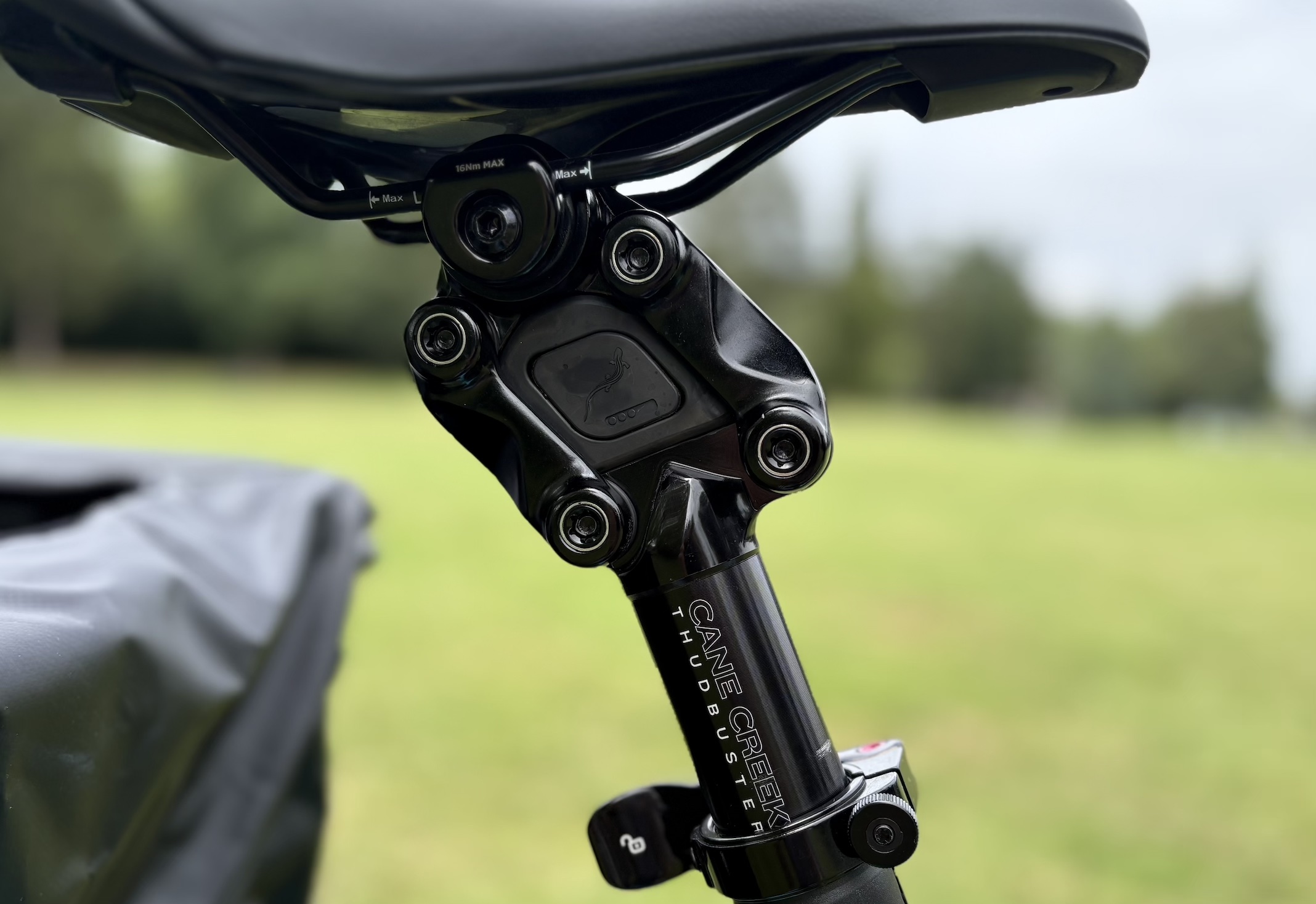
What does help over bumps and poor surfaces is the suspension. The GSD comes with a set of Suntour suspension forks with 70mm of travel, and a Cane Creek Thudbuster seatpost. As well as softening the hard hits, the forks made it more intuitive to ride out of the saddle up a hill, as the front end moves in tune with your weight as it rocks from side to side.
Although you’re never going to hit high speeds on the GSD, you still need some serious stopping power when you consider the weight of the bike. An adult, two children and some shopping bags could easily amount to 100kg plus. 203mm rotors with four-piston, double pad hydraulic Magura callipers provide this, and, in a first for me, the bike comes with an Anti-Lock Braking System (ABS), making it impossible to lock up the front wheel.
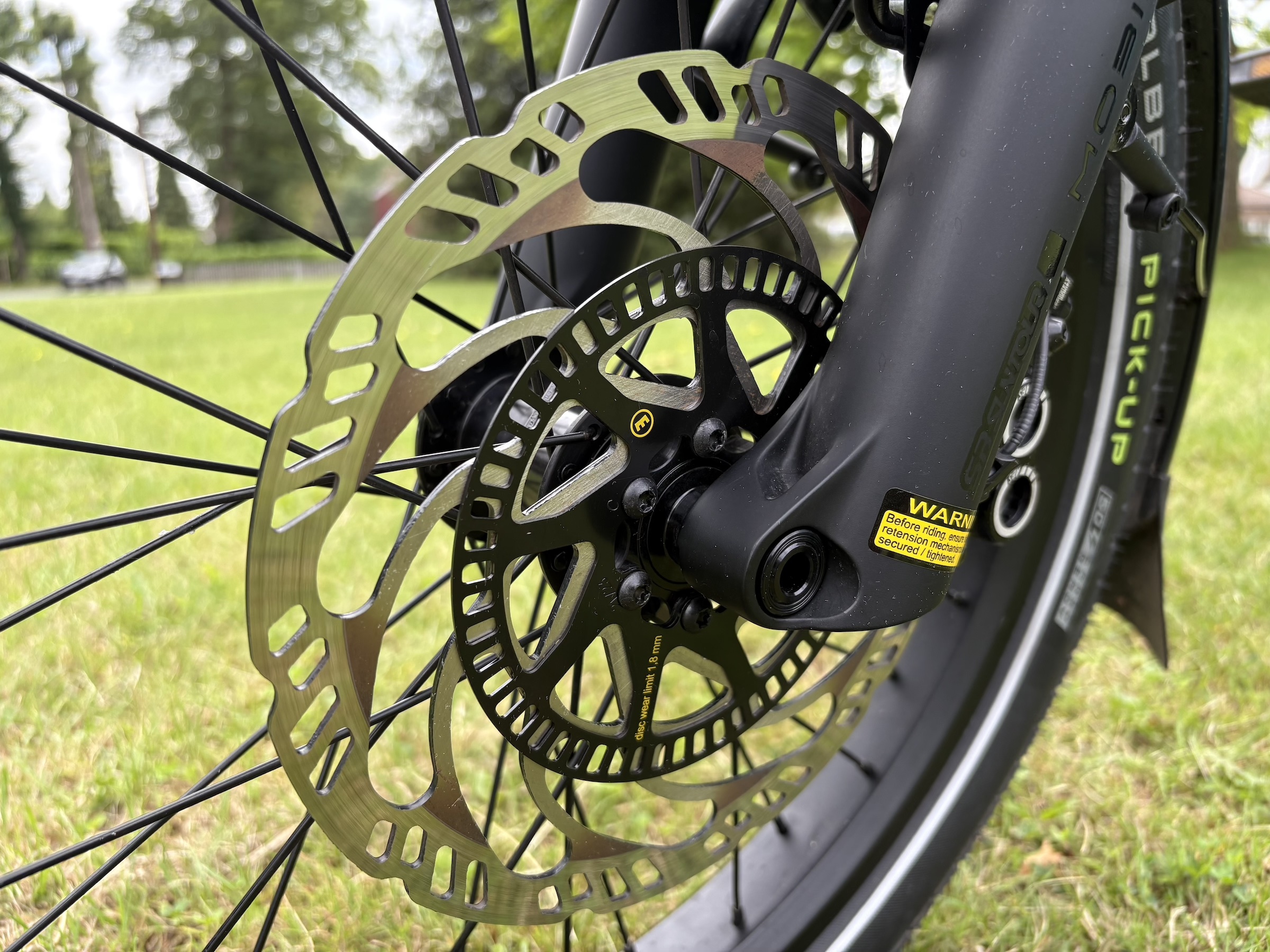
An ABS braking system means you’re never likely to lose the front wheel if slamming on the brakes
(Image credit: Future)
At least I didn’t manage it, despite multiple attempts. I thought I had as I slammed on the front brake (on dry tarmac) and came to a stop with a noticable judder, but technically, ABS should only activate if it detects the wheel skidding. A quick scan of the ride stats in Bosch’s Flow app showed (on a very short test run) I’d braked 26 times with no activations of the ABS system.
There’s some clever tech in this system that’s best explained via Bosch’s own videos that can be found on YouTube. And for anyone who wants more information on their own braking performance, the Bosch system can give stats on braking time and distance. All extremely clever and useful for improving DH MTB performance, but in all honesty, I didn’t feel the need to analyse this data after our 1.4-mile school run.
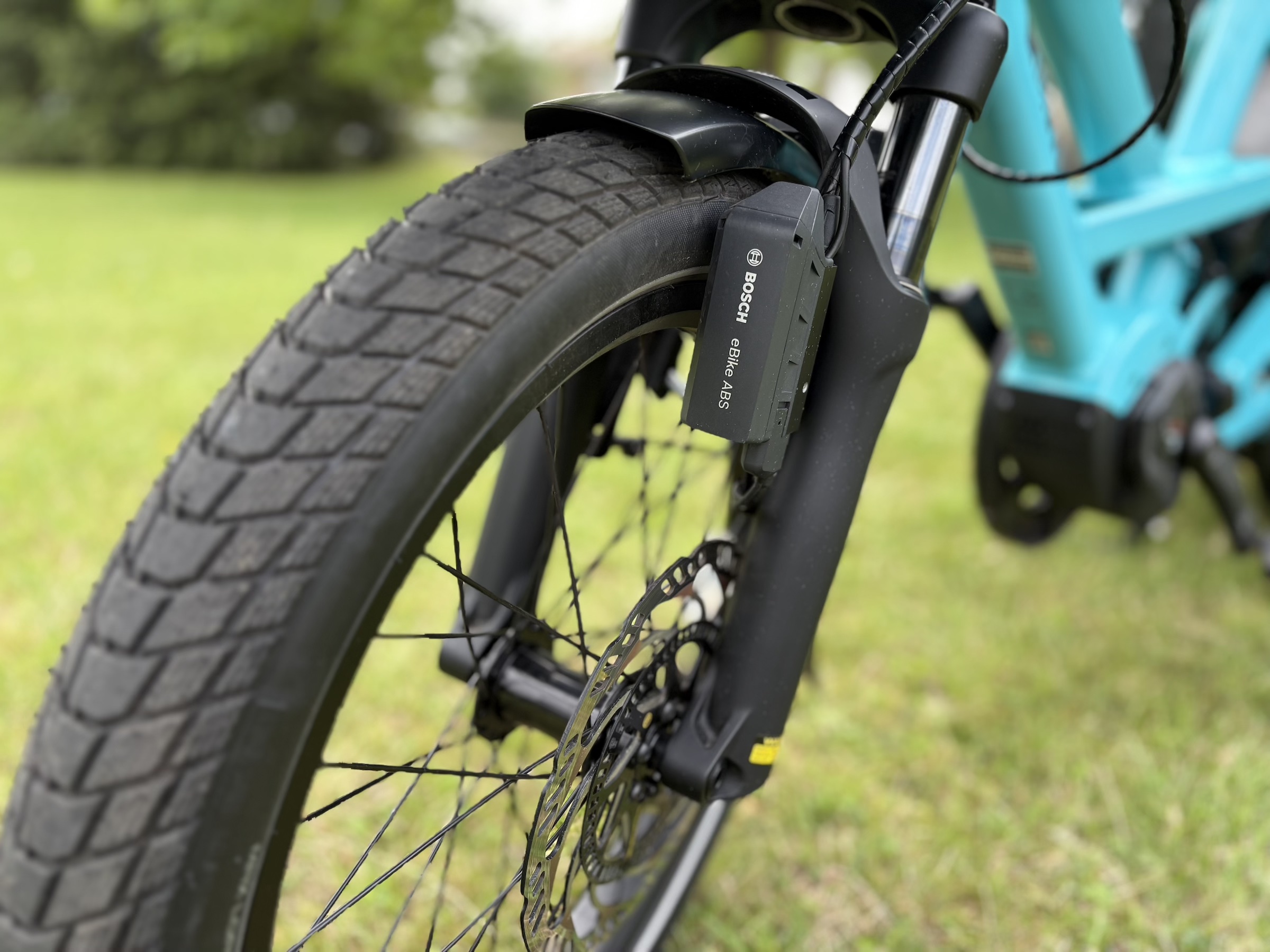
(Image credit: Future)
TERN GSD CARRYING CAPACITY AND ACCESSORIES
The upright nature of the riding position means most of the bike’s horizontal surface area is given over to storage, whether that be kit or kids. The short wheelbase is only part of the story of course, as the whole bike is longer. Front to back, it measures 192cm. Of that, the front rack takes up 33cm in space and the cage at the back is 70cm long.
It’s the rear rack that is the most adaptable part of this bike, with countless ways to set up what Tern calls The Clubhouse.
It can be a simple rack for those just transporting ‘stuff’, it can take one or two young kids with rigid child seats bolted inside the handhold cage, two older kids with seat pads inside the cage, one young kid and one old kid, a seat for an adult and you can even get ride along bars to mount behind the saddle or a tent-like structure for complete coverage. Oh, and there’s a trailer available too.
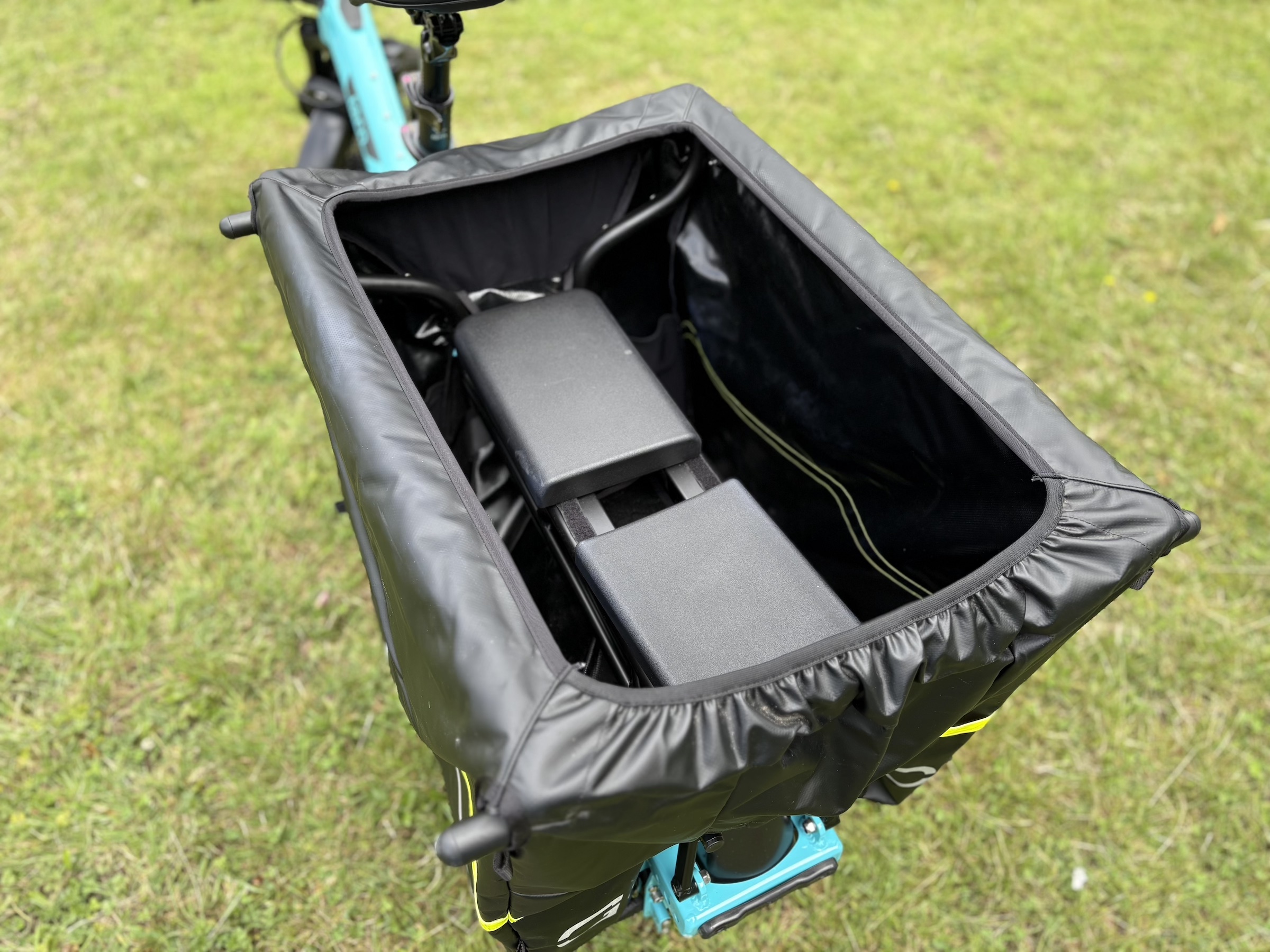
I tested the GSD S10 with two seat pads, a handhold cage and stow deck all covered by the Stormbox. I took this off as the weather improved, but despite the fact the Stormbox made it a little harder for my kids to get in and out of unsupervised, they preferred having that extra layer of protection the it offered. It also had four pockets inside for water bottles, which came in handy.
(Image credit: Future)
70cm doesn’t seem like much, but it was enough for my five and eight-year-old to fit in. It’s a bit of a squeeze and they have to mind where they put their feet, and how much they move their heads around (so as not to bonk each other with their helmets) but it only caused the occasional argument. There is an optional u-shaped bar that fixes to the back of the cage allowing the rear passenger some space to lean back a few inches.
The front and back bars of the handhold cage protruded further than the side bar, which importantly offers little hands some protection in the event of a sideways tumble. Their left foot is also protected from overheating brakes with a metal guard covering the rear caliper.
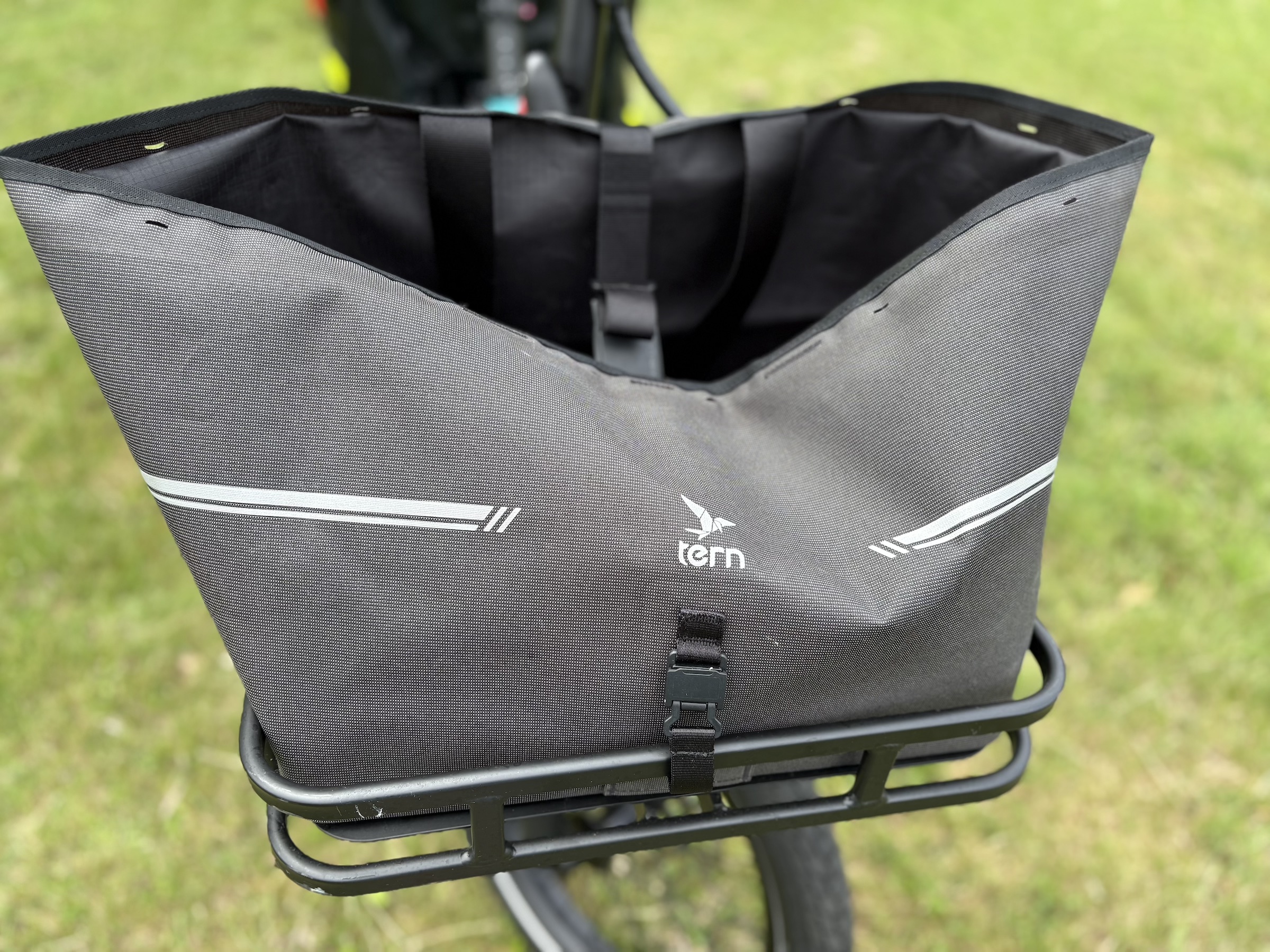
Up front, we had the transporter rack with a WeatherTop bag. A semi-rigid bag that will hold a lot of shopping, or a couple of school bags, and has a flap that goes over the top to protect contents from the rain. This will set you back an extra £145, however. Like I said, keep the prices in mind when choosing your extras
ELECTRONICS AND OTHER TECH
The GSD is powered by a Bosch Cargo Line motor with 85nm of torque and a Bosch Powerpack 545 battery. The 545 stands for the battery’s ‘watt hours’, the standard measure of an e-bike’s capacity. The bigger the wh, the more power your battery can store, and then deliver through the motor. The higher the motor’s torque, the better it is able to put the battery’s power into action.
Both the battery size and torque are standar size for a cargo bike (some use 400wh batteries and lack power as a result) as power trumps weight. There’s room for a second battery to be added if you think range might be an issue. Range, of course, being a hard thing to pin down. The battery takes several hours to fully charge (I typically left it on overnight, confident of the fact it wasn’t a cheap Chinese import off of some dodgy website) and lasted anything from 15km to 36km.
A battery’s range depends on how and where you use it. The power assist level you choose, the hills you do or don’t ride, how hard you ride, and how much you carry all feed into the equation. The system’s efficiency comes into play here as well, and is impossible to rate in an objective manner. As Bosch is the biggest player in the e-bike market, we can ride their systems with a good deal of confidence.
Essentially, the harder you ask your battery to work, the lower the range and vice versa. But it’s something you get used to over time, and the battery life and predicted range can be viewed on the Kiosk 300 display which is easy to scroll through
The Kiosk display is part of the Bosch ecosystem showing simple metrics like speed or time, but also more involved data such as rider power and braking distance. The display is controlled by the buttons on the unit to the side of the left-hand grip where you can also scroll through power assist modes and turn the system off and on. The display can also be mirrored on your smartphone via the Bosch Flow app.
The front and rear lights run off the battery, as does the brake light. One other thing that affects the range is whether or not you use it to charge your phone. Yes there’s a USB-C charging port just above the bottom bracket.
For security, it comes with an Abus frame lock that goes through the front wheel, and even if that isn’t locked, the bike can’t be ridden if the key isn’t in the lock. Top tip. Make a note of the key’s serial number and do not lose it. Bosch’s Flow app also has an anti-theft alarm, although you do have to subscribe to use this.
I have to mention the kickstand. It’s nice and solid, allowing kids to climb in and out of the clubhouse – carefully – without risk of the bike toppling over. The rubberized feet meant it didn’t get scuffed or scratched, and you can’t roll the bike off the stand without first engaging thumbshift lever on the bars.
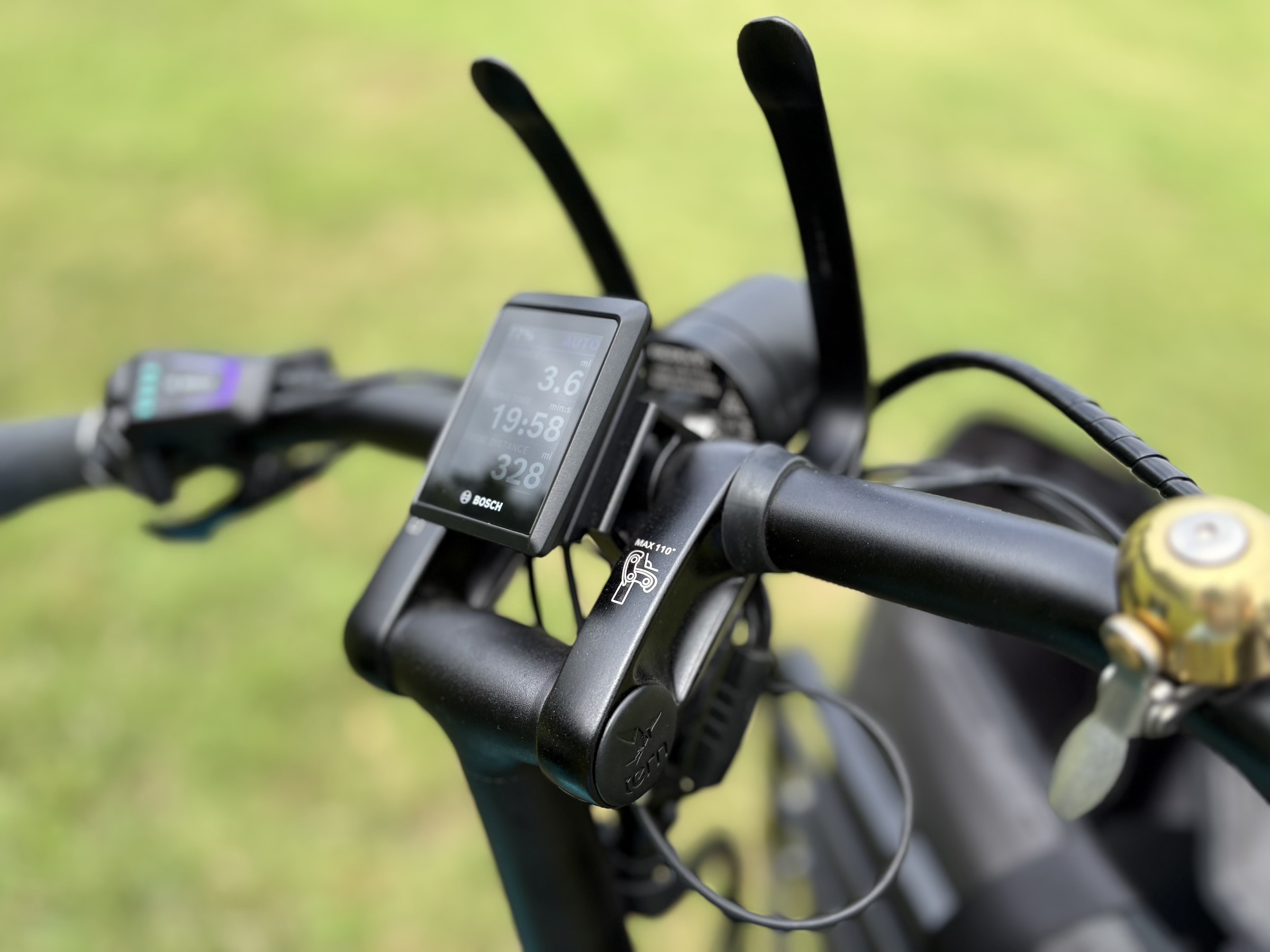
The Tern GSD is a one-size-fits-all bike, made to be adaptable
(Image credit: Future)
RIDING AND LIVING WITH THE TERN GSD
Perhaps the best commendation for the GSD’s ride-ability is that my non-riding partner hopped on it and rode off without any problems. The low step-through height of the frame makes it easy to get on and off, and the riding position is easy to adjust. The Cane Creek seat post slots into a sleeve, that slots into the frame, giving double the extension, while the handlebars rotate by releasing two big quick-release skewers either side of the stem. There’s enough adjustment built into it that Tern only produce this bike in one size, happy that it will fit everyone.
Once rolling, the ride is nicely balanced with a low centre of gravity and relaxed, upright riding position. As long as you get your foot down as soon as you stop, it’s easy to keep the bike upright when at a standstill, even with two passengers whose weight naturally raises the centre of gravity. Passengers leaning to one side does affect the steering and balance, but I never felt like the bike was at risk of toppling over.
Anyone who has ridden a Bosch based e-bike will know how easy and instinctive they are to ride. Anyone who hasn’t ridden one will be pleasantly surprised when they do. The assistance (limited by law to 15.5mph) was set to kick in at low speeds when riding in a small gear and slightly higher in the power phase in a bigger gear as it picks up on your input.
All this can be adjusted in the Bosch Flow app, but the basic settings will suit most people as they did me. The range goes from Eco, Tour, Auto and Cargo. I spent most of my time in Auto setting which adapts to your riding, only switching to cargo when approaching a long or steep hill.
The motor’s input is smooth throughout the pedal stroke, no matter what mode you’re in, or terrain you’re riding. There are no sudden surges as you accelerate and when it backs off it does so without any sudden kick back in speed.
(Image credit: Future)
The best thing about the GSD is that it feels like you’re riding at a good speed. Unlike the Raleigh Stride 3 that was painfully slow on climbs, the GSD is easy to get up to a good speed, in part thanks to torque that delivers plenty of power low in the phase and keeps it on higher up the speed range which you need on a steep climb.
Bike handling is solid and reliable and all the controls, from gears to lights to power ranges, are at your fingertips.
With a background in commuter bikes, Tern know a thing or two about making bikes easy, or easier, to live with. Neat trick number one is the ability to store this bike in an upright position. The handhold rack and heavy rubber pad at the back of the frame (below the brake light) are designed to give a stable base. I wouldn’t say it’s easy to lift the front wheel up due to the bike’s weight, and you wouldn’t want people brushing past it, but it does takes up a lot less floor space.
The handlebars can also be stowed by releasing the clamp just above the headtube, lowering them down and holding them in position with a rubber strap on the downtube. This reduces the width, handy if kept in a hallway, or anywhere people are likely to be walking past it.
(Image credit: Future)
CONCLUSION
While not cheap, the GSD is great fun to ride, packed with tech that makes it easy to ride and easier to store, and can be built to suit your needs, whatever they may be. The range of accessories really is extraordinary, meaning you can use this for pretty much anything you can think of, and the little touches, features and inbuilt tech show Tern’s design team know what their customers need. A standard chain and rear mech that’s tucked away behind guards and framework – and the fact the bike can’t be lifted into a stand – does mean drivetrain maintenance is not easy. But if spending thousands on a bike such as this, I would recommend an annual service as a bare minimum.
Specification
The bike
Frame: Tern GSD 6061-AL Multi-truss design
Fork: Suntour suspension fork (70mm travel)
Wheels: Tern Atlas heavy duty 36mm rims on Tern Atlas hubs
Seatpost: Tern telescopic + Cane Creek Thudbuster
Handlbar: Tern Sweep
Saddle: Tern GSD
Brakes: Magura MT-C ABS 4-piston hydraulic
Gears: Shimano Deore 1 x 10spd
Electronics
Motor: Bosch Cargo Line (400% assist)
Battery: Bosch 545 Powerpack
Display: Bosch Kiosk
Charger: 220V, 4A
Lights: Ignis front light, RearStop brake light
Onboard charging: USB-C
Accessories
Frame lock: Abus
Kickstand: Atlas Lockstand