
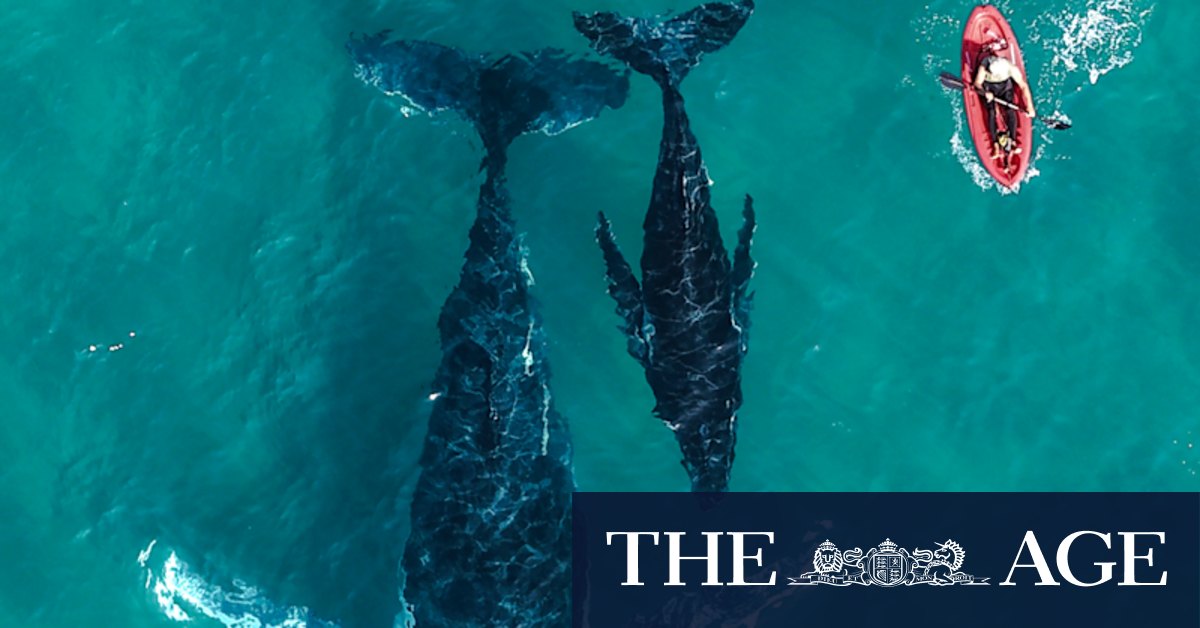
“It was amazing, the best moment I’ve ever had with a whale,” says Badgery.
According to Franklin, who with his wife, Trish, has created the largest database of images identifying whale flukes, the song sung along the migration changes each year. Compared with previous years, this year’s song is “robust and simple”. The songs are composed over the course of the long migrations and then shared with other populations in the cold feeding grounds of the Antarctic. This way a composure first identified in Western Australia might be heard a few seasons later in New Zealand or Tonga.
The east coast humpback population has bounced back faster than other populations and species since industrial whaling was all but abandoned in the 1970s and 1980s. Their success is still a matter of keen study, says Franklin, but it is thought to be due to a combination of good regulation and good luck.
The humpbacks that sing in our waters feed in parts of the Antarctic that remain largely free of commercial exploitation, and their migration takes them up a long coastline that affords them bays and harbours to use as sanctuaries and nurseries for recovery and schooling.
On Thursday, Franklin observed a mother teaching a calf to belt its tail into the water, a tactic used by whales to fight off attacks by orcas.
“That tail fluke is an incredible weapon,” he says. “Smash that on either a shark or an orca, and it would do considerable damage.”
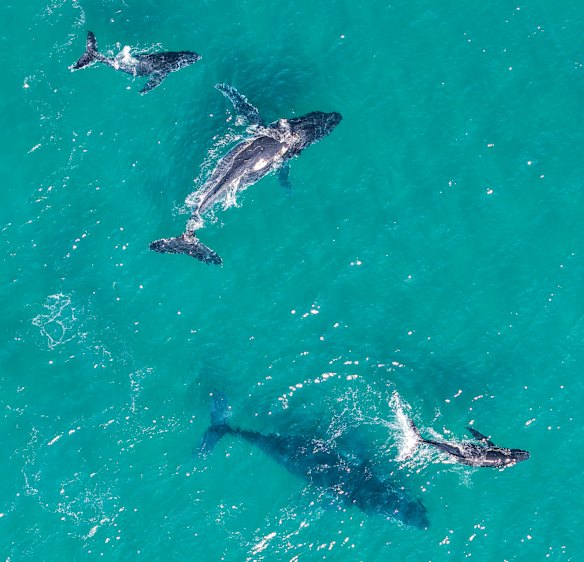
Mothers and calves at Wategos, Byron Bay.Credit: Danielle Smith
As the calves head south this spring they are under strict supervision and instruction. “In that first 12 months of their life those calves have got to go from kindergarten to high school and university,” says Franklin. “By the time they’ve made the first trip to Antarctica and come back, they’ve got to graduate from whale university, fully competent and capable of looking after themselves.”
Most will, but not all. Nearly 9 per cent of the animals have orca teeth marks on their skin, and others fall to ocean litter. Last week, Badgery reported one entangled in abandoned fishing gear at Byron Bay.
But for now, the population is still growing. At 50,000 strong, it is larger than most expected it would become, perhaps because it lacks competition from other whales for food, perhaps because early population estimates are out.
Soon, says Franklin, the waters will reach their carrying capacity and the number will plateau, but the migration and its songs will continue.
“We think it is the glue that hold the whole procession together,” he says.
Get to the heart of what’s happening with climate change and the environment. Sign up for our fortnightly Environment newsletter.